
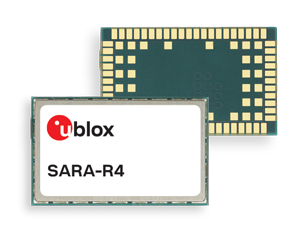
u-blox (SIX:UBXN), a global provider of leading positioning and wireless communication technologies, announced certification of its SARA-R410M-73B module for South Korea on SK Telecom’s LTE-M cellular network. The module series will support a broad spectrum of IoT applications such as smart metering, telematics, asset and vehicle tracking, security systems, building automation, as well as smart lighting solutions and connected health.
“u-blox has always considered security in the design of its positioning and wireless communications products,” says Eric Heiser, Head of Services/Security at u-blox. “With SARA-R410M-73B, we are launching our first commercial module featuring device and data security implementation in partnership with Kudelski, utilizing their patented technology for key management.”




Built-in device and data security
The SARA-R410M-73B modules are ideal for mission-critical IoT solutions, as they include a unique and immutable root of trust (RoT). This provides the foundation for a trusted set of advanced security functionalities.
Patty Felts, Product Manager, Product Center Cellular at u-blox stressed: “The scalable, pre-shared key management system offers best-in-class data encryption and decryption, both on-device as well as from-device-to-cloud. Utilizing the latest (D)TLS stack and cipher suites with hardware-based crypto acceleration provides robust, efficient, and protected communication.”
Always and everywhere location, with u-blox CellLocate
u-blox CellLocate cellular positioning technology enables standalone location estimation based on surrounding mobile network information or in conjunction with GNSS (Global Navigation Satellite System) positioning data to improve location.
Future-proof solutions via LWM2M with dynamically loaded objects and uFOTA
Customers can future-proof their solutions by means of uFOTA (Firmware Over The Air) client/server firmware updates, which utilizes LWM2M, a light and compact protocol ideal for IoT applications. Customized objects and resources can be created and added to devices that are already commercially in the field via the LWM2M dynamically loaded objects functionality. And with manufacturing in ISO/TS 16949-certified production sites and an extended operating temperature range of –40° C to +85° C, it is ideal for industrial applications.
For more information, visit www.u-blox.com

