

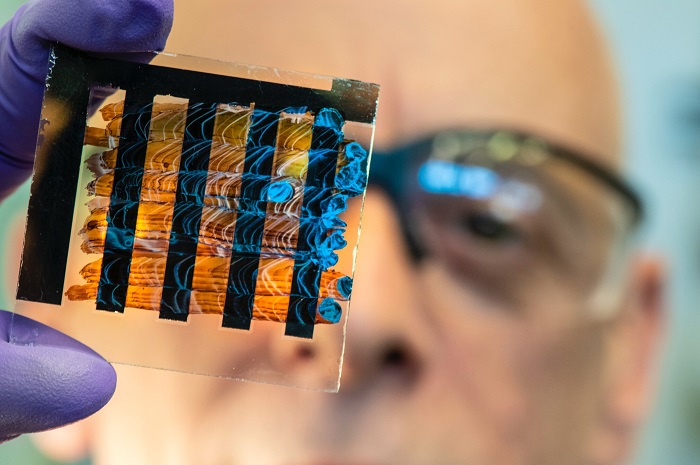
Perovskite solar cells have gained attention in recent years because of their ability to deliver high photovoltaic performance under a low-cost and low-temperature solution-based fabrication processing, which allows materials to be dissolved in suitable solvents to produce inks.
Perovskites are a family of materials with a specific three-dimensional lattice crystal structure named after a naturally occurring mineral. Despite the remarkable growth in the power conversion efficiency of the perovskite solar cells during the last decade, several challenges remain in place—such as the producibility of high-quality, scalable perovskite thin film preparation.




Researchers from Surrey’s Advanced Technology Institute (ATI) reveal their progress in solvent engineering to help achieve the highest quality for perovskite light-absorbing layers.
The essential characteristics of the developed solvent systems and the engineering methods for perovskite thin film preparation, thereby paving the way for future evolutions in how the solar-cell devices and their inks are produced.
The researchers argue that achieving efficiency as high as 25 percent for perovskite solar cells requires precise control of the device architecture, perovskite composition, solvent system, additive and fabrication technique.
Dr. Ehsan Rezaee, postdoctoral research fellow at the ATI at the University of Surrey, said, “The emergence of perovskite solar cells as the highly efficient new generation of solar harvesting technology is incredibly exciting. However, while their flexibility, lightweight nature and semitransparency are all pluses, there are fundamental challenges to address if they are ever to be commercially viable.
“High-throughput and large-scale industrial manufacturing of perovskite thin films depends on the successful development of both fabrication techniques and suitable inks. We hope our roadmap sets the course for these promising materials to reach their full potential.”
Professor Ravi Silva, Director of the ATI at the University of Surrey, said, “Our organization has always believed in the potential of solar panels to be a critical part of the energy mix that finally allows us all to move away from dangerous outdated energy sources. However, we must do more to improve the power conversion efficiency of these promising devices, and we hope this significant paper helps pave the way for those advancements.”

