

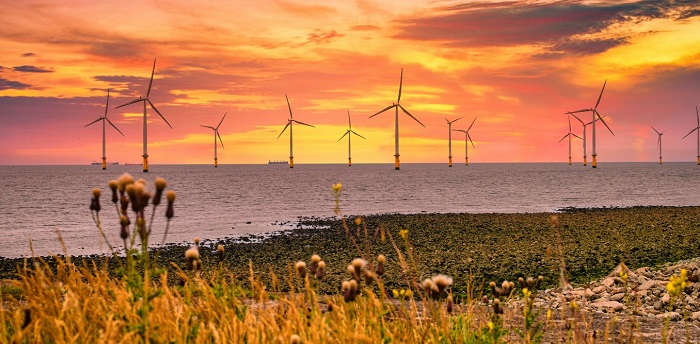
The UK is planning to install 40 gigawatts of offshore wind power turbines by 2030—enough to provide electricity to every home in the country. This would require 5,000 wind turbines—double the number installed offshore worldwide at the end of 2020. Current projections indicate 234 gigawatts of offshore wind energy will be installed globally by 2030, which could mean around 30,000 turbines.
Green energy developers hope to exploit the faster winds that blow offshore and allow larger turbines to generate more electricity than their onshore equivalents. Supplying the equivalent of a UK home’s worth of electricity for nine billion people by 2050 would require something like half a million offshore wind turbines. Besides the more than two million fishing vessels, industrial activity in the ocean on this scale is unprecedented. Over the last 70 years, only around 5,000 offshore oil and gas rigs have been installed at sea, and many of these have since been removed.



Developing oil and gas offshore has helped engineers learn how to design ocean structures that remain fixed in one place, far from land, for decades. As the world transitions from low numbers of oil and gas installations to large numbers of renewable energy devices, how engineers design in the ocean must evolve too. Just as fossil fuel extraction must end, so should the design philosophy which sustained this industry. That is, meeting narrowly defined human need and a high return on investment.
Old design philosophies
To make wind turbines work offshore, great technological advances have been made. Using remote sensors, engineers can precisely control the angle of 80 meter-long blades to maximize how much energy they generate, or prevent damage in bad weather. Steel tubes ten meters wide can be hammered vertically into the seabed to support wind turbines installed over vast areas.
Engineers are working to design yet bigger turbines, operating more efficiently and for longer, which can be installed further from shore, like floating turbines for waters deeper than 50 meters. All this innovation has been driven with one job in mind: making electricity. In common with the oil and gas industry (and most others), the prevailing design philosophy of offshore wind is to build something that achieves this purpose while meeting environmental and safety obligations for the lowest price.

