

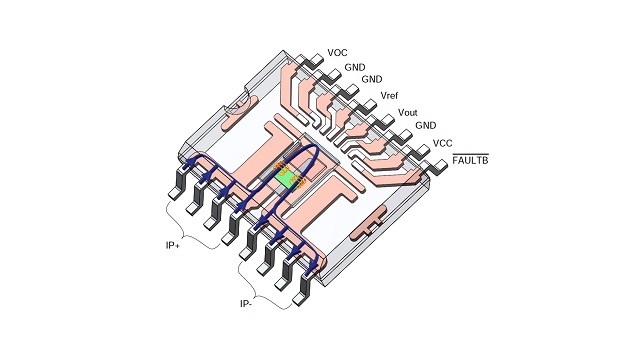
ACEINNA announced that their industry leading MCx1101 family of Current Sensors now supports 3.3-volt applications. These highly accurate, wide bandwidth AMR-based current sensors are now available for a wide range of ADC and microprocessor-based power systems and applications.
“Our integrated, AMR based Current Sensor family provides the best performance for the price in the industry,” says Khagendra Thapa, VP Current Sensor Product for ACEINNA. “Unlike other AMR based current sensing solutions on the market that require an extensive and time consuming integration to make them work, ours are plug and play.”



The MCx1101 are fully integrated, bi-directional current sensors that offer much higher DC accuracy and dynamic range compared with alternative solutions. For example, the ±20A version has a typical accuracy of ±0.6% and are guaranteed to achieve an accuracy of ±2.0% (max) at 85°C. These new current sensors are in an industry standard SOIC-16 package with a low impedance (0.9 milli-ohm) current path and are certified by UL/IEC/EN for isolated applications.
These new current sensors also guarantee an offset of ±60mA, or ±0.3% of FSR (max) over temperature, which means that high accuracy can be achieved over a roughly 10:1 range of currents providing significant improvement in dynamic range vs. leading Hall-sensor-based devices.
These devices deliver a unique combination of high accuracy, 1.5MHz signal bandwidth with industry benchmark phase shift vs. frequency, fast output step response and 4.8kV isolation making them ideal for current sensing in fast current control loops and protection for high-performance power supplies, inverters and motor control applications.
The fast response and high bandwidth of the MCx1101 is also ideal for fast switching SiC and GaN-based power stages enabling power system designers to make use of the higher speeds and smaller components enabled by wide band-gap switches. Output step response time is 0.3us. The MCx1101 also provides an integrated over current detection flag to help implement OCD (Over Current Detection) required in modern power systems. Overcurrent detection response time is fast 0.2us.
The family includes ±50, ±20, and ±5A ranges, and is offered in both fixed gain (MCA1101) and ratiometric gain (MCR1101) versions.
Click here for more information

