
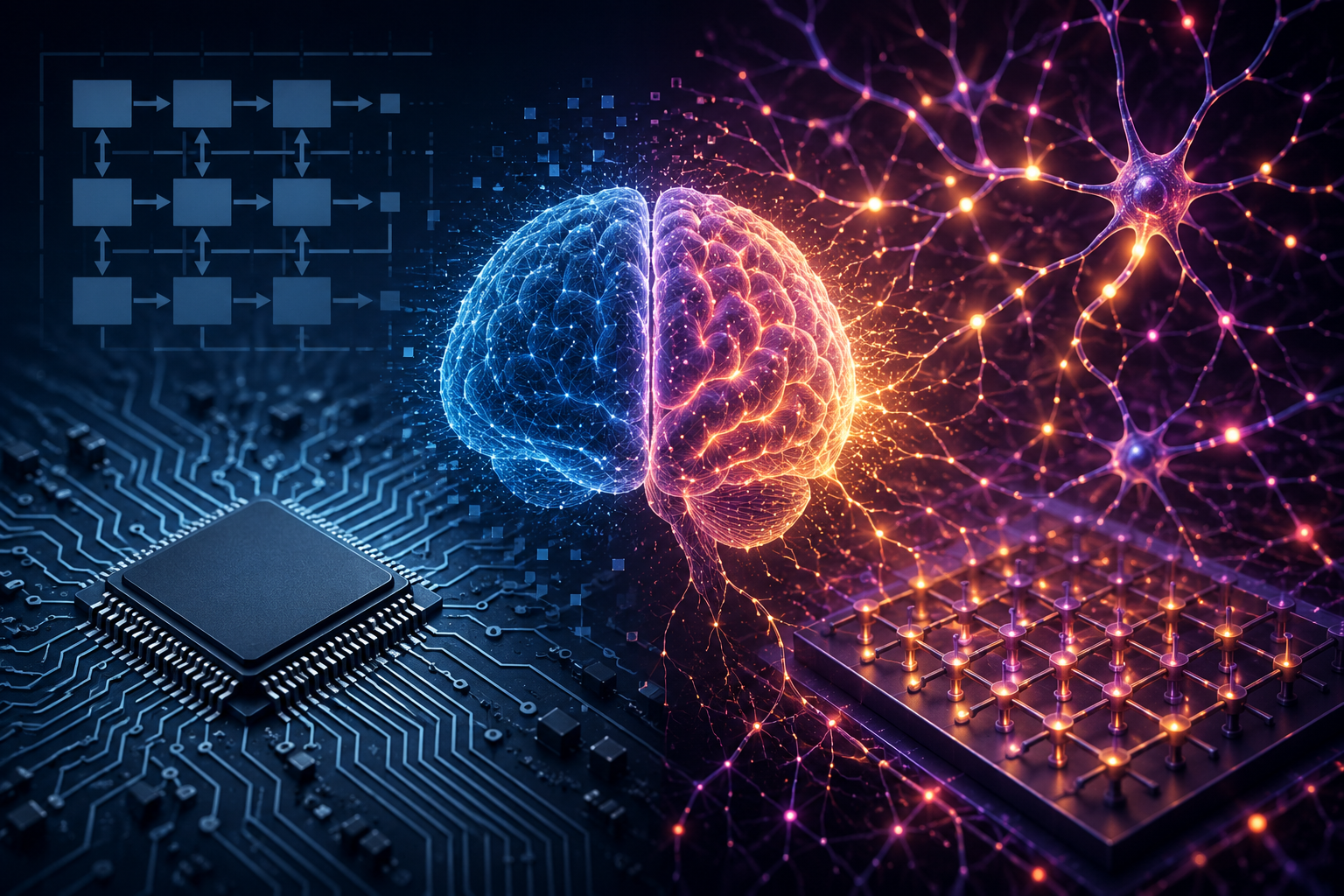
For more than five decades, the computing industry has relied on the von Neumann architecture, where memory and processing units are physically separated. While this architecture has enabled remarkable advances in computing power, it also faces significant challenges in today’s data-driven world. The continuous movement of data between memory and processors consumes enormous amounts of energy and creates performance bottlenecks, particularly in artificial intelligence (AI) and edge computing applications.
To address these limitations, researchers and semiconductor companies are increasingly turning to a radically different approach inspired by nature’s most efficient computing system—the human brain. Neuromorphic computing represents a paradigm shift in processor design, enabling machines to process information more like biological neural networks while consuming a fraction of the energy required by conventional systems.




Understanding Neuromorphic Computing
Neuromorphic computing refers to the design of hardware systems that mimic the structure and operation of the human brain. Unlike traditional processors that execute instructions sequentially, neuromorphic chips consist of artificial neurons and synapses that operate in parallel and communicate through event-driven signals known as spikes.
The human brain contains approximately 86 billion neurons interconnected through trillions of synapses. Despite this immense complexity, the brain operates on roughly 20 watts of power—less than many household light bulbs. Neuromorphic engineers aim to replicate this extraordinary efficiency in silicon.
In a neuromorphic system:
- Artificial neurons process incoming signals.
- Synapses store connection strengths and learning parameters.
- Information is transmitted only when meaningful events occur.
- Memory and computation are closely integrated.
- Learning can occur directly on the device.
This architecture significantly reduces the energy and latency associated with moving data between separate memory and processing units.
Why Traditional Architectures Are Reaching Their Limits
Modern AI applications generate enormous volumes of data from sensors, cameras, microphones, and connected devices. Conventional CPUs and GPUs must continuously shuttle this data between memory and processing cores, creating what is commonly known as the “memory wall.”
Key limitations include: High Power Consumption, Latency Challenges and Scalability Constraints. Neuromorphic computing addresses these challenges by bringing memory, learning, and processing closer together in a brain-like architecture.
Event-Driven Processing: The Key to Efficiency
One of the most innovative aspects of neuromorphic systems is event-driven computation. Traditional processors operate continuously, executing clock cycles whether useful work is being performed or not. Neuromorphic chips, however, remain largely inactive until significant events occur.
For example, consider a surveillance camera monitoring a quiet corridor. A conventional AI processor continuously analyzes every video frame. A neuromorphic processor only activates when movement or a meaningful change is detected. The result is intelligent systems that can remain operational for extended periods without frequent charging or cloud connectivity.
Real-Time Learning at the Edge
One of the most promising capabilities of neuromorphic hardware is on-device learning. Traditional AI systems are typically trained in data centers and deployed as fixed models. Updating these models often requires cloud access, large datasets, and significant computational resources.
Neuromorphic chips can adapt continuously based on experience, much like biological brains. This capability enables: Personalized Wearables, Autonomous Robots, Smart Sensors and Adaptive Industrial Systems. Such capabilities are particularly valuable in environments where network connectivity is limited or unavailable.
Applications Across Industries: Autonomous Vehicles: Self-driving vehicles process enormous amounts of sensory information from cameras, radar, LiDAR, and ultrasonic sensors. Healthcare and Wearables: Smart medical devices require continuous monitoring while maintaining long battery life. Industrial Automation: Factories increasingly rely on intelligent edge devices for predictive maintenance, quality inspection, and process optimization. Aerospace and Defense: Autonomous drones and surveillance systems benefit from low-power AI processing capable of operating independently in challenging environments. Internet of Things (IoT): Billions of connected devices generate vast quantities of sensor data.
Leading Neuromorphic Hardware Developments
Several organizations are actively advancing neuromorphic technology: Intel Corporation has developed the Loihi family of neuromorphic research chips capable of on-chip learning and adaptive processing. IBM pioneered large-scale neuromorphic architectures with its TrueNorth processor. European Human Brain Project has invested heavily in brain-inspired computing research. Numerous startups are developing specialized neuromorphic solutions for edge AI, robotics, and industrial applications.
Technical Challenges Ahead
Despite significant progress, neuromorphic computing remains an emerging field. Key challenges include: Programming Complexity: Developing software for spiking neural networks differs substantially from conventional programming methodologies. Ecosystem Maturity: Tools, frameworks, and standards remain less mature than those available for CPUs, GPUs, and traditional AI accelerators. Commercial Scalability: Manufacturing and integrating neuromorphic hardware into mainstream products requires further technological advancement and industry adoption. Benchmarking Difficulties: Comparing neuromorphic performance against conventional systems remains challenging because the architectures operate fundamentally differently.
The Future of Brain-Inspired Computing
As AI increasingly moves from centralized data centers to intelligent edge devices, energy efficiency and real-time adaptability become critical requirements. Neuromorphic computing offers a compelling solution by emulating the principles that make the human brain remarkably powerful and efficient.
Rather than replacing traditional CPUs and GPUs entirely, neuromorphic processors are likely to emerge as specialized accelerators for applications requiring low power consumption, continuous learning, and rapid decision-making at the edge.
For working engineers, neuromorphic computing represents more than just another processor innovation. It signals the beginning of a new computing paradigm where machines learn, adapt, and respond with unprecedented efficiency. As edge AI, robotics, autonomous systems, and wearable technologies continue to expand, brain-inspired architectures may become a foundational component of next-generation intelligent systems.
Neuromorphic computing is redefining how engineers think about processing, memory, and intelligence. By mimicking the brain’s structure and operation, neuromorphic chips achieve remarkable energy efficiency while enabling real-time learning and adaptation.

