

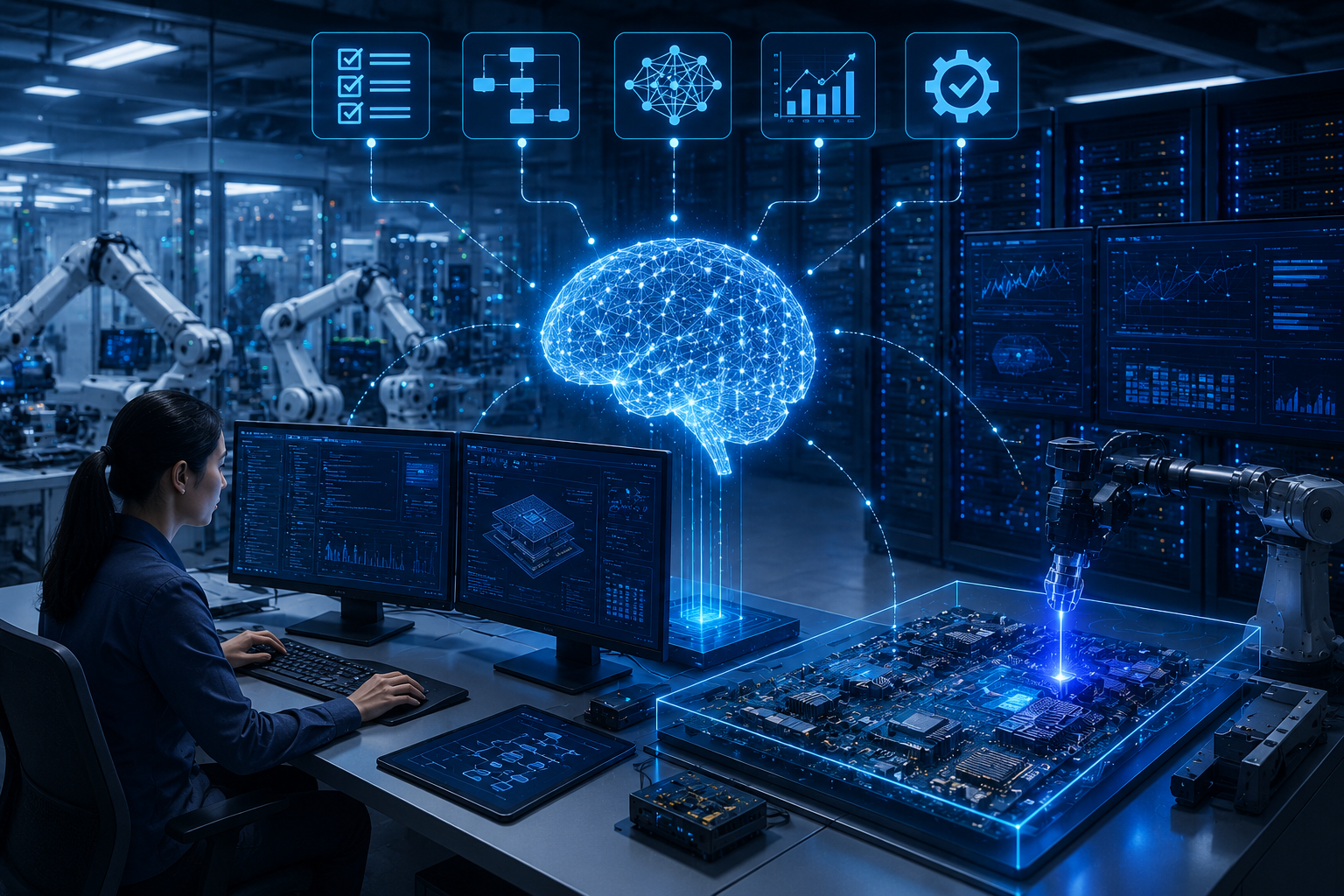
Introduction: When Speed Outpaces Validation
Enterprise software is no longer built for stability. It is built for continuous change. Modern systems evolve over distributed architectures, cloud-native platforms, and microservice ecosystems, with release cycles measured in days rather than months. Against this rapid evolution, the customary boundaries of testing are being fundamentally redefined.
Validation, once a discrete phase in the development lifecycle, now operates under constant pressure to keep pace with rapid deployment. The challenge is no longer simply guaranteeing correctness, but doing so continuously, at scale, and amid mounting system complexity.



Conventional automation frameworks, designed for predictability and control, are beginning to show their limitations. As systems evolve dynamically, static test scripts and rule-based execution models struggle to remain effective. It is within this context that AI-augmented test automation is emerging not as a replacement, but as an essential evolution of how enterprise systems are validated.
From Scripted Automation to Adaptive Testing Systems
Traditional automation has long relied on predefined scripts and deterministic workflows. While this strategy delivers consistency, it is inherently rigid. Even minor changes in application interfaces or workflows is able to disrupt test execution, causing frequent maintenance cycles that consume time and engineering effort.
AI introduces adaptability into this equation, fundamentally shifting the testing landscape. By using historical data, execution patterns, and system behaviour, AI-augmented frameworks can interpret changes and operate dynamically. As a result, testing systems begin to move past static execution toward context-aware validation, where decisions are informed by data rather than predefined rules alone.
This shift isn’t incremental; it is a redefinition of automation itself. Testing no longer centres solely on executing what is known, but on intelligently responding to what changes. As Satya Nadella has emphasised, “Every company is becoming a software company, and agility is key regarding innovation.” In such an environment, testing must evolve into an enabler of that agility, not a constraint on it.
The Scaling Challenge: Complexity at Enterprise Level
At enterprise scale, testing is not simply about validating features—it is about ensuring the coordinated functioning of distributed systems. Applications span multiple services, environments, and configurations, each introducing its own layer of variability.
What makes this challenge particularly significant is not just the volume of test cases, but the rate at which they become outdated. As systems change, test suites expand, execution times increase, and maintenance overhead grows disproportionately.
The core pressures can be summarized as:
- Expanding and continuously evolving test suites
- Increasing difficulty in maintaining reliable test execution
- The need for comprehensive coverage across diverse system states
These challenges do not scale linearly—they compound. Without intelligent optimization, testing becomes a bottleneck, slowing down the very innovation it is meant to support. AI-augmented automation addresses this by introducing prioritization, reducing redundancy, and aligning testing efforts with actual system risk.
Resilience Through Self-Healing Automation
One of the most tangible advancements enabled by AI is the concept of self-healing automation. In traditional systems, test failures often result from minor interface changes—renamed elements, altered layouts, or modified identifiers. These failures require manual intervention, creating inefficiencies in otherwise automated workflows.
AI-driven systems mitigate this limitation by recognizing patterns and relationships within application structures. Instead of failing immediately, they can identify alternative elements or pathways, allowing tests to continue execution. This capability significantly reduces maintenance cycles and enhances overall system resilience.
More importantly, it shifts the role of automation from a fragile executor to a robust validation layer capable of adapting alongside the applications it tests.
Intelligent Test Design: From Coverage to Risk-Based Validation
A critical evolution in AI-augmented testing also lies in how test cases are generated and optimised. Established approaches often prioritise exhaustive coverage, leading to large but inefficient test suites. In contrast, AI enables a more strategic model—one that focuses on risk, impact, and system operation.
More specifically, by analysing historical defects, usage patterns, and code changes, AI systems can identify which areas of an application are most likely to fail and prioritise testing accordingly. This switch from coverage-driven to risk-based validation amounts to a significant improvement in both capability and effectiveness.
Instead of attempting to execute all possible scenarios, testing becomes targeted and adaptive, ensuring that critical paths receive the highest level of scrutiny, thus increasing the effectiveness of the entire process.
Continuous Testing in High-Velocity Pipelines
Integrating testing into CI/CD pipelines has fundamentally changed how software is delivered. While the speed of these pipelines is transformative, it also introduces challenges. Testing must provide rapid, reliable feedback without becoming a performance bottleneck.
AI addresses this by introducing decision intelligence into test execution. Rather than running all tests indiscriminately, systems select and prioritise tests based on relevance to recent changes. This reduces execution time while maintaining validation quality.
In this model, testing is no longer a passive checkpoint; it becomes an active, intelligent participant in the delivery pipeline, continuously adjusting to the system’s evolving state.
From Test Execution to Quality Intelligence
Looking beyond automation and execution, AI delivers a wider transformation: the evolution of testing into a source of engineering intelligence. By analysing large volumes of test data, system logs, and defect histories, AI systems can discover patterns that inform not only testing strategies but also system design decisions.
This shift repositions testing from a reactive activity to an anticipatory capability. Instead of identifying defects after they occur, systems can predict possible failure points and guide engineering efforts toward more robust designs.
In this sense, testing acts not only as a validation function but also as a contributor to overall system quality and reliability.
Human Expertise in an AI-Augmented Ecosystem
Despite the growing role of AI, human expertise remains central to the testing process. AI excels at handling scale, pattern recognition, and repetitive execution, but it lacks contextual judgment and domain-specific insight.
Human testers bring critical thinking, scenario understanding, and strategic supervision capabilities that cannot be fully automated. The most effective testing environments are therefore not AI-driven in isolation, but AI-augmented, where people and computers’ capabilities complement each other.
This balance ensures that, as efficiency improves, the depth and reliability of validation are not compromised.
Adoption Realities: Engineering and Integration Challenges
The adoption of AI-augmented testing is not free from challenges. Integrating intelligent systems into existing enterprise environments requires careful planning, particularly in data quality, tool compatibility, and workflow alignment.
Organisations must ensure sufficient data is available to train AI models effectively, while also preserving transparency in decision-making. Integration with legacy systems can make deployments more complex, requiring incremental adoption strategies.
These considerations highlight an important reality: the transition to AI-augmented testing is as much an organisational shift as it is a technological one.
Future Outlook: Toward Autonomous Testing Ecosystems
Going forward, the trajectory of test automation points toward increasing autonomy. AI systems are expected to take on more responsibility in managing test lifecycles, from generation and execution to optimisation and maintenance.
Future systems will not only execute tests but also constantly learn from outcomes, improving strategies and adjusting to evolving system behaviour. This progression moves testing closer to a self-sustaining ecosystem, where validation progresses alongside the software it supports.
As Sundar Pichai has noted, “AI is one of the most profound technologies we are working on.” Its application in testing demonstrates a broader transformation, one in which intelligence becomes embedded in the core of engineering processes.
Conclusion: Redefining the Role of Testing in Enterprise Systems
AI-augmented test automation represents more than an enhancement of existing practices; it constitutes a fundamental change in how enterprise systems are validated. In an age distinguished by speed, scale, and complexity, established approaches are no longer sufficient.
Testing must evolve into an intelligent, adaptive capability, one that not only verifies system operation but also actively contributes to its reliability and dependability. AI enables this transformation by introducing adaptability, insight, and capability into every stage of the testing lifecycle.
As enterprise systems continue to grow in complexity, the role of AI in testing will become increasingly central. The future of quality assurance will not be defined by how extensively systems are tested, but by how intelligently they are validated consistently, efficiently, and at scale.

