

Self-driving car startup Comma.ai announced today that it is making its software platform and plans for an associated hardware module free for download on its Github site. The software and hardware plans are being released as open source under the MIT License, with the intention that hackers and makers can retrofit cars with self-driving capabilities.
Comma.ai’s self-driving platform is currently only capable of working on the Acura ILX and Honda Civic, when equipped with the LaneWatch package. The Comma.ai kit’s self-driving capabilities currently extend to allowing adaptive cruise control, making a car slow down from its set speed for slower traffic ahead and self-steering to maintain its place in a lane. Company founder George Hotz, once best known for jailbreaking the iPhone, claimed that only Tesla’s AutoPilot was more advanced than the Comma.ai platform.




All of the major automakers, and many startups, equipment suppliers and even services such as Uber, are working on developing self-driving cars. The technology has the potential to do everything from eliminating car crashes to reducing traffic, but will also have a major impact on jobs and the economy. Developers of the technology say it could reduce the 33,000 yearly deaths due to crashes on US roads.
Hotz promised earlier that Comma.ai would offer a self-driving car for under $1,000, and initially showed off the Comma One as a product to retrofit existing cars. Progress on that product ground to a halt in October when the California DMV and the National Highway Traffic Safety Administration (NHTSA) began asking for documentation about the product, and threatened a fine of $21,000 per day for non-compliance.
According to Hotz, offering the Comma Neo, an anagram for Comma One, as open source hardware plans, along with the OpenPilot software, NHTSA has no grounds for regulation, as the administration only controls products for sale.
Hotz also hopes that a community of hackers will take up the Comma Neo, adding capabilities and extending its applicability to other car models.
Comma.ai’s software platform includes a deep learning stack the company has trained with 17,000 hours of driving data. When drivers use Comma Neo, it processes visual input, such as lane lines, and makes driving decisions onboard. It also shares and downloads data from Comma.ai’s stack, improving its own capabilities and those of other Comma Neo units.
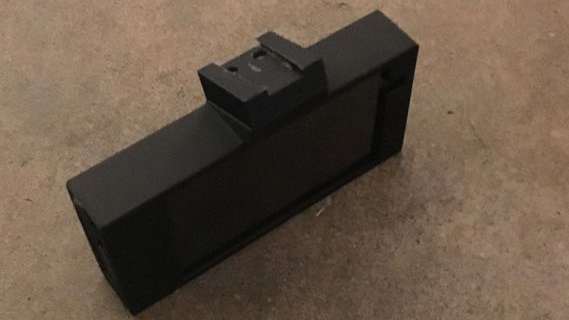
The hardware module, which replaces the rear-view mirror in a car, has at its center a OnePlus 3 Android phone, supplied by the user, and flashed with Comma.ai’s operating system. The casing for the Comma Neo is designed to be 3D printed. The phone camera serves as the primary visual sensor for the system, and with its Qualcomm Snapdragon 820 processor, handles visual identification and driving decisions.
The Comma Neo can connect to a car in a variety of ways, according to Hotz, such as through an OBD-II port. The user supplies a data plan for the phone so that it can connect to the Comma.ai deep learning stack.
Although Hotz did not mention any funding for Comma.ai, he said that he would like to work with aftermarket equipment makers to commercialize the Neo.

