
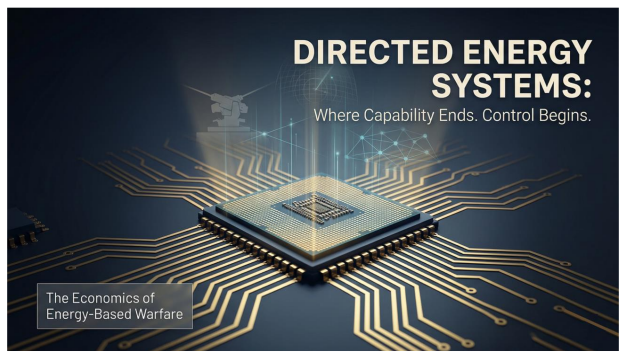
by Sukhendu Deb Roy, Industry Consultant
Key Takeaways
- The economics of warfare have flipped, with cost asymmetry emerging as a primary battlefield dynamic
- Directed energy systems shift defence from inventory-driven models to energy-driven ones
- Future defence architectures will be AI-orchestrated, integrated, and multi-domain
- Semiconductor capability is central to defence sovereignty
Introduction: The Shift in Modern Warfare
Modern warfare is undergoing a structural and economic shift—one that is redefining how conflicts are fought and sustained. Across theatres, adversaries are increasingly deploying low-cost, high-volume threats designed not just to penetrate defences, but to exhaust them. This is not merely a tactical evolution; it is an economic strategy aimed directly at the cost structure of defence systems rather than their technical limits.




In response, Directed Energy Weapons (DEW), particularly high-energy laser (HEL) systems, are emerging as a compelling alternative. By reducing the cost per engagement to near-zero and removing dependence on finite ammunition, they signal a transition toward energy-based warfare—where power availability replaces inventory as the primary constraint.
Operational systems today, typically in the 100–300 kW class, are already capable of countering drones, small boats, and select aerial threats. However, their performance remains constrained by power density, beam quality, and thermal dissipation limits.
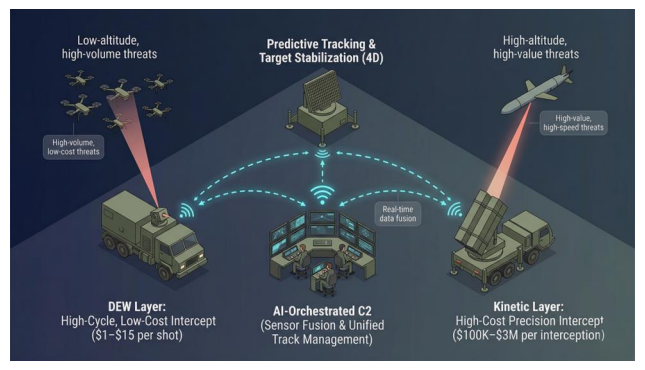
Figure 1. Emerging multi-layered defence architectures integrating kinetic and directed energy systems through AI-driven command and control.
The Problem: Capability Without Control
This advantage, however, is not absolute. Real-world deployments continue to reveal persistent constraints—thermal limits, atmospheric attenuation, beam dwell time, and power scalability challenges. These are not isolated engineering challenges; they are systemic constraints.
More importantly, they reveal a deeper dependency: the effectiveness of directed energy systems is inseparable from the ecosystem that supports them. Performance is not defined solely by the platform, but by the electronics, semiconductors, and supply chains beneath it.
This creates a structural risk. A nation may deploy advanced directed energy systems, yet remain dependent on external control at the component and semiconductor level.
The future of defence, therefore, will not be determined by the deployment of advanced platforms alone, but by the ability to secure control over the enabling ecosystem that makes those platforms viable at scale.
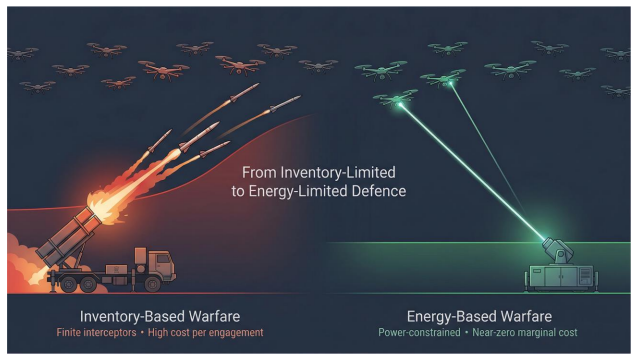
Figure 2. Directed energy systems deliver visible capability, but remain dependent on underlying electronics and semiconductor ecosystems—creating hidden vulnerabilities in control.
The Economic War of Attrition
At the heart of this transformation lies a fundamental imbalance shaping modern conflict. Defenders are increasingly forced to deploy high-value interceptors against low-cost threats, creating an unsustainable economic equation. Systems such as surface-to-air missiles or kinetic interceptors become prohibitively expensive when faced with saturation attacks.
This imbalance is not incidental—it is being deliberately operationalized through drone swarm attacks and loitering munitions designed to overwhelm defences through sheer volume rather than technological sophistication. The objective is clear: to stretch defensive resources to their limits and exploit the cost asymmetry inherent in traditional systems.
Directed energy systems fundamentally alter this equation. By shifting from consumable munitions to energy-based engagement, they dramatically reduce marginal costs and enable sustained operation without the constraints of inventory—as long as sufficient power is available.
This represents more than a technological evolution. It is a financial reset in how defence is structured and sustained. This is the defining shift from inventory-based warfare to energy-based warfare.
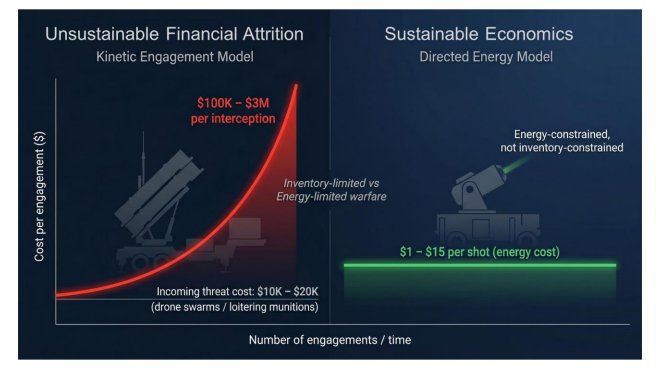
Figure 3. Cost asymmetry in modern warfare—low-cost threats forcing disproportionately expensive kinetic responses, driving unsustainable defence economics.
Without such a transition, the long-term economics of defence operations risk becoming untenable in the face of increasingly scalable, low-cost threats.
The Illusion of Sovereignty
The visible success of a directed energy intercept can be compelling. It signals speed, precision, and technological sophistication—creating the impression of true strategic independence. But that impression can be deceptive.
Beneath every such system lies a tightly integrated ecosystem of power electronics, thermal systems, optical assemblies, RF components, and semiconductors. If these critical elements are externally sourced, control has not been achieved—it has merely shifted out of view. Dependence is not eliminated; it is reconfigured.
In practice, this dependence surfaces through export controls, defence supply chain choke points, firmware constraints, and restricted access to advanced semiconductor nodes. Under normal conditions, these limitations may remain hidden. Under geopolitical stress, they translate directly into operational risk.
Capability alone does not ensure sovereignty.
Control does.
Where Control Actually Resides
To understand where control truly resides, directed energy systems must be viewed not as standalone platforms, but as layered architectures.
At the surface lies the platform layer—the visible capability, including laser systems deployed on land, sea, or air platforms. Beneath this sits the system layer, where command-and-control frameworks, targeting systems, and sensor fusion enable coordinated operation.
Deeper still is the engineering layer, which determines real-world performance. This includes power electronics that stabilize output, thermal systems that govern endurance, and optical and beam control mechanisms that ensure precision.
At the foundation lies the control layer—the least visible, yet most decisive. This layer encompasses semiconductors, advanced materials, packaging, and the broader supply chain that sustains the system.
It is this lowest layer that anchors performance, scalability, and resilience. Any external dependence here propagates upward, constraining every layer above and limiting true autonomy.
Performance, scalability, and resilience are determined at the lowest layer. Any external dependence at the control layer propagates upward, constraining the entire system.
Sovereignty, in this context, is not a function of the platform—it is a function of control at the component and semiconductor level.
These constraints are not theoretical—they are engineered into the system itself.
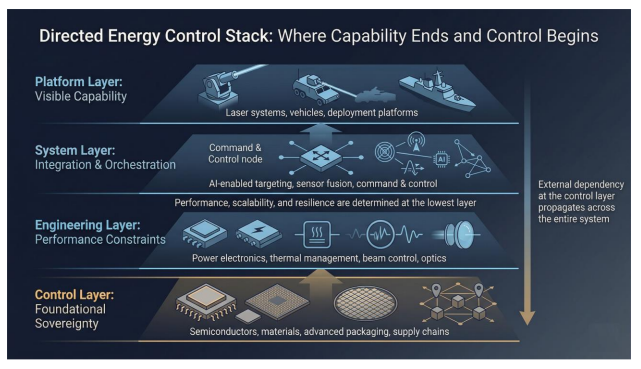
Figure 4. Directed energy performance is constrained by tightly coupled power, thermal, and semiconductor systems—highlighting the central role of control-layer technologies such as GaN-based switching.
The Real Bottlenecks
The challenges facing directed energy systems are physical, not conceptual.
- Thermal constraints limit sustained firing duration
- Advanced power electronics define efficiency
- Atmospheric conditions degrade beam propagation
- Beam dwell time limits effectiveness against fast-moving targets
- AI-enabled defence systems must operate at machine speed
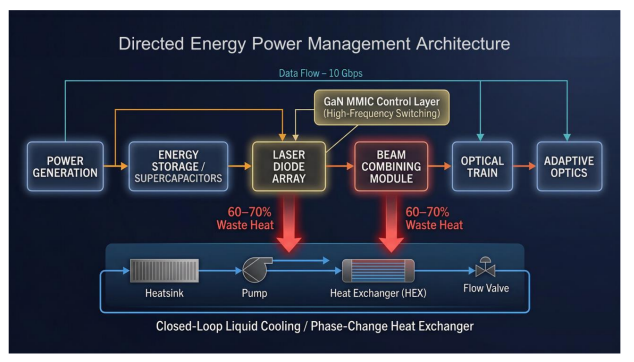
Figure 5. Directed energy constraints are interdependent—thermal, power, and control limitations must be solved as an integrated system, not in isolation.
These constraints do not exist in isolation—they reinforce and amplify one another. Addressing a single limitation, whether in thermal management or power delivery, does not translate into real operational capability on its own. What is required is coordinated industrial depth across multiple domains, from materials science and semiconductor design to power systems and real-time computation.
A directed energy system is only as effective as the ecosystem that sustains it.
From Weapons to Systems
Directed energy is no longer a standalone capability. It is steadily becoming part of integrated, AI-orchestrated defence architectures—often described as Cognitive Hybrid Defence—where multiple systems operate in coordination rather than isolation. In this emerging model, directed energy systems function alongside electronic warfare, cyber capabilities, and kinetic interceptors, all unified through real-time command-and-control frameworks.
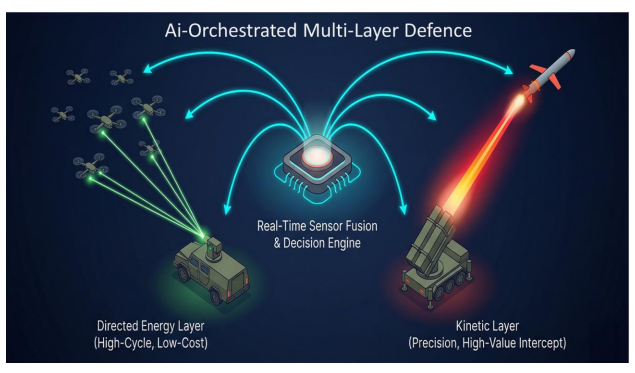
Figure 6. Transition from standalone weapons to AI-orchestrated, multi-layer defence systems, where threats are dynamically assigned to the most efficient response layer.
This shift is already visible in operational programs such as the U.S. Navy’s HELIOS system and Israel’s Iron Beam, both of which demonstrate how layered, multi-domain defence is replacing single-point solutions. The objective is no longer limited to individual interception—it is about orchestrating responses across domains with speed, precision, and economic efficiency. As this transition accelerates, control over the underlying technological ecosystem becomes even more critical.
Semiconductor Policy is Defense Policy
This convergence carries direct implications for national strategy. Defence capability and semiconductor capability can no longer be treated as separate domains—they are structurally interdependent. Initiatives such as India’s Electronics Component Manufacturing Scheme (ECMS) and the India Semiconductor Mission (ISM 2.0) must be viewed through this lens. These initiatives are central to building semiconductor sovereignty and securing India’s position in the global defence technology supply chain. They are not merely industrial policies; they are foundational to future defence capability.
Yet the challenge is not one of intent or conceptual understanding. It lies in industrial depth—particularly in manufacturing, materials ecosystems, and advanced semiconductor fabrication. Without control over critical technologies such as Gallium Nitride (GaN)-based power electronics systems, advanced packaging, and high-reliability electronics, there is a real risk of remaining a system integrator rather than a true control holder. Sovereignty, in this context, is not achieved through system assembly but through ownership of the components and technologies that define performance and resilience.
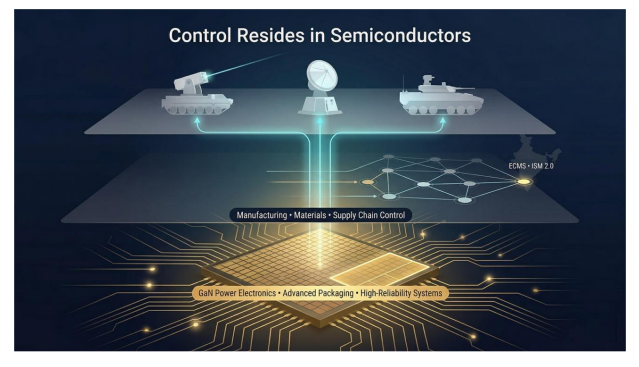
Figure 7. Defence capability is fundamentally anchored in semiconductor ecosystems—spanning materials, manufacturing, and advanced power electronics such as GaN-based systems.
Conclusion: Capability vs Control
What emerges is a broader shift in how warfare itself is understood. We are moving into a phase defined by energy, integration, and system-level thinking. Directed energy systems will become increasingly visible on the battlefield, delivering immediate and measurable impact. However, the true determinants of success will remain largely invisible—embedded in defence supply chains, semiconductor ecosystems, and industrial capability.
This creates a clear strategic imperative. Nations must move beyond assembling advanced platforms to controlling them end-to-end.
Forward Outlook
Looking ahead, the defining question of the next decade will not be who deploys directed energy systems first, but who can sustain and scale them under real-world conditions. Future conflicts may become power-limited rather than ammunition-limited, where grid resilience, energy density, and power electronics infrastructure and power distribution emerge as core defence parameters.
Meeting this challenge will require closer alignment between defence procurement and semiconductor strategy, sustained investment in power electronics, thermal systems, and advanced materials, and a decisive shift from platform-centric thinking to ecosystem-centric design.
Countries that recognize this transition early will build not just capability, but resilience. Those that do not will remain dependent—regardless of how advanced their visible systems may appear.
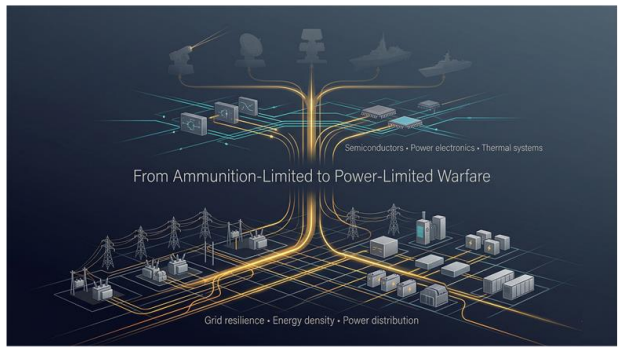
Figure 8. Future defence systems will be constrained by power, energy infrastructure, and semiconductor capability—marking the shift from ammunition-limited to energy-limited warfare.
Final Perspective
In the next generation of warfare, capability will be visible. Control will be decisive.

