

Courtesy: Keysight Technologies
Stray light can significantly impact the performance of optical systems, leading to unwanted artifacts and reduced image quality. Addressing this issue requires sophisticated tools and methodologies to analyze and mitigate stray light effects. In this blog post, we will explore the capabilities of LightTools for stray light analysis, including ghost image analysis, sequence ray tracing, and practical examples of their application.




What is stray light?
Stray light refers to any unwanted radiation that interferes with the intended function of an optical system. It can originate from within the system or from external sources such as the sun, moon, or artificial lights. Stray light can deteriorate the contrast and color of the final image captured on the camera sensor.
Stray light can be categorized into two main types: ghost images and bright, unwanted images caused by flare or veiling glare. Ghost images are typically caused by multiple reflections between imaging components and filters, leading to secondary images that degrade the quality of the primary image. Flares and veiling glare are caused by bright light sources within or outside the field of view, leading to scattered light that reduces image contrast and color fidelity.
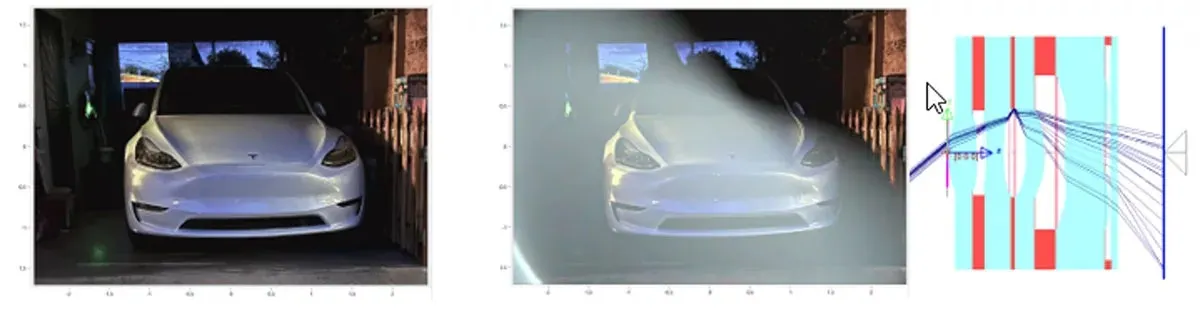
The above example shows how the image quality is deteriorated by the stray light due to a bright off-axis source present just outside the field of view of the camera. This is caused by the flare from the mechanical mounts.
Stray light analysis in LightTools
Stray light analysis can be a cumbersome process without proper simulation and analysis features. LightTools offers a robust feature set for this. Accelerated ray tracing with multi-threading and cluster simulations, ray paths, and sequence trace are among the most notable features.
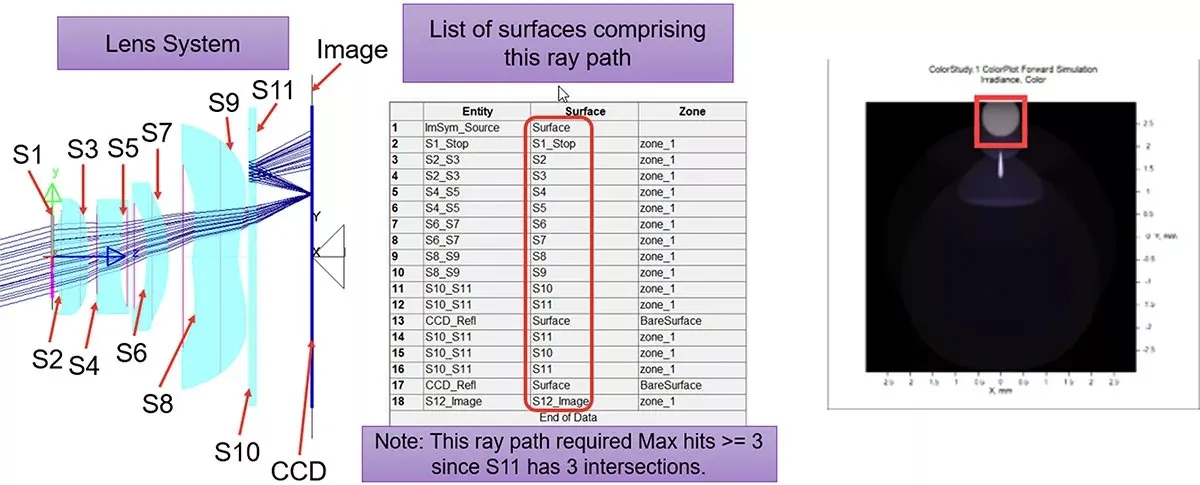
LightTools lets you look at all the ray paths in your system for a given number of max hits on each surface, and isolate paths you care about, for instance, by sorting paths according to power, peak irradiance, number of rays, and more.
Ray path analysis allows us to identify the specific interactions between lens surfaces that lead to ghost images and address them effectively. Furthermore, we can adjust the anti-reflective coatings and other surface treatments to minimize the reflections that cause these ghost images.
Enhanced results using sequence ray tracing
Sequence ray tracing in LightTools enhances the efficiency of stray light analysis by allowing us to trace rays along selected paths. This technique focuses computational resources on paths of interest, enabling higher fidelity images and faster simulations. By isolating specific paths using the ray path tool, we can achieve more accurate results and better understand the behavior of stray light within the optical system.
This method is particularly useful for complex systems where traditional ray tracing methods might be computationally prohibitive. With sequence ray tracing, we can conduct detailed analyses in a fraction of the time. The following example shows the use of sequence trace to enhance a stray light path identified after the first simulation.
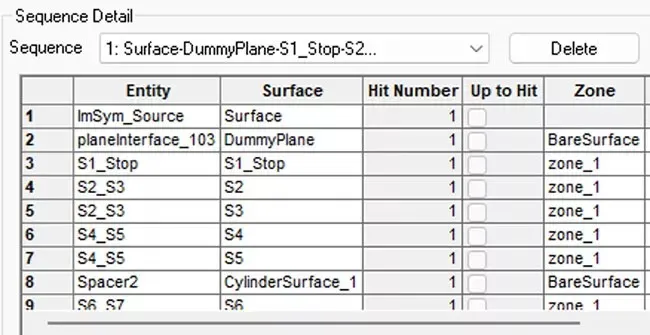
Furthermore, LightTools can be integrated with our image simulation product, ImSym, to provide a comprehensive analysis. This integration, using the Stray Light Scanner feature, allows for a more detailed understanding of how stray light behaves in real-world scenarios, enhancing the accuracy of our simulations. By using ImSym in conjunction with LightTools, we can simulate the impact of various environmental factors on stray light and develop more robust optical systems.
Conclusion
LightTools offers a comprehensive set of features for precise and efficient stray light analysis, enabling improved optical system performance. With ray paths, sequence ray tracing, and other advanced features, LightTools effectively addresses stray light issues, ensuring high-quality imaging simulations identify ghost images, flares, and replicate complex scenes. The integration of ImSym and the Stray Light Scanner further enhances analysis by incorporating scatter effects modeled in LightTools with image analysis. These tools help provide clear insights into model performance, allowing designers to make informed decisions and achieve significant improvements in image quality and system performance.

