

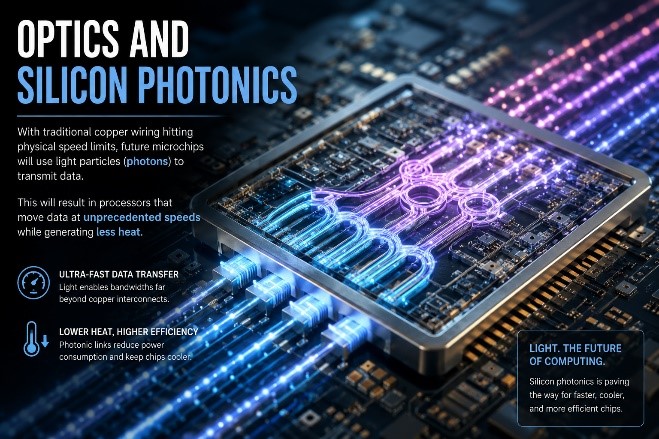
For more than five decades, the semiconductor industry has relied on a simple principle: increasing transistor density to deliver higher computing performance. While transistor scaling continues to advance, a new bottleneck has emerged inside modern computing systems—data movement.
Today’s processors, AI accelerators, memory systems, and data centers spend a significant portion of their energy simply moving data through metallic interconnects. Traditional copper wiring, which has served electronics faithfully for decades, is rapidly approaching its physical limitations. Resistance, capacitance, signal attenuation, electromagnetic interference, and heat generation increasingly constrain performance.



To overcome these challenges, the semiconductor industry is turning toward a revolutionary solution: Silicon Photonics. Instead of electrons traveling through copper traces, future chips will increasingly use photons—particles of light—to carry information. The result could be processors capable of transferring data at unprecedented speeds while consuming significantly less power and generating far less heat.
What is Silicon Photonics?: Silicon Photonics is a technology that integrates optical communication components directly onto silicon chips using semiconductor manufacturing processes similar to those used for CMOS integrated circuits.
Instead of transmitting information via electrical signals, silicon photonic devices use light waves traveling through microscopic optical waveguides fabricated on silicon wafers.
A typical silicon photonic system consists of:
- Lasers
- Optical modulators
- Waveguides
- Multiplexers
- Photodetectors
- Electronic control circuits
Together, these components allow information to be converted from electrical signals into optical signals and back again.
For working engineers, the story is no longer just about making transistors smaller. It is about moving data fast enough to keep up with them. As electrical links stretch across boards, packages, and racks, copper starts to run into familiar physical problems: resistance, crosstalk, signal loss, heat, and rising power cost per bit. Silicon photonics answers that bottleneck by carrying information as light rather than electrons, using optical links to push bandwidth higher while reducing the energy spent on interconnects. In practice, that makes photonics one of the most important enabling technologies for AI systems, HPC clusters, and data-center networking.
The engineering shift is straightforward in concept and hard in implementation. A silicon photonics platform integrates optical devices with standard CMOS-style manufacturing so data can be modulated, routed, and detected on or near the chip package. Intel describes its platform as combining silicon manufacturing scale with light on a single chip, and says its solutions now span 400G, 800G, and 1.6T-class interfaces. Ayar Labs takes a similar direction with optical I/O chiplets, positioning them as a low-power, low-latency alternative to copper backplanes and pluggable optics.
The practical reason this matters is bandwidth density. When systems scale from a handful of accelerators to dense AI fabrics, the bottleneck is often not compute silicon itself but how quickly data can enter, leave, and circulate around it. That is why the industry is moving from pluggable transceivers toward co-packaged optics, where optical engines sit much closer to the switch ASIC or accelerator package. NVIDIA says its silicon-photonics-based networking is aimed at this problem, with its 2025 Spectrum-X Photonics announcement targeting scale-out AI factories and claiming major gains in energy efficiency and resiliency. Broadcom is also pushing co-packaged optics and silicon-photonics chiplets for high-radix AI networks.
A useful way to think about the transition is this: copper is still excellent for short, simple, low-cost links, but it becomes expensive in power and signal integrity as reach and rate increase. Silicon photonics does not eliminate that tradeoff everywhere, but it moves the break-even point dramatically. Intel says its platform has already shipped more than 8 million photonic integrated circuits and more than 32 million on-chip lasers, while NVIDIA and Broadcom are both anchoring their latest AI networking roadmaps around photonics and co-packaged optics.
For engineers, the opportunity is not just faster links; it is system design freedom. Optical interconnects can relax board routing constraints, reduce electrical retiming overhead, and help keep power budgets under control as data rates climb. That is why the near-term adoption path is strongest in the I/O layer, package-to-package links, switch fabrics, and rack-scale interconnects, where the cost of moving bits is becoming as important as the cost of computing them. The architecture of future systems will still be electronic at the logic core, but increasingly optical at the boundaries where data movement hurts most.
In short, silicon photonics is not a futuristic side project anymore. It is becoming a serious engineering answer to a very present problem: how to keep AI, HPC, and networking systems from drowning in their own data traffic. The companies most visibly shaping the field today include Intel, NVIDIA, Ayar Labs, and Broadcom, each attacking the same bottleneck from a slightly different angle. For engineers building the next generation of systems, photonics is moving from “interesting” to “necessary.”
The semiconductor industry’s next breakthrough may not come solely from smaller transistors, but from replacing electrons with photons for data movement. As copper interconnects approach fundamental physical limits, silicon photonics offers a path toward dramatically higher bandwidth, lower latency, and significantly improved energy efficiency.
For working engineers, the transition to photonic computing represents more than an incremental improvement—it signals a fundamental architectural shift in how information is transported within and between computing systems. Companies such as Intel, NVIDIA, Cisco, Broadcom, Ayar Labs, Lightmatter, and Celestial AI are already laying the foundation for this future.
Over the coming decade, optical interconnects, co-packaged optics, and photonic processors are expected to become core enabling technologies for AI supercomputers, hyperscale data centers, and next-generation embedded systems. Just as silicon transformed computing in the twentieth century, silicon photonics may define the computational infrastructure of the twenty-first century.

