

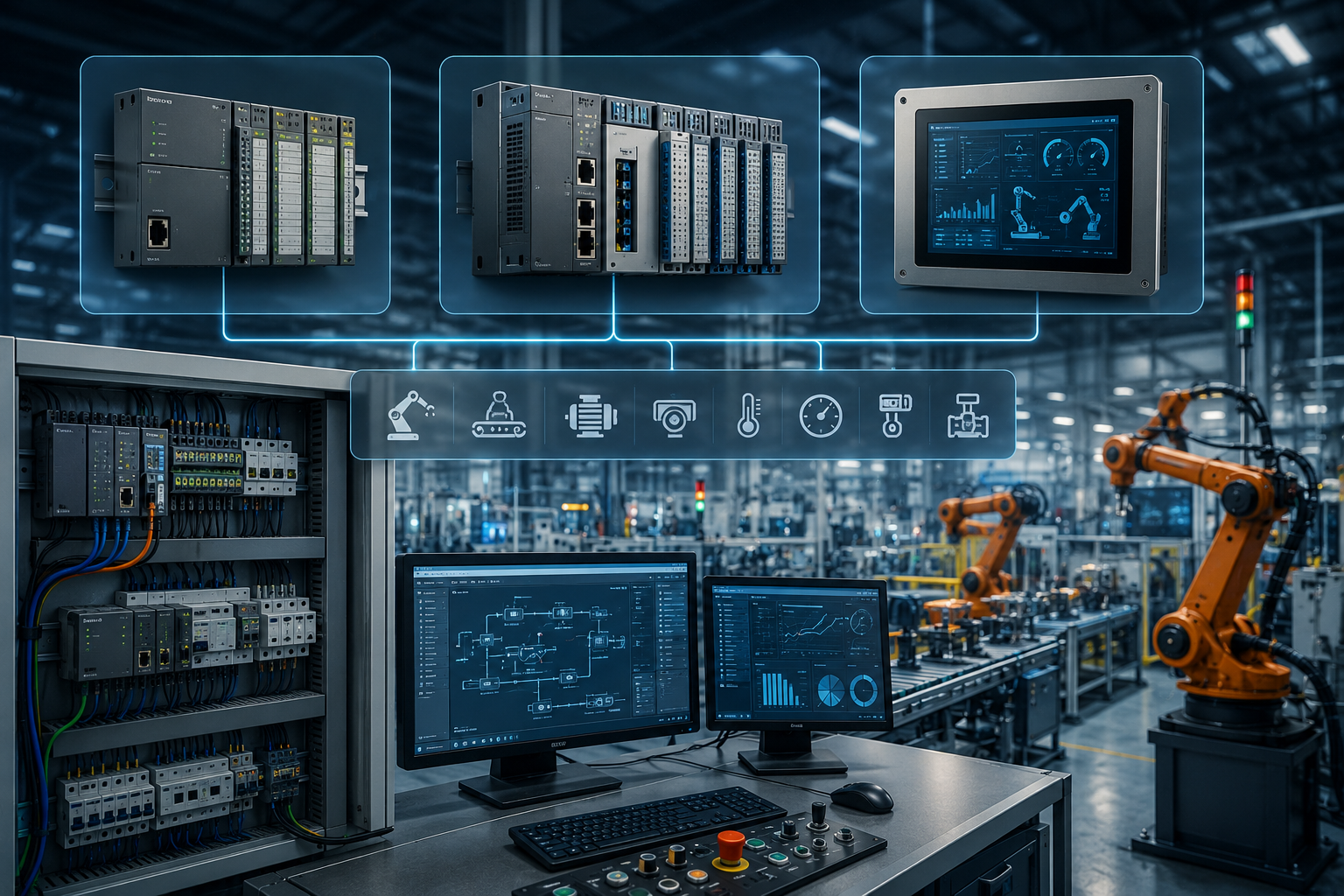
Navigating the New Era of Industrial Control Systems
Introduction
Industrial automation is undergoing a fundamental transformation. Traditional control systems designed primarily for machine sequencing and process control are now expected to support advanced analytics, predictive maintenance, artificial intelligence (AI), digital twins, cloud connectivity, and cybersecurity frameworks. As manufacturing and infrastructure systems become increasingly data-intensive, engineers face a critical challenge: selecting the most appropriate control architecture.



For decades, the Programmable Logic Controller (PLC) was the undisputed backbone of industrial automation. Later, Programmable Automation Controllers (PACs) emerged to bridge the gap between deterministic control and information processing. Today, Industrial PCs (IPCs) have evolved into powerful edge-computing platforms capable of running sophisticated automation software alongside AI and data analytics workloads.
The boundaries between these technologies are becoming increasingly blurred. Modern PLCs offer edge computing capabilities, PACs provide PC-like processing power, and industrial PCs deliver real-time deterministic control. Consequently, selecting the right controller is no longer about choosing the “best” technology but about understanding engineering requirements, operational constraints, and lifecycle considerations.
Understanding the Architectural Differences
PLC: The Deterministic Workhorse
PLCs were designed specifically for industrial environments where reliability and deterministic operation are paramount. Their architecture is optimized for real-time control tasks, including discrete I/O management, sequencing, interlocking, and safety functions.
Typical PLC architecture includes:
- Dedicated real-time operating systems
- Ruggedized hardware
- Scan-cycle execution model
- Integrated digital and analog I/O
- Long operational life cycles
- High resistance to electrical noise and harsh environments
The PLC continuously executes a control loop consisting of:
- Input scan
- Logic execution
- Output update
- Communication services
This deterministic behavior makes PLCs ideal for packaging machines, conveyor systems, assembly lines, water treatment plants, and utility infrastructure.
Key Strength: Predictable control performance with extremely high reliability.
Limitation: Limited computational capability for data-intensive applications.
PAC: Bridging Control and Information
Programmable Automation Controllers emerged as industrial systems became more complex and interconnected.
PACs combine the deterministic nature of PLCs with the flexibility of modern computing platforms. Unlike traditional PLCs, PACs support:
- Multi-domain automation
- Advanced motion control
- Large memory capacity
- Object-oriented programming
- Integrated networking
- Database connectivity
PACs generally comply with IEC 61131-3 standards while supporting higher-level software architectures.
Industrial PC: The Data-Centric Controller
Industrial PCs bring standard computing power into the industrial environment.
Modern IPCs feature:
- Multi-core processors
- High-capacity memory
- Solid-state storage
- Virtualization support
- AI acceleration
- GPU integration
- Industrial communication interfaces
Unlike PLCs, IPCs typically run:
- Windows
- Linux
- Real-Time Linux
- Hypervisor-based architectures
The rise of Industry 4.0 has significantly increased IPC adoption because they can process massive datasets locally while maintaining cloud connectivity.
Engineering Decision Framework
Instead of asking, “Which controller is better?” engineers should ask the following questions:
- How Critical Is Deterministic Performance?
Applications such as:
- Emergency shutdown systems
- Turbine control
- Motion synchronization
- Safety systems
require guaranteed response times.
In such cases, PLCs and PACs remain the preferred solutions.
- How Much Data Must Be Processed?
Modern smart factories generate terabytes of operational data.
Applications involving:
- AI-based inspection
- Video analytics
- Condition monitoring
- Predictive maintenance
often exceed traditional PLC capabilities and favour Industrial PCs.
- What Is the Environmental Requirement?
PLCs generally provide the highest environmental resilience, although ruggedized IPCs continue to improve.
- What Is the Expected Lifecycle?
Many manufacturing facilities expect automation assets to operate for decades.
PLC vendors often provide long-term support and product availability, making them attractive for infrastructure projects with extended service lives.
Industrial PCs may require more frequent hardware refresh cycles.
- What Are the Cybersecurity Requirements?
As operational technology (OT) becomes connected to enterprise IT networks, cybersecurity has become a critical design consideration.
Industrial PCs running conventional operating systems introduce a larger attack surface than dedicated PLC platforms.
Engineers must evaluate:
- Patch management
- Network segmentation
- Secure boot
- Endpoint protection
- Zero-trust architectures
before selecting a controller platform.
Emerging Hybrid Architectures
The most significant trend in industrial automation is convergence.
Leading automation vendors are increasingly integrating PLC, PAC, and IPC technologies into unified architectures.
Companies such as Siemens, Rockwell Automation, Schneider Electric, Beckhoff Automation, and Bosch Rexroth are investing heavily in software-centric automation architectures that blur traditional controller boundaries.
In many modern facilities, the architecture is no longer PLC versus IPC. Instead, PLCs provide deterministic machine control while Industrial PCs handle AI, visualization, and analytics at the edge. PACs often serve as the integration layer between these domains.
The Future: Software-Defined Industrial Control
The next generation of automation systems will increasingly separate software from hardware.
Virtualized controllers running on industrial servers are beginning to challenge conventional hardware-based automation architectures. AI-assisted engineering tools, digital twins, and edge computing platforms will continue driving demand for more computationally capable control systems.
However, deterministic control remains the foundation of industrial automation. Regardless of future innovations, the engineering challenge will continue to revolve around balancing reliability, performance, security, scalability, and cost.
Conclusion
The debate between PLCs, PACs, and Industrial PCs is no longer a simple technology comparison. Each architecture serves a distinct purpose within modern automation ecosystems.
For today’s engineers, the optimal solution is increasingly a hybrid architecture that combines the strengths of all three platforms. Success lies not in choosing a single controller type but in understanding the specific operational requirements and designing a system architecture that balances control integrity with digital innovation.
As factories evolve toward autonomous, connected, and intelligent operations, the future belongs to architectures that seamlessly integrate deterministic control with data-driven intelligence.

