

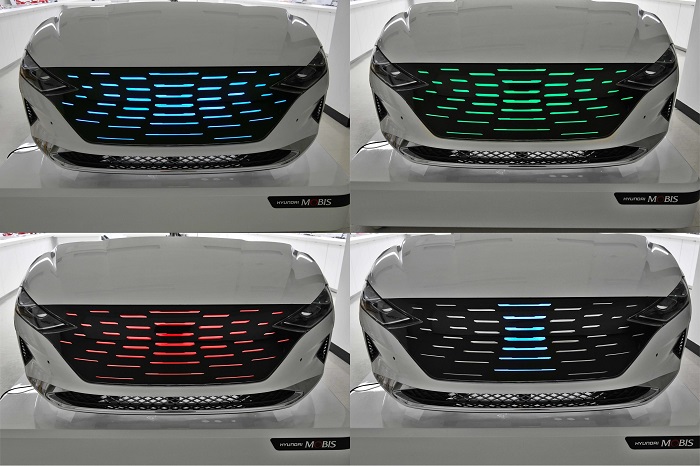
Hyundai Mobis has developed new ‘lighting grille’ technology, which implements an LED lighting function in the front grille of a car. The company says it helps determine the first impression, and also integrate the other new ‘grille integral active air flap’ technology.
The company said it completed earlier this year the development of the technology, the result of its R&D efforts in response to the megatrends of electric vehicles and autonomous vehicles. It is now verifying its reliability for commercialisation. Mass production is slated for next year. The core of the new grille technology consists of the ‘lighting grille’ and the ‘moving grille.’ Over the years, the automotive grille has been regarded as a vent for cooling the engine and as a design element that determines the first impression of the vehicle. However, with EVs gaining ground in recent years, the existing grille is being transformed to have different uses including lighting systems, sound systems and displays.
Using the grille as a lighting device Hyundai Mobis’ ‘lighting grille’ technology can use the entire front grille of the car as a lighting device. It is characterised by being able to implement various scenarios such as the autonomous driving mode, the EV charging mode, the welcome light function, the sound beat display, and an emergency warning light display.



The ‘lighting grille’ can be used as a means of communicating with other vehicles or pedestrians and it can also create strong and unique design effects, depending on how the lighting patterns are applied.
The ‘moving grille’ technology, also developed by Hyundai Mobis, automatically controls the outside air to cool the engine as the grille moves and provides the lighting function as well. Unlike the existing method (built-in), as this has been developed as a grille integral type (external), it is expected to not only improve fuel efficiency and reduce exhaust gas, but also realise a sense of luxury in the exterior design of the vehicle. The built-in air flap, located insidem the automotive grille, detects changes in the temperature of the coolant and blocks the inflow of outside air by lowering the flap if cooling is not necessary.
If this device is applied to a vehicle, it can improve fuel efficiency as it reduces air resistance (if outside air is blocked) and reduce the emission of pollutants through the exhaust gas by improving the cooling efficiency inside the engine room. The advantage of the grille integral (external) air flap is that it can implement differentiated design patterns through its lighting while also enhancing the eco-friendly effect. “We are making constant efforts to develop new technologies that can meet customer needs in response to the changes in future car trends,” Lee Woo-il, head of the Module Lab of Hyundai Mobis, said.
“We will preempt the global market with innovative products that combine a high level of technology readiness with emotional quality” he added.
Last year Hyundai Mobis developed a virtual engine sound system that uses the automotive grille as a global first. If this technology is applied to vehicles, it can be used not only for the virtual engine sound, but also as the turn signal sound, the Electric Vehicle charging alarm sound, and speakers for playing music while camping, the company said.

