
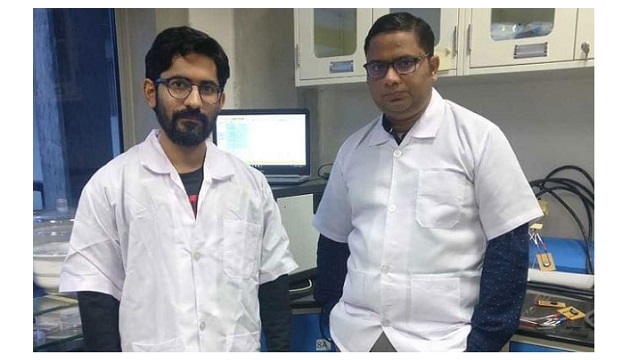
A semiconductor that can detect hydrogen gas leaks with high sensitivity, has been developed by research ream from IIT Hyderabad and IIT Jodhpur. The semiconductor would help in the development of reliable and robust hydrogen gas sensors with high sensitivity and quick response, for domestic as well as industrial applications.
The idea for the semiconductor was floated at the ‘National Frontiers of Science’ meeting organized by Indian National Young Academy of Sciences (INYAS) at IIT Hyderabad in December 2018. During this meeting, Dr. Chandra Shekhar Sharma, Associate Professor, Creative and Advanced Research Based On Nanomaterials (CARBON) Laboratory, Department of Chemical Engineering, IIT Hyderabad, and his research team held discussions on collaborations with Dr. Mahesh Kumar, Associate Professor, Department of Electrical Engineering, IIT Jodhpur.




Speaking about the importance of this research, Dr. Chandra Shekhar Sharma said, “In the past few decades, the importance of hydrogen has grown tremendously because of its promise as a primary energy source with the potential to become a panacea for clean energy generation.”
Despite the enormous promise of ‘hydrogen economy,’ there are two problems associated with the gas. One is that it is difficult to produce, and the second is that it is hard to detect, and because hydrogen is inflammable, leaks can be catastrophic if not detected immediately. The latter problem is one that this collaborative research between IIT Hyderabad and IIT Jodhpur attempts to solve.
Highlighting the need for this research, Dr. Mahesh Kumar, Associate Professor, Department of Electrical Engineering, IIT Jodhpur, said, “The explosive range (4-75%) and low ignition energy of hydrogen make leaks very dangerous. Human beings can’t sense hydrogen because it is colorless and odorless, which makes it essential to develop tools and sensors to detect hydrogen.”
Many kinds of hydrogen sensors are being studied, including optical, electrochemical and electrical sensors. Electrical sensors, in particular, resistive sensors, are the closest to practicality due to their low cost, simple design and possibility of good sensitivity. The sensors to hydrogen gas must be highly sensitive and selective to the gas.
Explaining how resistive sensors work, Dr. Mahesh Kumar said, “Certain materials undergo a change in their electrical resistance when they come in contact with specific gases. For example, metal oxide semiconductors such as zinc oxide show changes in their electrical resistance when they come in contact with hydrogen.”
“The sensitivity of zinc oxide’s response to hydrogen gas depends upon its surface area – the larger the surface area, or the smaller the particles, the better its sensitivity,” said Dr. Sharma.
Nano particles of zinc oxide, in which the particle sizes are a hundred thousand times smaller than the width of a single human hair, have good hydrogen sensing properties. The research team has further improved the sensitivity of this material.
The researchers have loaded the zinc oxide nanoparticles onto nanofibres of carbon and have shown that this results in a sensing response of nearly 74% compared to 44.5% in pure ZnO nanoparticles. Nanofibres are extremely thin fibres that are bundled to look like cotton candy.

