
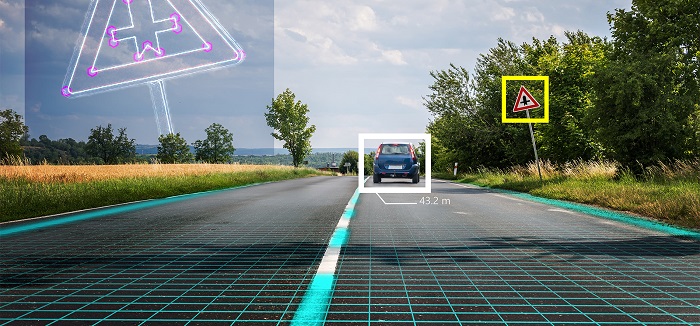
Technology adds new safety features to every generation of road vehicle—seatbelts, airbags, parking sensors, and in work published in the International Journal of Vehicle Safety, the possibility of an in-vehicle road sign recognition system is discussed. Researchers from the University of Monastir, Monastir, Tunisia, have turned to an algorithm known as an edited shuffled leapfrog algorithm to carry out the recognition task.
There are dozens of algorithms based on biological phenomena, such as swarming and foraging. The natural algorithms used by honeybees, for instance, can be modeled in a computer to solve complex, non-linear problems, such as plotting the shortest route on a map to take into account all the essential stops. Similarly, a novel trial-and-error (meta-heuristic) algorithm that models the behavior of frogs searching for food can be used to solve other problems.




Ameur Zaibi of the Laboratory of Automation, Electrical Systems and Environment (LAESE) and colleagues have developed Edited Shuffled Frogs Leaping Algorithm (ESFLA) to optimize the analysis of images of road signs and to correlate the output of the trained algorithm with an internal listing of the road signs a driver may encounter. The system can recognize signs with high accuracy regardless of viewing angle, light conditions, and even partial obstructions. Indeed, the team reports a detection rate of almost 97 percent compared with previous techniques developed by other researchers which have achieved between 91 and 96 percent.
If incorporated into the vehicle’s computer system, the algorithm could be used to alert the driver to road signs in a timely manner and perhaps quicker than they would see them themselves. The system could improve safety for all drivers, but would also be of great assistance to drivers on unfamiliar or foreign roads.
The next step would be to incorporate such a road sign recognition system into the controls for a self-driving vehicle so that it could have even greater autonomy than do such vehicles.

