

Courtesy: Murata Electronics
What is fashion tech? – diverse technologies and methods evolving the industry



“Fashion tech” is a term that combines fashion and technology. It refers to the use of big data, artificial intelligence (AI), augmented reality/virtual reality (AR/VR), and IT in customer services; the development of products incorporating functional materials and wearable devices; and the application of electronics and digital technologies in manufacturing, processing, and distribution processes.
Fashion tech is expected to garner even more attention as a means to invigorate future consumption activities, products, industries, and markets as technology progresses and new products and services are introduced. As mentioned earlier, fashion tech is a broad term, but it can be classified into two categories based on its nature. One is the evolution of services and customer experiences (CX), and the other is the evolution of product functionality and manufacturing processes. We explain these two aspects of fashion tech in the following sections.
Fashion tech evolving the customer experience (CX)
IT and digital transformation (DX) are currently driving fashion tech. There have been many challenges in enhancing sales CX in stores and on e-commerce sites, but many of these have been addressed through IT and DX initiatives.
For example, when selling clothing, shoes, jewellery, watches, eyewear, bags, etc., online, a longstanding issue has been the high hurdle for purchase decisions due to the difficulty for individual consumers to imagine how the actual products would look on them. However, in recent years, virtual fitting via AR (augmented reality), which can be easily used with smartphones and tablets, has become widely adopted. Even without 3D data for products, the technology to enable three-dimensional representation in AR using artificial intelligence (AI), if multiple 2D images of the product are prepared, has lowered the barrier to service introduction.
In parallel with virtual fitting, services are now emerging whereby AI assesses how well eyewear and accessories suit a consumer based on the individual’s facial features and the item’s shape and size. These technological advances are driving improvements in CX through the introduction of fashion tech.
Furthermore, the adoption of radio frequency identification (RFID) technology, including RFID tags and readers, is also advancing, and its applications are moving beyond rationalising inventory management. RFID is being used to reduce checkout lines and payment hassles by simplifying self-checkout and protecting brands, such as by authenticating genuine products.
Additionally, AI is being used to analyse customer and consumption trends across physical stores and e-commerce sites using RFID data. This enables a swift response to customer needs through appropriate inventory adjustments. These are just some of the ways technology is being used.
Fashion tech is evolving product value and manufacturing processes through technology
The DX and CX-oriented fashion tech mentioned above is expected to develop further. In addition, fashion tech that provides new added value to consumers through new characteristics and functions of materials and products is likely to garner more attention in the future due to advancements in materials, wearable devices, engineering, and manufacturing processes.
Here, we introduce technologies such as digital fabrication, smart textiles, smart fabrics, and wearables, which are said to be key to the future development of fashion tech.
Digital fabrication
Digital fabrication is a general term for technologies that make or process products based on digital data. In fashion product manufacturing, it refers to using 3D scanners and 3D CAD to digitise product ideas and patterns and then importing the digitised data into digital manufacturing machines such as 3D printers and laser cutters to shape or process the ideas and patterns.
Digital fabrication has attracted attention in recent years due to the diversification of needs and the development of digital technologies. By streamlining the design and manufacturing processes, digital fabrication has made it possible to accommodate high-mix, low-volume production and the manufacturing of personalised products. It is also gaining attention as a technology for providing new added value to products, such as the manufacturing and processing of materials with structures, functions, and properties that were not previously available.
Smart fabrics (smart textiles)
Expectations are rising for smart fabrics or smart textiles (hereinafter, smart fabrics), technologies that create new added value by imparting functionality to fashion products’ materials themselves. The digital fabrication mentioned earlier is also a means to realise these technologies.
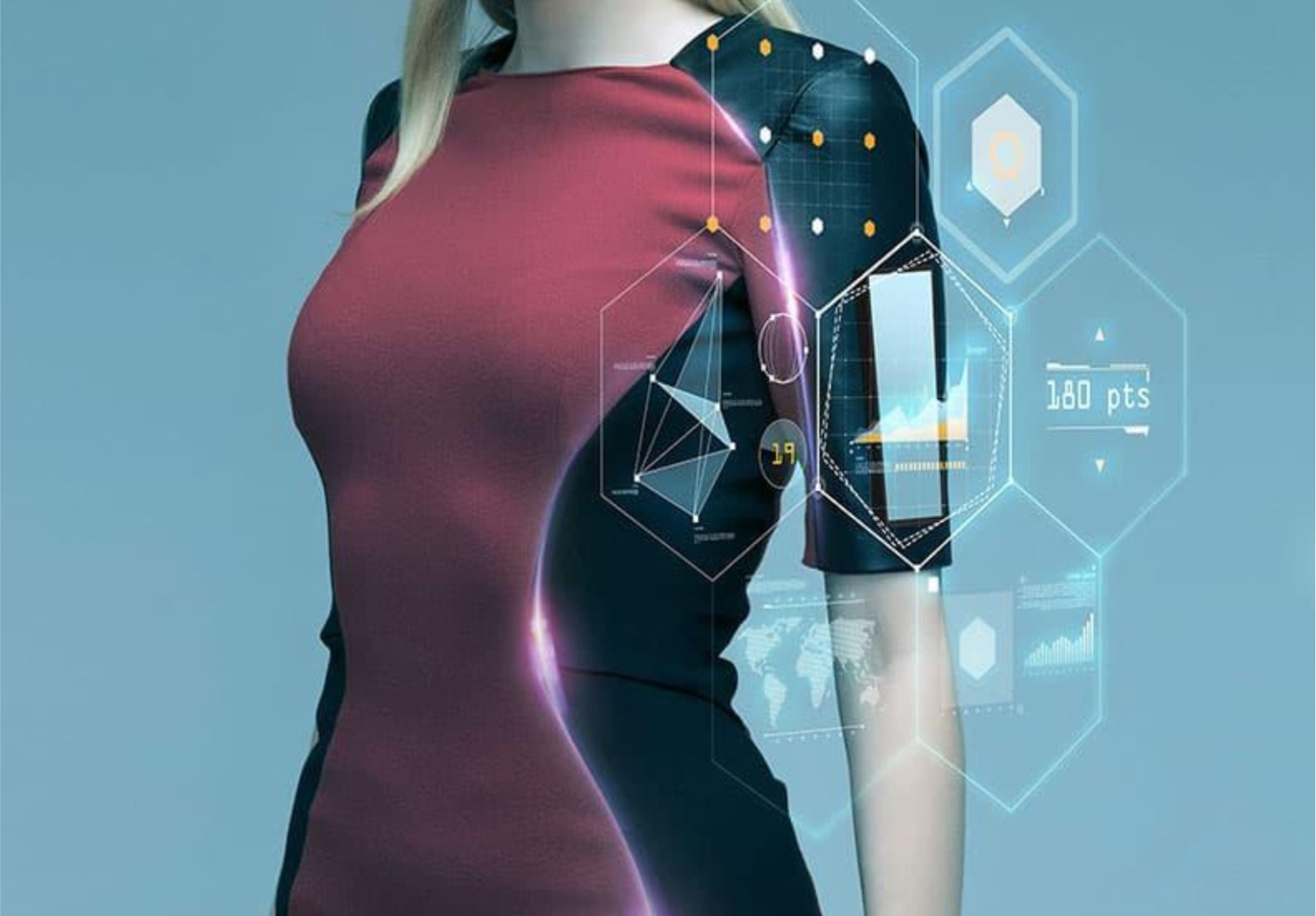
Smart fabrics generally refer to imparting functionality to fibres by integrating electronic technology. The functions are diverse. For example, the clothing itself may function as a sensor to monitor the wearer’s health condition, use electricity for sterilisation, or regulate temperature. Various R&D and commercialisation efforts are underway to realise these functions.
Many of these technologies are attracting attention for a wide range of purposes, such as health and medical care, sports and fitness, and safety improvement. The introduction of such technologies into everyday clothing is being plotted to provide new added value through fashion products with advanced functionality.
Wearable and flexible electronics
The integration of wearable devices into fashion items and the IoT-ization of fashion items themselves are also anticipated as a technology closely related to smart fabrics. For instance, by using wearable devices to process, communicate, display, manipulate, and control data sensed by smart fabrics, products could be endowed with a variety of functions and performance.
Many wearable devices, such as smartwatches, have rigid mounting boards and housings, which is fine for wristwatches. However, these rigid components can interfere with body movement and risk device damage when implemented in wearable items such as clothing.
One promising solution to such challenges is flexible electronics. Flexible electronics refer to pliable electronic circuits and components that can bend. This high compatibility with smart fabrics and wearables raises expectations for their application to future fashion tech and the sophistication of functions it will bring.
Fashion trends cyclically go through revivals. It is hard to imagine that futuristic designs like something out of a sci-fi movie will suddenly become mainstream. This is likely because established designs are rational and fit most people’s sensibilities. On the other hand, while the outward appearance of items may follow traditional lines, the purchasing experience, product functionality, and added value will continue to evolve through fashion tech.

