
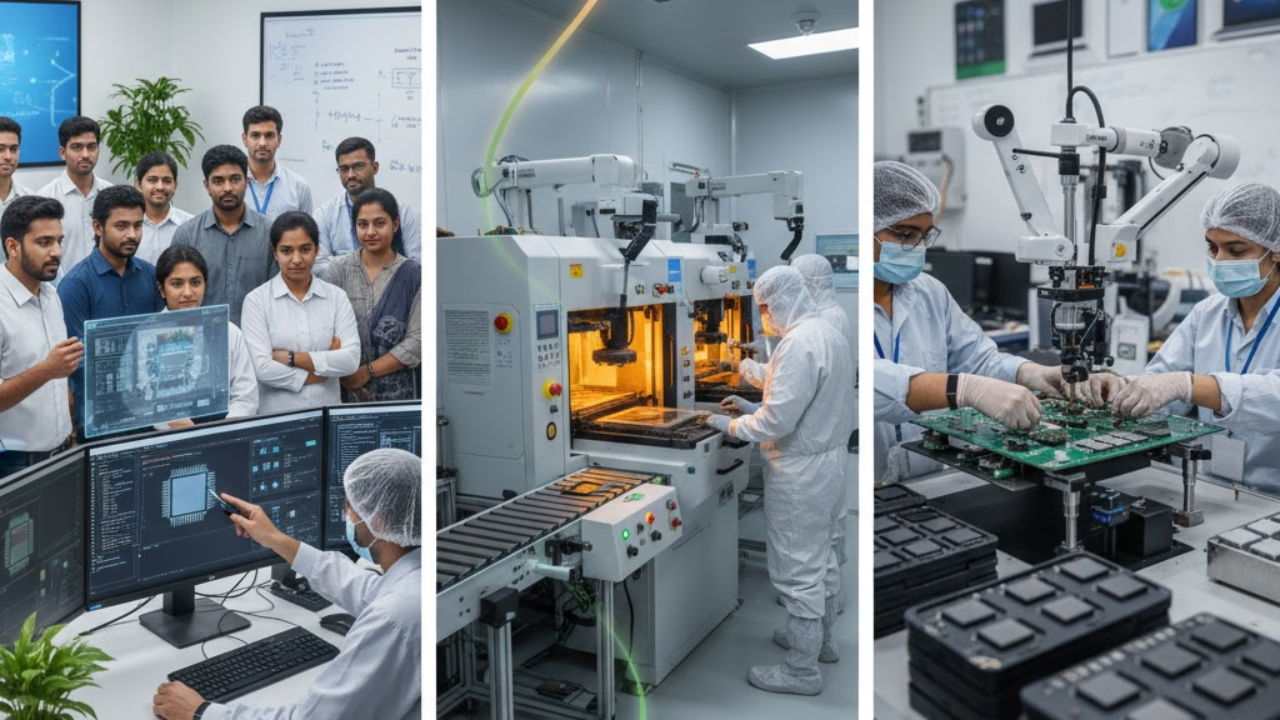
Union Minister of State for Electronics and Information Technology Shri Jitin Prasada, stated India’s achievements from the Semicon India Programme. The Indian Government launched the programme to develop a complete ecosystem ranging from design, fabrication, assembly, testing and packaging.
The government approved 10 units worth Rs. 1.6 lakh crore to set up Silicon fab, Silicon Carbide fab, advanced packaging, memory packaging, among others. These are expected to cater to chip requirements of multiple sectors such as consumer appliances, industrial electronics, automobiles, telecommunications, aerospace, and power electronics. The minister also recalled how some of the approved projects are also using indigenous technology for assembly, testing and packaging of semiconductor chips.




Additionally, the Product Linked Incentive scheme (PLI) for large scale electronics manufacturing of mobile phones and certain specified components, attracted an investment of Rs 14,065 Cr. up to October 2025.
Design Development
On the design front, the government launched the Design Linked Incentive scheme (DLI), which provided support to 23 companies (24 designs) for designing chips and SoCs for the products in satellite communication, drones, surveillance camera, Internet of Things (IoT) devices, LEDs driver, AI devices, telecom equipment, smart meter, etc. Additionally, to assist with infrastructure, the government provided free design tool (EDA) access to 94 startups, enabling 47 lakh hours of design tool usage.
Developing a Skilled Workforce
Realising the importance of skilled workforce in the semiconductor manufacturing process, the government also launched several programmes and collaborations to build a skilled workforce for India. The All India Council for Technical Education (AICTE) has launched various courses to provide technical training to students.
The government’s Chips to Start-up (C2S) Programme encourage India’s young engineers, where the government provides latest design tools (EDA) to 397 universities and start-ups.
A Skilled Manpower Advanced Research and Training (SMART) Lab has also been setup in NIELIT Calicut with an aim to train 1 lakh engineers nation-wide. More than 62 thousand engineers have already been trained.
ISM has also partnered with Lam Research for conducting a large-scale training programme in nanofabrication and process-engineering skills. These would further augment skilled workforce for ATMP and advanced packaging. The program aims to generate 60,000 trained manpower in next 10 years.
Subsequently, the FutureSkills PRIME program is a collaborative initiative of MeitY and National Association of Software and Service Companies (NASSCOM) aimed at making India a cutting-edge digital talent nation.

