
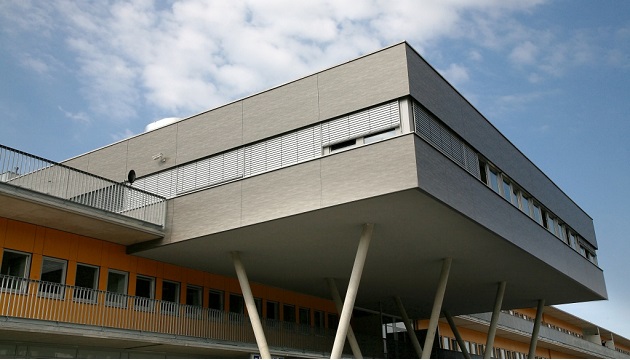
Infineon will strengthen its research and development efforts in the field of high-frequency components. To this end the Infineon Austria holding company DICE (Danube Integrated Circuit Engineering) in Linz will be provided with a new home. Today the company broke ground for the new site. By the summer of 2020 the new building will provide room for 400 employees – and thus in the medium run for 220 new jobs. Today, 180 people work for the development center. Its main focus is on 77 GHz radar chips for driver assistance systems. Components for mobile telephony and navigation applications are another key area of the company’s business.
Research strengths: mobility and communication




The Linz site develops solutions for important future markets, as Peter Schiefer, President of the Automotive Division of the Infineon Group, explained: “Infineon is shaping the future of mobility and communication. Microelectronics accounts for the majority of all innovations in the car and in the smartphone. The further development of advanced driver assistance systems, smartphones, tablets and navigation devices is a powerful driver of growth for Infineon. And the semiconductor solutions for all of this are developed in Linz among other locations.”
“As one of the leading research-focused industrial companies in Austria, our site in Linz is continuously focusing on the expansion of local expertise and global research tasks in the future-oriented field of high frequency technology”, Sabine Herlitschka, CEO of Infineon Technologies Austria AG, emphasized. “The local education institutions and research players provide a strong regional knowledge environment that enables outstanding innovations.”
100 million radar chips sold
With its development center in Linz, Infineon is a pioneer in radar for driver assistance systems: The high-tech company launched the world’s first 77 GHz radar chip to use silicon-germanium technology in 2009. For example, these radar sensors are used in distance warning and automatic emergency braking systems and thus make driving safer. With more than 100 million 77 GHz radar chips sold, Infineon is the technology and world market leader in this segment. The aim is to develop this safety technology further. Radar sensors will be part of the standard equipment of every new car in the future. Among other things, they are required for autonomous driving.

