
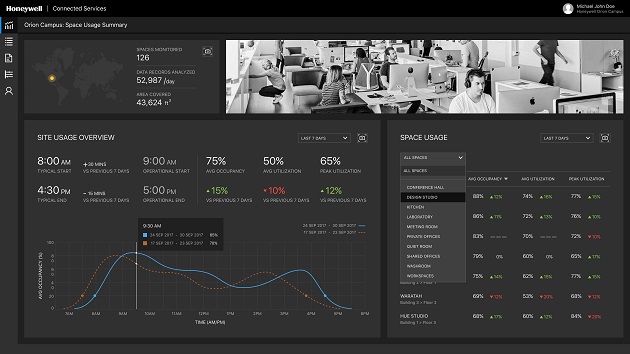
Honeywell, a global leader in Connected Buildings, introduced Honeywell Vector Space Sense, a software solution that shows where, when and how building spaces are used at any given point in time. As a result, the building operations team can make better-informed real estate and space usage decisions that provide opportunities to optimize costs and promote better building experiences for occupants.
“From higher levels of employee productivity to healthier environments that help drive cost savings, Connected Buildings have real benefits for owners, operators, and occupants,” said Vimal Kapur, president and chief executive officer, Honeywell Building Technologies. “Honeywell Vector Space Sense is the latest example of how Honeywell is using cutting-edge technology to enable smarter, data-driven buildings that work for their organizations.”




Recent studies indicate most offices around the world are underutilized by as much as half of their actual capacity due to factors such as shifting work schedules, mobile technology usage and changing business needs. However, many facility managers lack the comprehensive insights required to take action to address these usage issues. This can lead to overpaying for unused space, wasted energy usage, off-temperature spaces and other inefficiencies that negatively impact an organization’s bottom line.
Honeywell Vector Space Sense helps address this issue by gathering and analyzing data from multiple sources throughout a building to deliver actionable insights that help personnel better utilize, optimize and prioritize building spaces. The facility team can view these insights through detailed, information-rich dashboards and reports incorporating visualization methods like maps, usage profiles, overall trends and other metrics to show where, when, and how space is used, along with opportunities to optimize usage and help reduce costs. For example, organizations can gain the necessary insights to repurpose unused spaces for more productive uses, make better-informed decisions about future space investments or divestments, and better align building equipment schedules with actual usage patterns.
Honeywell Vector Space Sense is in use at London Health Sciences Centre, a London, Ontario-based hospital network with 15,000 employees that covers 1.9 million square feet and served more than 1 million patients in 2017. The hospital network chose to implement the technology to better understand the use of its clinical and office spaces, following complaints of overcrowding and office expansion requests. With Honeywell Vector Space Sense, the network discovered that overcrowding in certain areas only happened at specific times, while other spaces often went unused for long periods of time. This information helped inform better space reallocation and scheduling.
“Hospitals are complex systems, and not only are the operational costs high, so are the stakes. There’s no room for error when it comes to using your space most effectively,” said Derek Lall, director of facilities management, London Health Sciences Centre. “As a regional acute hospital, we must strike a balance between efficiency and comfort to ensure we’re delivering the best care possible and getting the most out of available resources. Honeywell Vector Space Sense is helping us do that by providing a level of insight all in one place that we’d otherwise have no way of obtaining.”
Backed by a cloud-based infrastructure, Honeywell Vector Space Sense follows a three-step process that starts with gathering space utilization data from multiple sources such as smart lights, Bluetooth beacons, mobile apps, and other sensor-connected devices and equipment. The solution then applies analytics to the collected data, using customized algorithms and space utilization models to deliver actionable insights—the third and final step.
“Expenses associated with unused building spaces often go unnoticed, simply because it’s so difficult to get an accurate, moment-by-moment view into how building spaces are used, or if they’re being used at all,” said John Rajchert, president, Building Solutions, Honeywell Building Technologies. “Honeywell Vector Space Sense takes the mystery out of space usage through real-time, IoT-enabled insights that give organizations the real picture of where and how people are using spaces, so they can get the most out of their buildings.”
Honeywell Vector Space Sense is part of Honeywell’s Connected Services portfolio, which includes other technologies such as the Honeywell Vector Occupant App that leverage the connectivity of buildings to improve how they operate and the experiences they offer for those who visit and work within them. For more information, visit honeywell.com.

