
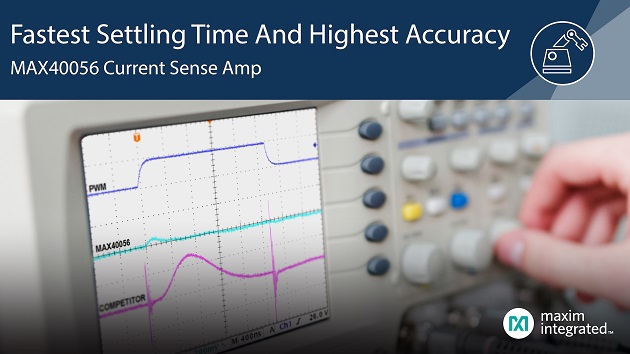
Designers can now improve motor efficiency and reduce vibration using the MAX40056 bi-directional current sense amplifier with patented pulse-width modulation (PWM) rejection from Maxim Integrated Products, Inc. This high speed, wide-bandwidth amplifier extends Maxim’s industry leadership in precision, high-voltage current sense amplifiers into motor control applications.
Creating a motor control system requires precise current sensing and measurement of motor winding currents. A commonly used approach is to infer winding currents by performing ground or supply referenced measurements in the bridge circuit. Direct winding current measurement is a simpler and more accurate method, but the implementation is challenging due to the high common mode swing of the PWM signal. Adoption of this approach has been limited by poor PWM rejection and slow settling speed of existing solutions.




MAX40056 rejects PWM slew rates of greater than 500V/µs and settles within 500ns to provide 0.3 percent accurate, full-scale winding current measurement. The patented PWM rejection scheme achieves 4 times faster settling time than competitive offerings, allowing motor control designers to increase drive frequency or decrease minimum duty cycle without sacrificing measurement accuracy. Higher PWM frequency smoothes out the current flow and reduces torque ripple, resulting in more efficient motor operation. Accurate winding current measurement at low duty cycle helps reduce or virtually eliminate vibration when the motor is running at a slow speed. MAX40056 has a wide common mode voltage range of -0.1V to +65V and a protection range of -5V to 70V to ensure the inductive kickback does not damage the IC. With bi-directional sensing capability, it is ideal for DC motor control, base station, datacenter, battery stack and many other applications which require precise current measurements in noisy environments.
Key Advantages:
- Fastest Settling Time: patented technique rejects common mode PWM signals and yields fastest settling time within 500ns.
- Highest Accuracy: accurate direct motor winding current measurement at 4 times higher PWM frequency or 4 times lower duty cycle than competitive offerings.
- Increased Performance: improved motor efficiency and reduced vibration.
“Complex and highly sensitive systems such as self-driving and autonomous vehicles require extremely accurate sensing feedback to provide a high level of functionality and increased safety,” said Rahul Kumar, analyst at Allied Market Research. “The industry is ripe for a solution that can provide increasingly precise motor controls, especially with the expected autonomous vehicle market growth predicted to reach $556.67 billion by 2026.”
“MAX40056’s high PWM rejection and fast settling time obtains current measurements inline with the motor windings for highest accuracy and greatest control in sensitive applications,” said Dimitry Goder, director of applications and product definition for the Core Products Group at Maxim Integrated. “Its unique design architecture unlocks higher performance and future innovation in motor control applications.”
For more information, visit: www.maximintegrated.com

