
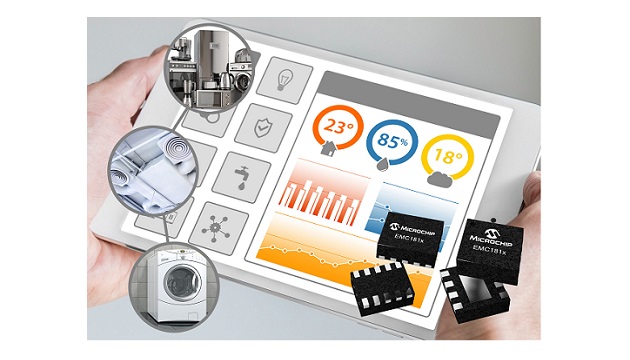
Temperature measurement is central to the functionality of Internet of Things (IoT) and personal computing devices, making it imperative that developers integrate temperature sensors that reduce power consumption and lower system voltage in applications. To meet these needs, Microchip Technology Inc. has announced five new 1.8V temperature sensors, including the industry’s smallest five-channel temperature sensor with standard lead spacing.
The EMC181x temperature sensor family also introduces system temperature rate-of-change reporting, a feature that provides advanced warning on how the temperature of a system is fluctuating.




Monitoring temperature at multiple locations with a single, integrated temperature sensor reduces board complexity and simplifies design. The EMC181x temperature sensor family offers a variety of remote channels at 1.8V operation to fit different design needs, ranging from two to five channels.
The family is ideal for applications migrating from 3.3V systems to lower voltage rails, such as battery operated IoT applications, personal computing devices, field-programmable gate arrays (FPGAs) and graphics processing units (GPUs).
“As customers migrate to lower voltage rails, the demand for multi-channel, low voltage temperature sensors continue to grow,” said Bryan Liddiard, Vice President of Microchip’s Mixed-Signal and Linear Division. “The EMC181x family exemplifies Microchip’s leadership in thermal management, offering customers flexible design choices and a new feature in rate-of-change reporting,” he added.
At 1.8V, the EMC181x multi-channel sensor family is compatible with Microchip’s extensive portfolio of low voltage and low power microcontrollers.
Development Tools
The ADM00773 evaluation board provides everything needed to demonstrate the 1.8V three-channel two-wire EMC1833 temperature sensor and gives functional insight into the other EMC181x family members. It facilitates evaluation of programmable features such as rate-of-change, temperature alert limits and Resistance Error Correction (REC), in addition to providing off-board temperature measurements and data logging. The evaluation board connects to a PC through a USB interface board and comes with the Microchip Thermal Management Software Graphical User Interface (GUI).

