
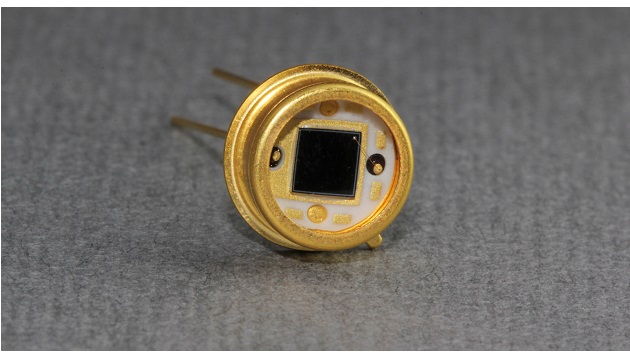
Marktech Optoelectronics, Inc. (Marktech), a privately-held and veteran-owned designer and manufacturer of standard and custom optoelectronics components and assemblies, including UV, visible, near-infrared (NIR), and short wavelength infrared (SWIR) emitters, detectors, InP epiwafers and other materials, announced the global market introduction of its Series 4 UV-enhancement process for PIN photodiodes.
The new Series 4 process allows for the optimization of Marktech PIN photodiodes for accurate, effective measurements in both the UV and blue-green spectral ranges, or at 365 nm (0.22 A/W), as well as over a wavelength range of 300 nm to 1100 nm. The process further allows the Series 4 to offer high sensitivity, low noise, low dark current, low capacitance and long-term stability against UV and Gamma radiation exposures.




Standard Series 4 UV-enhanced PIN photodiodes from Marktech are available with customer choice of either a TO-46 (3-pin) or TO-5 (2-pin and 3-pin) metal can package. Small-to-medium sized quantities are typically available with 24-hour shipment from stock via Marktech’s longtime distribution partner, Digi-Key Corporation. Beyond standard product, Series 4 UV-enhanced PIN photodiodes are offered with a full range of supporting LED emitter accessories, including UV, visible, and NIR types.
The Marktech LED emitters can be supplied along with Series 4 PIN photodiodes as either two separate components; or, combined into a single, seamlessly integrated package, such as a reflective switch. Most custom and hybrid designs from Marktech are available in as few as 6-8 weeks from prototype approvals and may be produced in virtually any-sized quantity, from prototype to OEM volumes. Please consult the company’s Latham, New York-based worldwide R&D center and corporate headquarters for applications assistance.
The Series 4 process allows Marktech PIN photodiodes to be specified within virtually any application where high-sensitivity, low-noise performance and long-term stability against UV and Gamma radiation levels are required. Typical applications include, though are not limited to, color meters, currency authentication, photometry, spectroscopy equipment, analytical systems, and fluorescence. All Series 4 UV-enhanced PIN photodiodes are 100% designed, developed, and manufactured in the USA. Units are both REACH and RoHS compliant.

