
National Instruments (NI) announced the PXIe-4163 high-density source measure unit (SMU), which provides six times more DC channel density than previous NI PXI SMUs for testing RF, MEMS, and mixed-signal and other analog semiconductor components.
“Highly disruptive technologies like 5G, the Internet of Things and autonomous vehicles place continued pressure on semiconductor organizations to evolve and adopt more efficient approaches to semiconductor test – from the lab environment to the production floor,” said Eric Starkloff, NI executive vice president of global sales and marketing. “Semiconductor test is a strategic focus for NI. We are extending the capabilities of our software platform and PXI, exemplified by our newest PXI SMU, to help chipmakers address their top challenges.”




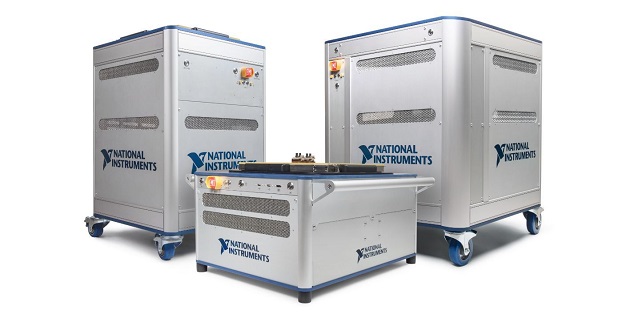
Chipmakers have rapidly adopted the Semiconductor Test System (STS) for its throughput, performance at cost and footprint on the production floor. The new PXIe-4163 SMU further complements these capabilities. It delivers increased DC channel density for higher parallelism in multisite applications and lab-grade measurement quality in a production-ready form factor. Engineers can take advantage of this combination to use the same instrumentation in the validation lab and the production floor, which reduces challenges with measurement correlation and shortens time to market.
Engineers can use the new PXIe-4163 SMU in either STS configurations or stand-alone PXI systems. Key product features include:
- Up to 24 channels in a single PXI Express slot
- +/- 24 V per channel
- Up to 100 mA source/sink per channel
- 100 pA current sensitivity
- Up to 100 kS/s sampling rate and update rate
- SourceAdapt for minimizing overshoot and oscillations
- Interactive configuration and debug software
- Up to 408 high-precision SMU channels in a single PXI chassis (4U of rack space)
- Fully supported in the STS including system-level cabling, calibration and pin-mapping support
Introduced in 2014, the STS offers a fundamentally different approach to semiconductor production test. It is based on the NI PXI platform that enables engineers to build smarter test systems. The PXI platform includes 1 GHz-bandwidth vector signal transceivers, fA-class SMUs, TestStand industry-leading commercial-off-the-shelf test management software and more than 600 PXI products ranging from DC to mmWave.
For more information on STS, visit ni.com.

