

AI: Fear of the unknown
These findings can be traced to a basic misunderstanding of AI by consumers. Seventy-two percent confidently claimed they understand AI, but far fewer could correctly define what it is or what it can do. For example, relatively few knew AI has the basic ability to interpret or understand speech (37 percent) or mimic humans (35 percent), while only half could identify some of the most common AI capabilities, like solving problems (50 percent) and learning (57 percent).




Demystifying AI
These misperceptions are important because the study shows they have a negative effect on consumers’ openness to using AI. The data shows consumers are significantly more comfortable with AI if they think they have previously been exposed to it. Only one quarter (25 percent) of the people who report no AI experience feel at ease with businesses using AI to engage with them. But for AI veterans, this number jumps to 55 percent – a full 30 points higher.
Signs of optimism
Somewhat contradictory to all of this, consumers also express optimism in the power of AI.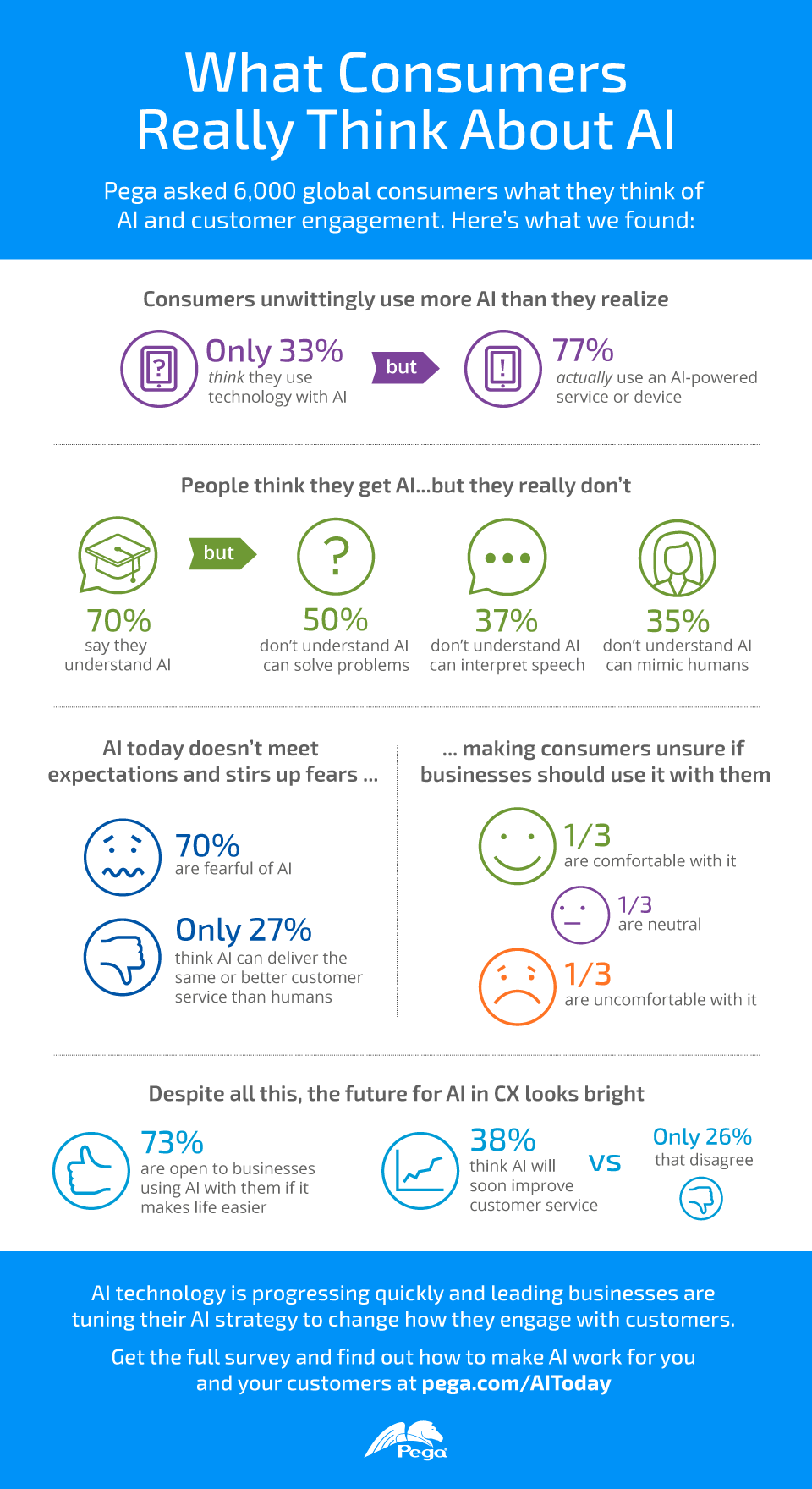 Nearly 70 percent say they want to experience more AI if it will help make their lives easier. Taken together, the survey results suggest businesses should be more transparent about the fair and pragmatic use of AI in their products and services. Companies should find non-threatening ways to expose customers to its benefits to change their misperceptions and establish trust and comfort over time.
The survey also highlighted some differences by gender and generation. For example:
- More men think they understand what AI is (80 percent) than women (66 percent). However, more women correctly identified that Siri (60 percent) and Alexa (43 percent) are powered by AI than men (54 percent and 38 percent, respectively).
- While those 55 and older are generally less comfortable with AI than millennials (ages 18-24), they are also surprisingly less fearful of AI consequences – 30 percent of baby boomers expressed no fears compared to 22 percent of millennials.
The report surveyed consumers across the US, Britain, France, Germany, the Netherlands, and Australia. To download the complete report, “What Consumers Really Think About AI: A Global Study,” go to http://www.pega.com/ai-survey.

