
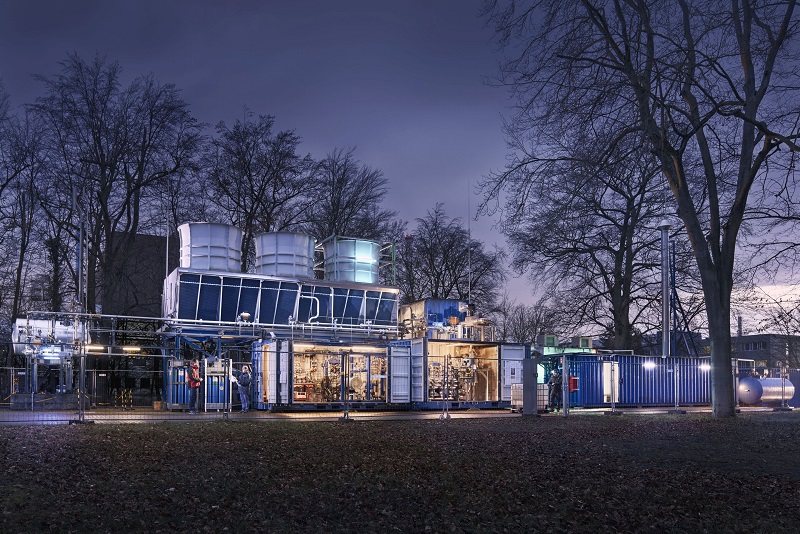
Low-Temperature heat in the form of waste heat from industry or geothermal power plants offers big potential for sustainable and need-tailored power supply. The Modular Low-Temperature Cycle Karlsruhe (MoNiKa), the only research facility of this kind in Europe, has now started operation at Karlsruhe Institute of Technology (KIT). Work is aimed at enhancing efficiency and environmental compatibility of the conversion of excessive heat into electric power by means of the organic Rankine cycle (ORC).
In the past years, Low-temperature heat gained importance for efficient electricity generation with low CO2 emissions. Instead of releasing excessive heat into the environment, it makes more sense to use it and to produce electricity from it. So-called ORC facilities are used to convert heat with a temperature below 200°C into electricity for private households. These facilities are based on the organic Rankine cycle, a process named after the British founder of thermodynamics, William John Macquorn Rankine, and mainly used in geothermal power0 plants.




It is a fluid-steam cycle, in which fluid is circulated and heated under pressure increase until it evaporates. The hot steam is passed to a turbine that reduces pressure and temperature and converts it into kinetic energy and electricity. The boiling point of water under pressure is several hundred degrees. This is far higher than what can be supplied by a low-temperature source, such as geothermal heat. For this reason, the ORC process uses other fluids as working media than a coal-fired power plant.
Strategies to Enhance the Efficiency of ORC Facilities
So far, the efficiency or power yield from excessive heat of ORC facilities has been in the range of 10 to 15 percent only. KIT researchers now want to develop new strategies to enhance the efficiency of ORC facilities and reduce their CO2 footprint. Contrary to most ORC power plants, the steam cycle of MoNiKa is operated supercritically. Regarding temperature, pressure, and density, the so-called critical point, at which a gas becomes fluid and vice versa, is exceeded. Phase transitions become smooth. “As a result, the electricity yield can be increased by 20 to 30 percent.
The modular facility includes a heating plant that simulates the source of low-temperature heat. Numerous sensors measure temperatures, pressures, and flow rates for comparing operation data with model calculations and improving prognosis quality. On this basis, researchers plan to analyze and optimize central components, such as the heat exchanger or the innovative hybrid capacitor, to enhance their energy efficiencies and environmental compatibilities. Work is also aimed at reducing or preventing leaks of the cycle.

