

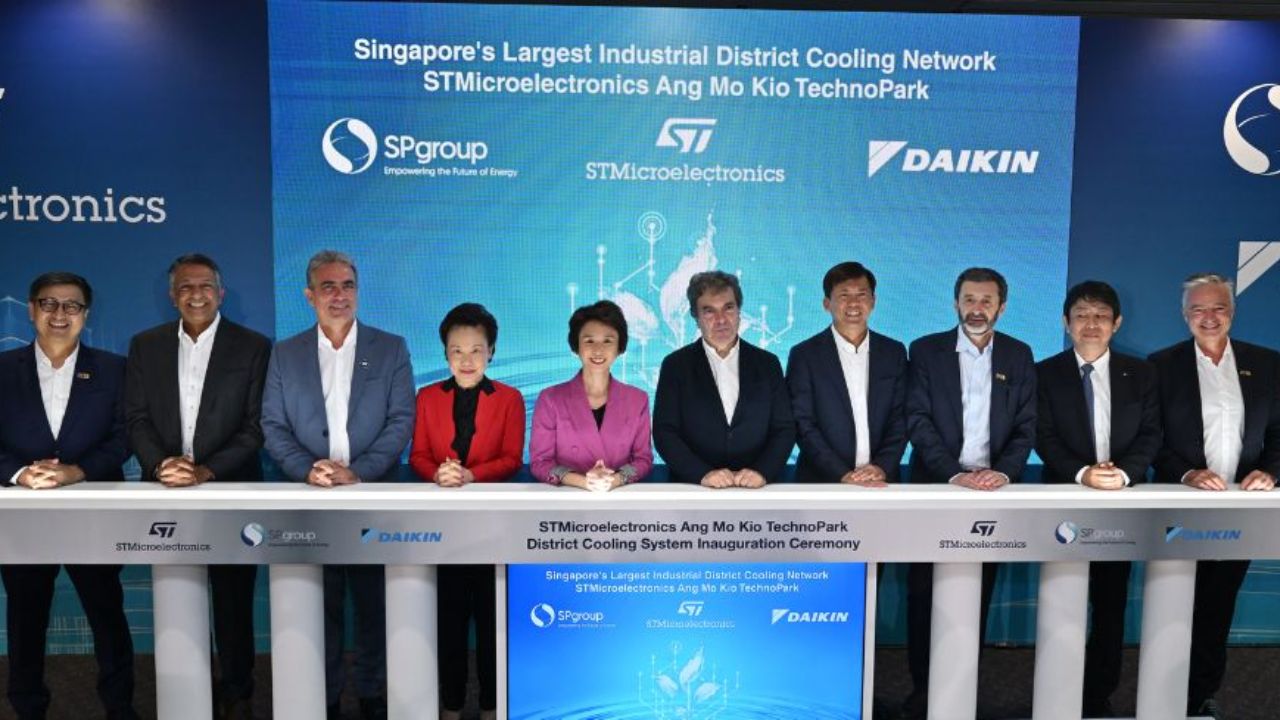
The District Cooling System at ST’s Ang Mo Kio (AMK) TechnoPark is operational and on time. Ms. Low Yen Ling, Senior Minister of State, Ministry of Trade and Industry & Ministry of Culture, Community and Youth, who joined ST in announcing this project in 2022, now took part in the inauguration ceremony. This launch is a critical milestone in ST’s goal to achieve carbon neutrality by 2027, and to work with local partners while also serving the communities as we move toward this sustainability objective.
Why a District Cooling System?
Composition of a District Cooling System
In a DCS, one plant cools water before sending it to a network of underground pipes that serve various buildings. The system thus pools resources to increase efficiency, reduce environmental impacts, and save space. Buildings no longer need chillers, saving power and maintenance costs thanks to the central plant. Moreover, a loop sends the water back to the plant to cool it again. The main plant also stores water. Cooling therefore can happen during off-peak periods to improve the efficiency.



According to the Encyclopedia of Energy, the first significant DCS project dates back to 1962 and was installed in the United States. The technology garnered some interest in the 70s before subsiding. DCS became popular again in the 90s as regulators mandated chlorofluorocarbons (CFC) reduction. And now, district cooling systems gain new grounds as the world looks to reduce carbon emissions and recycle water.
Why the ST Ang Mo Kio TechnoPark?
Anatomy of a Unique Project
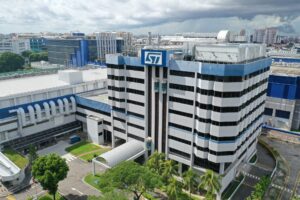
The AMK TechnoPark is ST’s largest wafer-production fab by volume. Bringing DCS to that particular site will thus have significant ripple effects. Traditionally, projects of this size target urban developments. For instance, the Deep Lake Water Cooling infrastructure in Toronto, Canada, has a similar capacity (40,000 tons), but the distribution network covers a chunk of the downtown area. The ST and SP Group infrastructure is thus unique because it’s one of the first at such a scale to cool an industrial manufacturing plant. It is also a first in the semiconductor industry. Most projects from competing fabs retrofit new chillers. With this new DCS, ST can re-purpose the space in favor of something much more efficient.
The project will cost an estimated USD 370 million, including the construction of the central cooling plant right next to the TechnoPark. Beyond energy savings, removing chillers within the ST plant will free up space for other environmental programs. For instance, the AMK site is looking at water conservation and solar panels, among other things. The SP Group should start construction of the central plant this year and is committed to managing the project for at least the next 20 years. Singapore also hopes that this project will inspire other companies. As Ms Low Yen Ling, Minister of State, Ministry of Culture, Community and Youth & Ministry of Trade and Industry stated, “I hope this initiative will inspire many more innovative decarbonization solutions across other industrial developments, and spur more companies to seek opportunities in sustainability.”

