
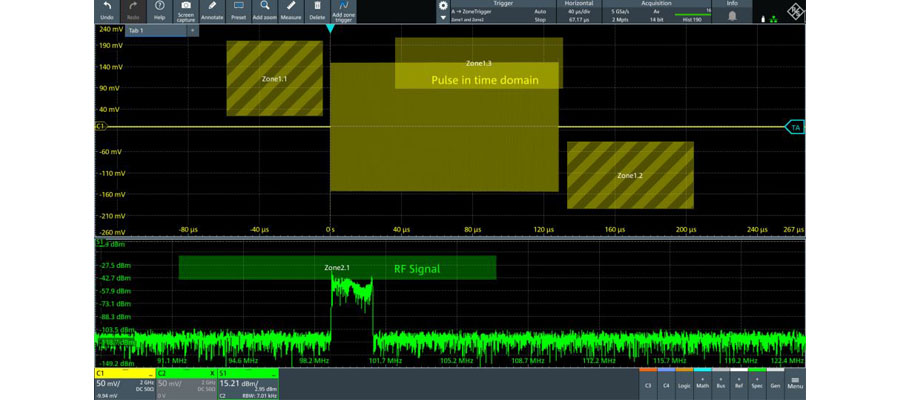
Rohde & Schwarz further strengthens its oscilloscope portfolio by introducing the industry’s first ASIC–based zone triggering. With this new approach, the MXO series can offer the world’s fastest zone trigger update rate of up to 600.000 waveforms per second and less than 1.45 us blind time between trigger events. It is up to 10 000 faster than competitive zone triggering offerings. Thanks to the new ASIC–based zone triggering, MXO oscilloscopes can precisely isolate events where traditional triggering does not provide the needed flexibility.
Rohde & Schwarz has developed the industry’s first ASIC–based zone triggering, implemented in the new MXO series oscilloscopes. This new functionality enhances the oscilloscopes’ ability to precisely isolate events that are difficult or impossible to detect with traditional oscilloscope triggers. Furthermore, the MXO zone trigger implementation is the industry’s fastest, surpassing others by several orders of magnitude.




Traditional oscilloscope trigger types – such as edge triggering – are often difficult to set up and/or inadequate to visualize certain trigger events. Zone triggering, on the other hand, allows users to specify trigger conditions by drawing one or more zone areas on the instrument’s display. The oscilloscope then inspects each acquisition for these conditions and shows the acquisitions on the display for events that meet the graphical conditions. If an event does not meet the graphical conditions, the waveform is discarded and not shown. Zone triggering can be very effective for triggering on non-monotonic edges, serial bus patterns, math waveforms, events across multiple channels, and events in the frequency domain. For these use cases traditional oscilloscope triggers simply do not work. The new zone triggering from Rohde & Schwarz is the world’s first ASIC–based solution that works on analog channel signals, math and spectrum.
Philip Diegmann, Vice President Oscilloscopes at Rohde & Schwarz, says: “The next-generation MXO-EP processing ASIC technology developed by Rohde & Schwarz is the foundation of the breakthrough signal visibility and user responsiveness of the MXO series. The chip design was laid out to have further hardware acceleration capabilities enabled down the road. This way we keep providing new functionalities to our oscilloscope customers never before seen in the industry. With MXO zone triggering, users obtain additional triggering capabilities without having to incur significant trigger blind times that historically have diminished the value of software-based zone triggering solutions.”
With the MXO zone triggering, users testing and debugging in the frequency domain using an oscilloscope can now draw specific zone areas. The oscilloscope will then trigger or activate when a certain tone exceeds a set power level within these zones. Or users can simply draw a zone for RF chirps or pulses. New to the industry is the MXO’s free run mode, where the oscilloscope captures as fast as possible without looking for an edge trigger event. Combining this with zone triggering can be very effective for power integrity measurements and EMI debug.
MXO zone triggering incorporates a new feature previously not found in the market: the ability to exclusively store waveforms in real time that match zone trigger criteria. This functionality enables users to exclusively focus on specific events relevant to their application.
Rohde & Schwarz offers the new ASIC–based zone triggering functionality as a standard feature for all MXO 4, MXO 5, and MXO 5C series oscilloscopes, beginning with version 2.2 firmware. The firmware is available as a free download on the web. Existing MXO users can update their instruments for free.

