
Electronic devices, including smartphones and tablet portable computers, are becoming increasingly advanced and compact. As their performance increases and their size decreases, these devices generate more heat, which can reduce their safety and cause them to break.
In recent years, engineers have thus been trying to develop strategies that could prevent electronics from overheating. One proposed solution entails the use of heat spreaders and layers that promote the spread and dissipation of heat inside devices.




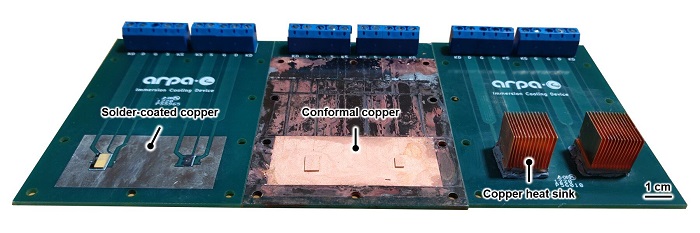
Researchers at the University of Illinois at Urbana-Champaign and the University of California, Berkeley (UC Berkeley) have recently devised an alternative strategy that could cool electronics more efficiently than other existing solutions. Their strategy, introduced is based on the use of heat spreaders comprised of an electrical insulating layer of poly (2-chloro-p-xylylene) (Parylene C) and a coating of copper.
“Our recent paper was the culmination of our efforts to produce coating heat spreaders for high-efficiency electronics cooling,” Tarek Gebrael, one of the researchers who carried out the study. “The motivation was to enable effective heat dissipation from power-dense electronics.”
Heat spreaders are cooling systems comprised of materials with high thermal conductivity, such as copper and aluminum. These systems can spread the heat generated by the devices across a larger surface area, making it easier for them to dissipate heat into the surrounding environment.
“The advantage of using our conformal coating heat spreaders is that they cover the electronic device entirely, including the top, bottom, and sides of the device,” Gebrael explained. “This is impossible with standard heat spreaders which are usually added on top of the device or with standard PCB copper planes. By achieving those conformal coatings, we were able to provide more routes for the heat to leave the electronic device, which translates into a better cooling performance.”
In the past, teams had developed similar techniques that prevent overheating by opening more “routes” for heat to leave electronic devices. Previously proposed solutions, however, utilize very expensive materials, such as diamonds. This makes them difficult to develop and implement on a large scale.
Gebrael and his colleagues evaluated their copper coated-heat spreaders in a series of tests and found that they performed extremely well. Specifically, their solution achieved up to a 740% increase in the power per unit volume compared to standard air-cooled copper heat sinks used today.
“This remarkable result derives from our spreaders’ effectiveness in dissipating the heat, as well as the compact volume they occupy when applied on printed circuit boards,” Gebrael said. “This feature enables fitting more electronics in a smaller space without overheating issues, which is essential to create the platforms of future technologies (AI, augmented reality, etc.).”
In the future, the heat spreaders developed by this team of researchers could be used to cool down electronic devices more efficiently, without requiring expensive materials. Notably, the coating recipe they proposed combines processes that are already in use in the electronics industry. This could further facilitate its application in real-world settings and its commercialization.
“We are now investigating the reliability and durability of our coatings in specific environments (boiling water, boiling dielectric fluids, thermal cycling, and high-voltage environments) for long periods of time,” Gebrael added. “We want to make sure that our coatings retain their superior cooling performance. We are also implementing the coatings with full-scale power modules and GPU cards, whereas we used only simple test boards in the initial work.”

