
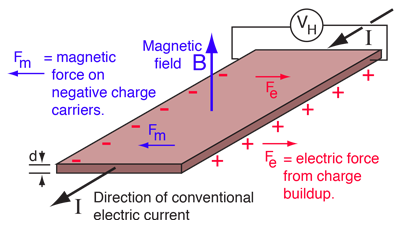
The Hall Effect is a physical phenomenon discovered by Edwin Hall in 1879. It describes the generation of a voltage difference (called the Hall voltage) across an electrical conductor when a magnetic field is applied perpendicular to the flow of electric current.
Hall Effect Principle
The Hall effect principle states that when a current-carrying conductor or semiconductor is placed in a perpendicular magnetic field, a voltage can be measured at a right angle to the current path.




How it Works
1. When a current-carrying conductor or semiconductor is placed in a magnetic field, the magnetic field exerts a force on the moving charge carriers (electrons or holes).
2. This force (called the Lorentz force) causes the charge carriers to accumulate on one side of the conductor, creating a voltage difference across the conductor.
3. This voltage is known as the Hall voltage, and its presence is the essence of the Hall Effect.
Key Components
– Current: Flowing through the conductor.
– Magnetic Field: Applied perpendicularly to the current.
– Hall Voltage: The measurable voltage generated across the conductor.
Applications of the Hall Effect
1. Magnetic Field Sensing:
– Hall Effect sensors detect the presence, strength, and direction of a magnetic field.
– Used in position sensing, speed detection (e.g., automotive wheel speed sensors), and current sensing.
2. Proximity Sensors:
– Hall sensors can detect the approach of magnetic objects without physical contact.
3. Current Measurement:
– Hall Effect sensors are used to measure current in conductors without interrupting the circuit.
4. Automotive Applications:
– Found in crankshaft position sensors, ABS braking systems, and electric power steering systems.
5. Brushless DC Motors:
– Hall sensors detect rotor position, enabling precise control of motor operation.
6. Semiconductor Applications:
– Helps in understanding properties of materials like charge carrier type (electrons/holes), carrier concentration, and mobility.
Hall Effect Theory and Formula
When a conductive plate is connected to a circuit powered by a battery, an electric current begins to flow through it. The charge carriers, such as electrons in a conductor, initially follow a straight path from one end of the plate to the other. This movement of charge carriers produces a magnetic field around them.
If an external magnet is placed near the conductive plate, its magnetic field interacts with the field created by the charge carriers, disturbing the straight path of their motion. The force responsible for altering the direction of the charge carriers is called the Lorentz force.
As a result of this force, the negatively charged electrons are deflected toward one side of the plate, while the positively charged holes move toward the opposite side. This separation of charges generates a potential difference between the two sides of the plate, which is known as the Hall voltage (\( V_H \)). This voltage can be measured using a meter.
The formula for Hall voltage is expressed as:
\[
V_H = \frac{IB}{nqd}
\]
Where:
– I is the current flowing through the sensor,
– B is the strength of the external magnetic field,
– n is the number of charge carriers per unit volume,
– q is the charge of each carrier, and
– d is the thickness of the conductive plate (sensor).
This principle forms the basis of the Hall Effect, widely used for measuring magnetic fields, current, and position in various applications.
Summary
The Hall Effect is the basis of many modern magnetic field sensors and current-measuring devices. It is crucial in industrial, automotive, and consumer electronics applications due to its accuracy, reliability, and non-contact sensing capabilities.

