

Courtesy: Synopsys
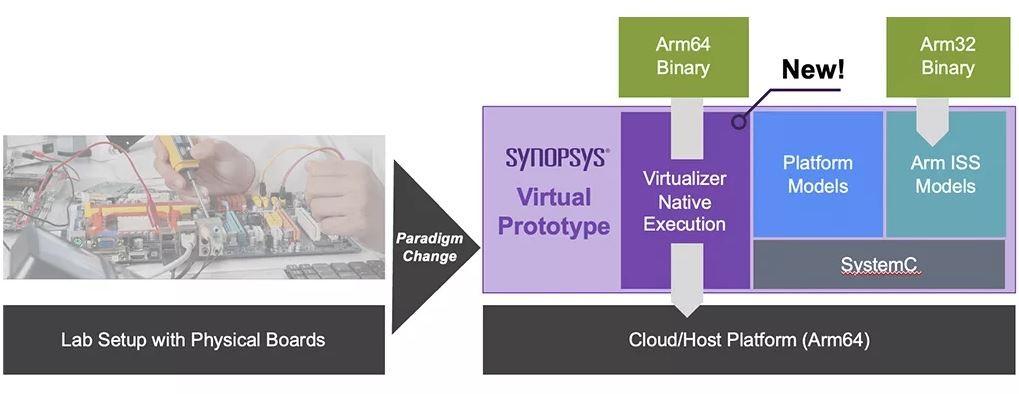
We’re excited to announce Virtualizer Native Execution for Arm-based machines. This groundbreaking virtual prototyping technology will transform how software is developed for edge devices and applications — particularly in the automotive, HPC, IoT, and mobile industries.




Virtualizer Native Execution enables a paradigm shift in edge-focused software development via improved:
- Simulation performance. Virtualizer Native Execution significantly boosts the performance of virtual prototypes — speeding up software development, debugging, and testing.
- Development productivity. Virtualizer Native Execution leverages cloud-native approaches to enhance productivity, reduce toolchain silos, and make modern development workflows more accessible for embedded software engineers.
Extending the industry-leading virtual prototyping solution to the Arm ecosystem
The market-leading virtual prototyping solution with the largest library of models and IP,Virtualizer enables developers to work with virtual prototypes of target hardware instead of physical setups that are location-dependent and difficult to scale.
Virtualizer Native Execution extends the complete Virtualizer tool suite to the Arm ecosystem, allowing virtual prototypes to be built, executed, and tested directly on Arm-based machines. And because it can be leveraged across development and computing environments — on-premises, in the cloud, and at the edge — it eliminates toolchain and workflow silos and helps increase development flexibility and agility.
Virtualizer Native Execution significantly boosts development speed and efficiency via:
- Native execution. Instead of simulating the target hardware’s CPU on an Instruction Set Simulator (ISS), Virtualizer Native Execution enables virtual prototypes to be executed directly on the host CPU. This significantly reduces boot times (from 20 minutes to tens of seconds for a typical Android boot).
- Scalability. Modern Arm host machines offer more than 96 cores, and Virtualizer Native Execution can directly map each core of the virtual system-on-chip (SoC) to a physical core to greatly accelerate prototype performance.
Supporting the increased adoption and development of Arm-based systems
Arm-based CPUs have long dominated the mobile market, and in recent years they’ve been increasingly used for automotive, IoT, consumer, and other edge-based applications. Those in the cloud and HPC markets have also embraced Arm CPUs and IP, which provide an alternative to traditional x86-based solutions and deliver exceptional performance, power, and cost benefits.
This widespread adoption is leading to greater alignment and uniformity of the CPUs and toolsets being used across on-premises, cloud, and edge environments. Often referred to as Instruction Set Architecture (ISA) parity, this uniformity provides new opportunities to streamline development efficiency and flexibility.
Virtualizer Native Execution supports the increased adoption and development of Arm-based solutions and takes advantage of ISA parity to supercharge software development and edge innovation.
Combining virtual prototyping with hardware-assisted verification (HAV)
Virtualizer Native Execution also supports hybrid emulation, which combines the unique strengths of virtual prototyping and hardware-assisted verification (HAV). Tightly integrated with Synopsys HAV solutions, Virtualizer Native Execution supports hybrid setups where the CPU subsystem is virtualized and the rest of the device under test (DUT) is emulated. And because it eliminates ISS overhead and runs natively on the host CPU, Virtualizer Native Execution is able to keep up with the fastest emulation systems (including the new ZeBu-200).The speed and scalability of Virtualizer Native Execution also enable new emulation use cases, like application-driven performance and power validation.
Taking embedded software development to the cloud
Developing embedded software for edge devices has long been a fragmented process involving complicated lab setups, delicate test boards and cables, and disparate toolsets. Not only has this hindered efficiency and scalability, but it has prevented the adoption of modern, agile development processes.
With Virtualizer Native Execution, developers can:
- Build and scale CI/CD pipelines in the cloud.
- Take advantage of higher performance and throughput as well as faster boot times.
- Replicate and align virtual prototypes across development and operating environments — on-premises, in the cloud, and at the edge.
Virtualizer Native Execution for Arm marks a significant leap forward in edge-focused software development. With better performance and scalability, native execution on Arm-based machines, and cloud-to-edge parity, developers can supercharge their virtual prototyping workflows.

