

Courtesy: Dr. Harilal Bhaskar, Chief Operating Officer (COO) and National Coordinator at I-STEM (Indian Science Technology and Engineering facilities Map) under the Office of Principal Scientific Adviser (P.S.A.) Government of India.
When Talent Meets Infrastructure



In a small university town in Bihar, a student dreams of designing renewable energy systems. She excels at theory and design, yet her laptop freezes during large-scale MATLAB simulations. In Andhra Pradesh, a doctoral scholar struggles to check her thesis against plagiarism databases because her institution lacks adequate licenses.
Meanwhile, across the world, peers in the United States, Europe, and China train artificial intelligence models on GPU clusters, run exascale climate simulations, and test quantum algorithms. The difference is not in talent—it is in infrastructure.
Innovation today is constrained not by ideas but by access to computing power. India’s researchers, start-ups, and students face uneven access to high-performance computing (HPC), AI platforms, and quantum resources. This gap threatens to widen inequality and slow national progress.
The Vision: A National Digital Commons
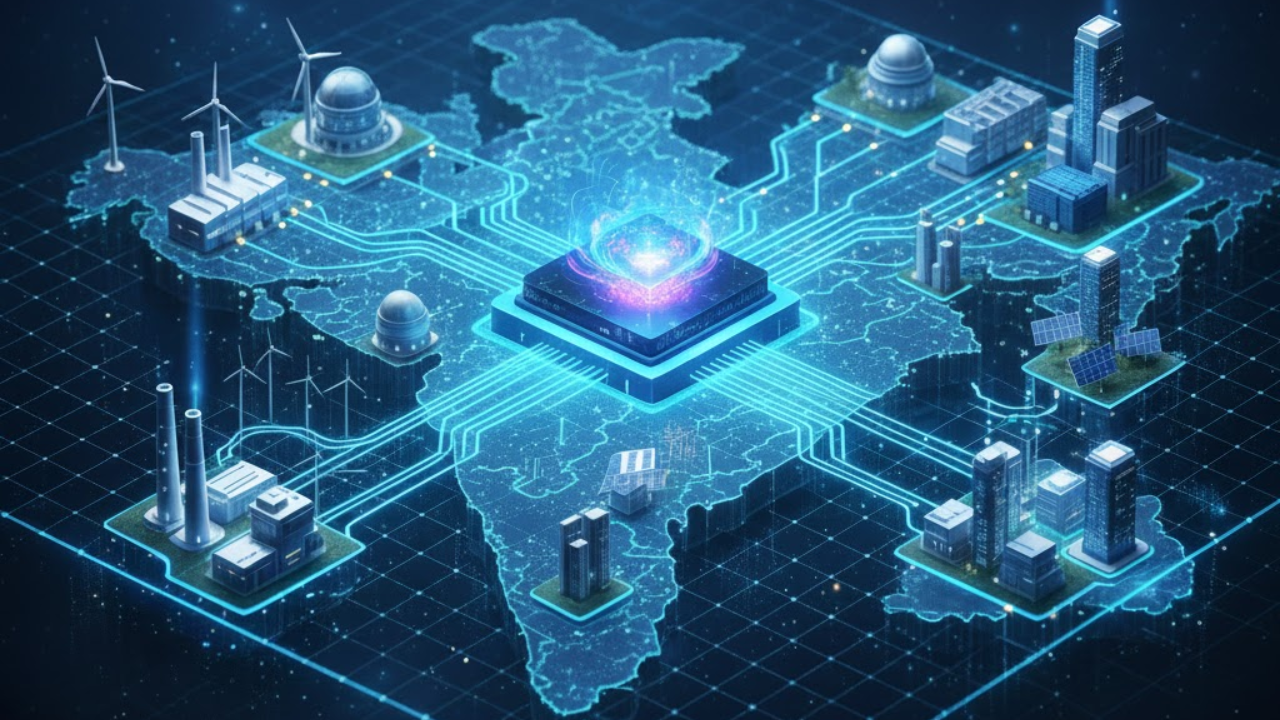
India’s answer is a federated national compute grid—a seamless network connecting supercomputers, AI labs, and emerging quantum facilities. Instead of duplicating procurement, ultra-expensive research platforms such as ANSYS Enterprise Suite, Dassault BIOVIA/SIMULIA, Schrödinger Drug Discovery, or quantum-grade simulation packages like VASP could be shared through centralized national licenses, reducing million-dollar expenditures while ensuring equitable access for researchers across domains.
Imagine the possibilities:
- A climate scientist in Assam running continental-scale simulations on a Bengaluru supercomputer.
- A linguist in Nagaland applying AI-powered text analytics without local infrastructure.
- A start-up in Pune experimenting with quantum testbeds via a national portal.
Such an ecosystem transforms access from privilege to commons, ensuring geography or budget does not decide opportunity.
Why Now: The Strategic Imperative
The global race for computational power is accelerating:
- United States: The NSF and Department of Energy provide access to some of the world’s fastest AI and supercomputing resources.
- European Union: The EuroHPC initiative builds exascale-ready systems while fostering cross-border collaboration.
- China: National HPC and quantum centres are aligned with industrial strategy and defence priorities.
India cannot afford fragmented approaches. A One Nation–One Compute Grid would unify HPC clusters, AI labs, quantum resources, and software licenses into a scalable, efficient national framework.
Current status underscores urgency: India’s most powerful system, PARAM Siddhi-AI, ranks only around 60th globally, far behind US and Chinese peers. Under the National Supercomputing Mission, 18 HPC systems have been deployed, but gaps remain in accessibility, GPUs, and quantum nodes. Without scale and coordination, India risks lagging behind in AI-driven innovation.
A National HPC–AI–Quantum Portal
Modern research in genomics, climate science, or AI requires resources far beyond individual labs. A National Compute Portal could:
- Catalogue available compute clusters, GPUs, and quantum nodes.
- Provide automated scheduling for resource booking.
- Allow priority allocation for urgent national missions (pandemic modelling, energy transition).
- Embed AI-guided support for booking and troubleshooting.
- Supply policymakers with dashboards for monitoring usage, efficiency, and outcomes.
This portal would serve as the command centre of India’s scientific computing ecosystem.
Building Skills and Human Capital
Infrastructure without skilled manpower risks underutilization. Alongside the portal, India must:
- Expand HPC/AI training programs in IITs, NITs, and universities.
- Develop quantum algorithm bootcamps for researchers and start-ups.
- Create national fellowships for AI-HPC specialists to ensure talent pipelines.
This ensures that the grid is not just available, but also actively and effectively used.
AI Labs, Industry Integration, and Regional Balance
HPC thrives when connected to broader ecosystems:
- Start-ups can test AI or quantum algorithms without heavy capital costs.
- Universities and national labs can pool datasets and compute power.
- Sector-specific labs—in health, climate, finance, cybersecurity—can run experiments at scale with real-world impact.
Equity must be central:
- Tier-2 and Tier-3 cities should gain equal access through the portal.
- Incentives must support rural and state universities, ensuring inclusion beyond elite IIT/IISc clusters.
Here, HPC and AI infrastructure are the engines, while software serves as a supporting layer.
Governance, Security, and Funding Models
A unified system requires layered governance:
- Central Government: anchor investments, negotiate national licenses, and set mission priorities.
- Institutions: contribute idle compute cycles and avoid duplication.
- Industry and CSR programmes: co-invest in AI accelerators, GPUs, and quantum nodes.
- Oversight: embed cybersecurity, fair-use policies, and ethical AI standards.
Security and sovereignty must be priorities:
- Strong encryption and access controls.
- Safeguards for genomic, financial, and citizen datasets.
- Alignment with India’s Digital Personal Data Protection Act (DPDPA, 2023).
Funding pathways could include:
- Public–private partnerships for data centres.
- Corporate CSR support for compute nodes.
- A “compute credit” model, where researchers and start-ups receive national cloud-like credits.
Learning from Global Models
- United States: Federated HPC networks maximize scale and reach.
- European Union: Cross-border HPC integration builds resilience and efficiency.
- China: Strategic placement of HPC and quantum centres accelerates industrial outcomes.
India can draw from all three—combining scale, inclusivity, and strategic alignment—into one unified ecosystem.
Sustainability and Green Computing
HPC centres are energy-intensive. To align with India’s climate commitments, the grid should:
- Use renewable-powered data centres.
- Incentivize energy-efficient GPUs and low-carbon quantum hardware.
- Deploy AI to optimize energy scheduling and cooling.
This ensures that innovation does not come at the cost of sustainability.
Global Collaboration
A national compute grid strengthens India’s role in global alliances:
- Participation in BRICS quantum/HPC research.
- Collaborations with the QUAD on AI standards.
- Bilateral HPC/quantum projects with partners like Japan, US, and EU.
India’s unified grid would make it a preferred partner in global science and innovation diplomacy.
The Payoff: Democratization and Innovation
A One Nation–One Compute Grid would:
- Democratize access to HPC, AI, and quantum platforms.
- Accelerate patents, research output, and industrial prototypes.
- Strengthen academic integrity with AI-powered plagiarism detection.
- Optimize the National Supercomputing Mission and quantum initiatives.
- Cut redundant spending on licenses and infrastructure.
- Empower start-ups, SMEs, and industry to innovate at scale.
- Ensure balanced regional development and global competitiveness.
The outcome is a knowledge republic, where innovation flows from ideas—not from institutional budgets or geography.
Conclusion: Building the Knowledge Republic
India has already transformed governance and finance with Aadhaar and UPI. The next frontier is research infrastructure.
A One Nation–One Compute Grid—anchored in HPC, AI labs, and quantum computing, and strengthened by shared software, skilled manpower, and green sustainability—can redefine India’s place in global innovation.
The real question is not whether India can build this system.
The question is: Can India afford not to?

