

Courtesy DefTech Bharat & DefTech Con Knowledge Desk
Future wars will be won not only by superior weapons, but by superior sensing, networking, electronic dominance, and AI-driven decision-making across the electromagnetic spectrum.



The future battlefield will be defined not merely by firepower but by dominance of the electromagnetic spectrum. Across the world, military planners are investing heavily in electronic warfare (EW), artificial intelligence, software-defined systems, autonomous platforms, and resilient communications. For defence electronics engineers, this transformation presents an unprecedented opportunity to develop agile, intelligent, and rapidly deployable systems capable of operating in highly contested environments.
Recent military operations have demonstrated that information superiority and electronic dominance can determine mission success before the first kinetic strike is launched. The growing convergence of electronic warfare, advanced semiconductors, cognitive computing, and network-centric operations is reshaping how next-generation defence systems are designed.
The Electronic Battlefield Has Changed
Traditional electronic warfare systems were largely platform-centric, consisting of dedicated radar warning receivers, jammers, communication intercept systems, and electronic countermeasures operating independently. Today’s battlefield is radically different.
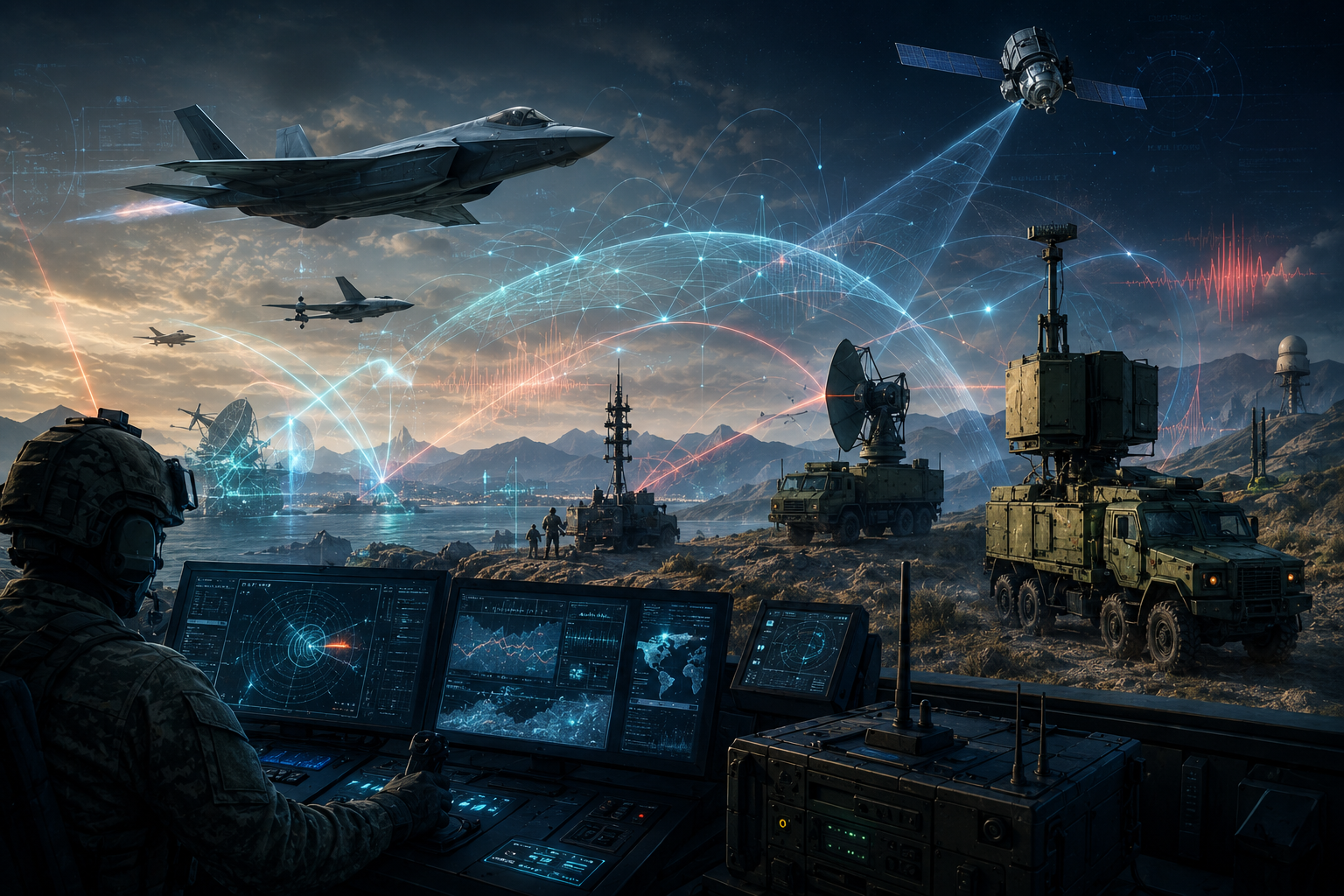
Modern EW is increasingly becoming a “system-of-systems” architecture where satellites, drones, radars, communication networks, command centers, and autonomous platforms work together as a unified electronic ecosystem.
This shift allows military forces to sense, decide, and act faster than their adversaries. The ability to identify a threat, process intelligence, distribute information, and launch a response within seconds has become a decisive advantage.
For design engineers, the challenge is no longer building standalone equipment but creating modular, networked systems capable of functioning as part of a larger digital battlespace.
Operation Sindoor: A Lesson in Modern Electronic Warfare
India’s Operation Sindoor demonstrated the growing importance of electronic warfare, intelligence fusion, and precision targeting in modern military operations.
While many operational details remain classified, publicly available assessments indicate that the operation reflected a high degree of integration between surveillance systems, communication networks, precision-guided weapons, and command-and-control architectures.
The success of such operations depends heavily on several electronic warfare capabilities:
- Real-time intelligence gathering
- Electronic support measures (ESM)
- Radar and communication signal monitoring
- Secure data networks
- Precision navigation and targeting
- Integrated command systems
The operation highlighted a critical reality of modern warfare: victory increasingly depends on controlling information and the electromagnetic spectrum.
Modern military forces are now investing heavily in systems that can detect enemy emissions, disrupt hostile communications, protect friendly networks, and maintain operational effectiveness even under electronic attack.
Gallium Nitride: The Foundation of Next-Generation RF Systems
One of the most significant advances in defence electronics is the adoption of Gallium Nitride (GaN) semiconductor technology.
Traditional radar and electronic warfare transmitters relied on traveling-wave tubes and other vacuum-tube technologies that required large cooling systems and bulky infrastructure.
For defence designers, this translates directly into reduced Size, Weight, Power, and Cost (SWaP-C).
Modern Active Electronically Scanned Array (AESA) radars, airborne jammers, counter-drone systems, and electronic attack platforms increasingly rely on GaN technology to achieve higher performance within smaller form factors.
The result is the ability to deploy powerful electronic warfare capabilities on tactical vehicles, unmanned systems, and even portable soldier-carried platforms.
Cognitive AI: The New EW Operator
Conventional electronic warfare systems depend on predefined threat libraries. However, modern adversaries employ agile waveforms, frequency hopping, low-probability-of-intercept communications, and adaptive radar systems.
To counter these threats, defence engineers are embedding artificial intelligence directly into EW platforms.
Once a signal is identified, the system can automatically generate optimal jamming, spoofing, or deception strategies without requiring human intervention.
The future electronic battlefield will increasingly be fought by autonomous systems capable of learning and adapting in real time.
Modular Open Systems Architecture (MOSA)
Another major trend transforming defence electronics is the adoption of Modular Open Systems Architecture (MOSA).
Historically, defence systems were highly customized and difficult to upgrade. Introducing a new capability often required extensive hardware redesign.
MOSA changes this paradigm by promoting standardized interfaces and plug-and-play architectures.
At the heart of this approach is the Software-Defined Radio (SDR).
This flexibility dramatically reduces lifecycle costs and accelerates technology refresh cycles.
As threats evolve faster than traditional procurement cycles, MOSA provides a practical path to continuous capability enhancement.
GNSS-Free Navigation: Operating When GPS Fails
One of the most important lessons from contemporary conflicts is the vulnerability of satellite navigation systems.
GPS jamming and spoofing have become routine tactics on modern battlefields.
As a result, defence designers are increasingly focusing on GNSS-independent navigation solutions.
Emerging systems combine:
- Inertial Navigation Systems (INS)
- Terrain contour matching
- Visual navigation
- RF beacon triangulation
- LTE and 5G positioning
- Sensor fusion algorithms
Artificial intelligence combines these inputs to maintain accurate positioning even when satellite signals are unavailable.
For autonomous systems, missiles, drones, and tactical vehicles, GNSS resilience is rapidly becoming a mission-critical capability.
AI-Driven SWaP-C Optimization
The pressure to reduce Size, Weight, Power, and Cost continues to influence every defence program.
Machine learning is now being used to optimize engineering trade-offs before physical prototypes are built.
AI-assisted design platforms can evaluate:
- RF chain performance
- Thermal management
- Antenna placement
- Power consumption
- Electromagnetic compatibility
- Structural constraints
Digital twin technology allows engineers to test thousands of virtual configurations, dramatically reducing development time and improving design quality.
The integration of AI into the design process is becoming as important as AI within the deployed system itself.
DefTech Bharat: Accelerating India’s Defence Innovation Ecosystem
As India’s defence technology ecosystem expands, industry platforms are playing a critical role in connecting innovators, manufacturers, startups, system integrators, armed forces, and policymakers.
DefTech Bharat is an innovation-led defence technology platform that brings together companies, engineers, startups, OEMs, and government stakeholders to showcase next-generation solutions across defence electronics, software, hardware, testing, telematics, AI, drones, quantum technologies, autonomous systems, and cyber defence. For innovators working on electronic warfare, secure communications, GaN-based RF hardware, modular SDR platforms, and GNSS-resilient navigation, it provides a timely venue to demonstrate technologies, exchange ideas, and build partnerships with the wider defence ecosystem. By combining exhibition, technical engagement, and B2B networking, DefTech Bharat positions itself as a launchpad for rapidly deployable, out-of-the-box defence solutions.
For innovators developing:
- Electronic warfare systems
- AI-enabled defence platforms
- Software-defined radios
- GaN-based RF solutions
- Counter-drone technologies
- Autonomous vehicles
- Secure communication systems
DefTech Bharat provides a valuable opportunity to demonstrate capabilities, interact with defence stakeholders, and explore collaborative development opportunities.
The platform enables technology providers to showcase working prototypes, advanced subsystems, and deployable solutions to government agencies, defence organizations, OEMs, and strategic partners.
As India pursues self-reliance in defence technologies under the Atmanirbhar Bharat initiative, such platforms serve as catalysts for innovation, commercialization, and technology transfer.

