
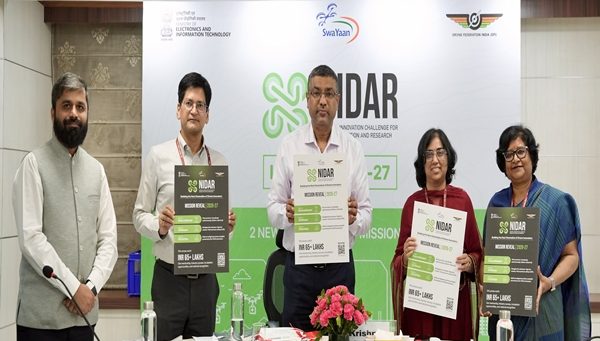
The Ministry of Electronics and Information Technology (MeitY) with Drone Federation of India, has introduced NIDAR 2.0 (2026-27) under the SwaYaan initiative to build indigenous drones and flight controllers powered by India’s homegrown VEGA
processor. This innovation reduces reliance on foreign chips, strengthen the domestic drone and electronics manufacturing ecosystem. This initiative aims to accelerate the development of next-generation unmanned aerial system (UAS) by encouraging startups, researchers, and industry to build drones using domestically manufactured electronic components.
NIDAR 2.0 stands for National Innovation Challenge for Drone Application and Research that aligns with government’s vision of Atmanirbhar Bharat, the India Semiconductor Mission (ISM), and the Designed Linked Incentive (DLI) Scheme. The goal of this hackathon is to provide a valuable opportunity for students and working professionals to build flight controller and autopilot hardware powered by India’s indigenous VEGA microchip.




According to MeitY release, NIDAR 2.0 offers a prize pool of more than 65 lakh that not only promote innovation but also supports startups, nurtures young talents, and accelerate the development of domestic drones and semiconductor technologies through incubation, technical mentorship, and industry collaboration.
Launching the challenge, MeitY Secretary S Krishnan said, “NIDAR 2.0 takes our students from just flying drones to building the drone’s brain. When the drone’s brain runs on India’s own VEGA processor, we are not just training engineers. We are laying the foundation of a self-reliant drone industry.”
The primary focus of this hackathon is to build autonomous swarm drones capable of locating survivors and delivering medical supplies in disaster-hit areas without an external communication network, and developing GPS-denied drones for indoor industrial inspection. By collaborating as a coordinated fleet, swarm drones can rapidly survey large areas, identify victims using onboard sensors and AI-based image processing, and optimizing search-and-rescue operations without relying on constant human intervention.

