HomeNewsIndia NewsPicoQuant introduces new software for the analysis of quantum correlations

    PicoQuant introduces new software for the analysis of quantum correlations

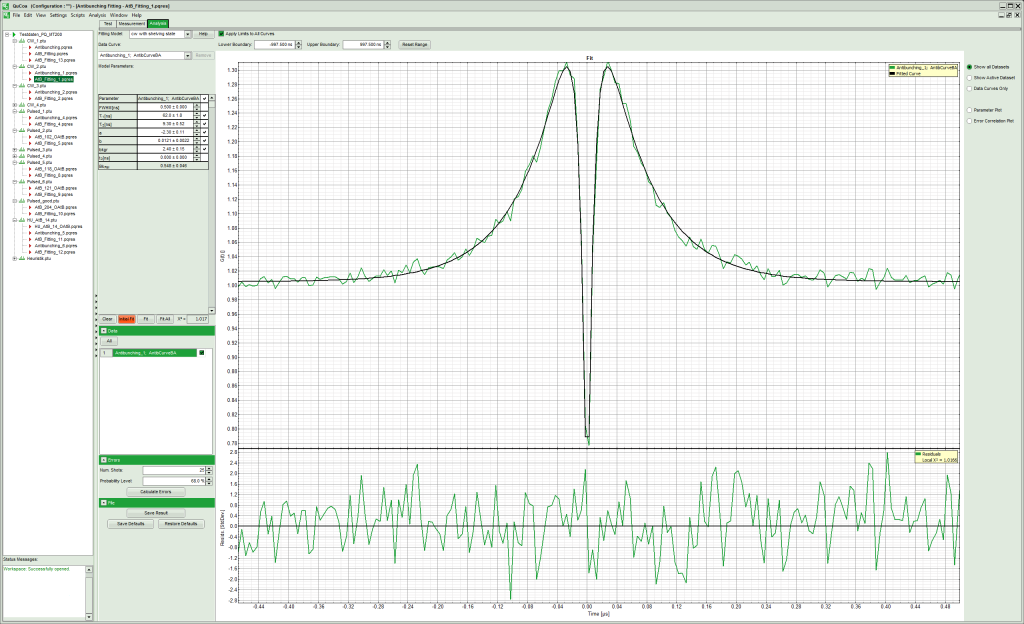
    PicoQuant has released the QuCoa software package, an integrated solution for data acquisition and analysis using the unique T2 time-tagging mode of PicoQuant’s TCSPC electronics. QuCoa is aimed at research areas relying on coincidence detection such as Hanbury-Brown-Twiss setups to study single photon sources (g(2) / antibunching), quantum key distributions (QKD), general quantum optics or the study of entanglement using Hong-Ou Mandel setups (HOM). The software offers special analysis routines for coincidence correlations as well as for coincidence counting applications.

    The QuCoa software features one of the fastest software correlators on the market for coincidence correlation, which permits to correlate the absolute arrival times of photons in real time. This allows, for example, assessing the quality of an antibunching curve already during the measurement. The g(2)(0) value and count rates on all detectors are continuously calculated and displayed. Several established models such as single emitter with or without shelved state or pulsed excitation based on exponential decays, including the influence of the limited detector resolution as well as correlated and uncorrelated background can be fitted to the measured data. The fitting models support both pulsed and cw excitation.


    QuCoa is an integrated solution for data acquisition and analysis using the unique T2 time-tagging mode of PicoQuant’s TCSPC electronics

    The QuCoa software also provides a unique, easy to use event filter feature for coincidence counting applications. Filters can be constructed via a simple and intuitive graphical user interface which permits combining detection channels and marker signals in a user-defined time window using logical operations (AND, OR, NOT). The filters can be applied both during data acquisition and offline analysis mode. By defining time gates, the user can restrict coincidence detection to specific time ranges.

    ELE Times Bureau
    ELE Times Bureauhttps://www.eletimes.ai/
    ELE Times provides a comprehensive global coverage of Electronics, Technology and the Market. In addition to providing in depth articles, ELE Times attracts the industry’s largest, qualified and highly engaged audiences, who appreciate our timely, relevant content and popular formats. ELE Times helps you build awareness, drive traffic, communicate your offerings to right audience, generate leads and sell your products better.

    Related News

    Must Read

    Keysight to Demonstrate NR-NTN devices Mobility Testing at MWC 2026 in Collaboration with Samsung

    Keysight Technologies, Inc. will demonstrate lab-based validation of new...

    ROHM Strengthens Supply Capability for GaN Power Devices

    Combining TSMC’s Process Technology to Build an End-to-End, In-Group...

    element14 Community launches smart security and surveillance design challenge

    element14, an Avnet Community, in collaboration with ADI, has...

    R & S and LITEON demonstrate high‑throughput 5G femtocell testing with the PVT360A

    Rohde & Schwarz and LITEON collaborate to showcase a...

    Infineon presents MCU and sensor solutions for the future of AI, IoT, mobility, and robotics

    Next-generation embedded systems are essential for applications in the...

    R&S advances AI-RAN testing using digital twins in collaboration with NVIDIA

    Rohde & Schwarz will showcase a new milestone in...

    Top Seven Tech Trends in the semiconductor sector for 2026

    By: STMicroelectronics In 2026, a new class of intelligent machines...