
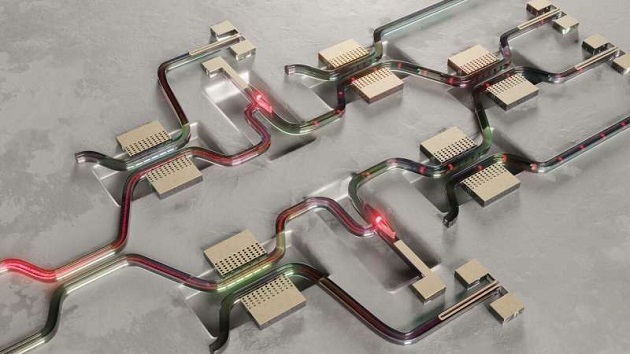
In a potential boost for Quantum Computing and communication, a European research collaboration reported a new method of controlling and manipulating single photons without generating heat. The solution makes it possible to integrate optical switches and single-photon detectors in a single chip.
Publishing in Nature Communications, the team reported having developed an optical switch that is reconfigured with macroscopic mechanical movement rather than heat, making the switch compatible with heat-sensitive single-photon detectors.




Optical switches in use today work by locally heating light guides inside a semiconductor chip. “This approach does not work for quantum optics,” says co-author Samuel Gyger, a Ph.D. student at KTH Royal Institute of Technology in Stockholm.
“Because we want to detect every single photon, we use quantum detectors that work by measuring the heat a single photon generates when absorbed by a superconducting material,” Gyger says. “If we use traditional switches, our detectors will be flooded by heat, and thus not work at all.”
The new method enables control of single photons without the disadvantage of heating up a semiconductor chip and thereby rendering single-photon detectors useless, says Carlos Errando Herranz, who conceived the research idea and led the work at KTH as part of the European Quantum Flagship project, S2QUIP.
Using microelectromechanical (MEMS) actuation, the solution enables optical switching and photon detection on a single semiconductor chip while maintaining the cold temperatures required by single-photon detectors.
“Our technology will help to connect all building blocks required for integrated optical circuits for quantum technologies,” Errando Herranz says.
“Quantum technologies will enable secure message encryption and methods of computation that solve problems today’s computers cannot,” he says. “And they will provide simulation tools that enable us to understand fundamental laws of nature, which can lead to new materials and medicines.”
The group will further develop the technology to make it compatible with typical electronics, which will involve reducing the voltages used in the experimental setup.
Errando Herranz says that the group aims to integrate the fabrication process in semiconductor foundries that already fabricate on-chip optics—a necessary step in order to make quantum optic circuits large enough to fulfill some of the promises of quantum technologies.

