
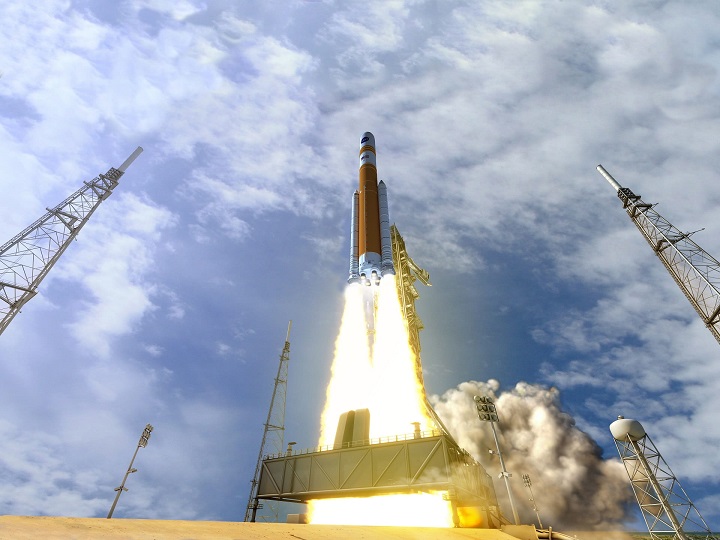
The largest rocket element NASA has ever built, the core stage of NASA’s Space Launch System (SLS) rocket, has fired its four RS-25 engines for 8 minutes and 19 seconds at NASA’s Stennis Space Center in Mississippi for Moon Missions.
The successful test, known as a hot fire, is a critical milestone ahead of the agency’s Artemis I mission, which will send an uncrewed Orion spacecraft on a test flight around the Moon and back to Earth, paving the way for future Artemis missions with astronauts.




The cryogenic core stage built by Boeing completed hot-fire testing as part of the SLS rocket’s Green Run test campaign on the B-2 test stand. Data from the test validated the core stage’s successful operation and will be used to help certify the stage for flight.
The SLS core stage is fuelled by liquid hydrogen and oxygen tanks feeding four RS-25 engines built by Aerojet Rocketdyne, together producing 1.6 million pounds of thrust during the test and at launch.
During a mission, the stage’s engines produce 2.2 million pounds of thrust. The engines burned for full duration of 499.6 seconds, or eight minutes and 19 seconds, during the test, providing critical verification data.
Engineers designed the eight-part Green Run test campaign to gradually bring the SLS core stage to life for the first time, culminating with the hot fire. The team will use data from the tests to validate the core stage design for flight.
Acting NASA administrator Steve Jurczyk commented: “Today’s successful hot fire test of the core stage for the SLS is an important milestone in NASA’s goal to return humans to the lunar surface – and beyond.”
Next, the core stage for SLS will be refurbished, then shipped to NASA’s Kennedy Space Center in Florida. There, the core stage will be assembled with the solid rocket boosters and other parts of the rocket and NASA’s Orion spacecraft on the mobile launcher inside the Vehicle Assembly Building at Kennedy in preparation for Artemis I.
SLS, Orion, and the ground systems at Kennedy, along with the human landing system and the Gateway in orbit around the Moon, are NASA’s backbone for deep space exploration.
SLS is the only rocket that can send Orion, astronauts, and supplies to the Moon on a single mission. The exploration of the Moon with NASA’s Artemis program includes preparations to send astronauts to Mars as part of America’s Moon to Mars exploration approach.

