

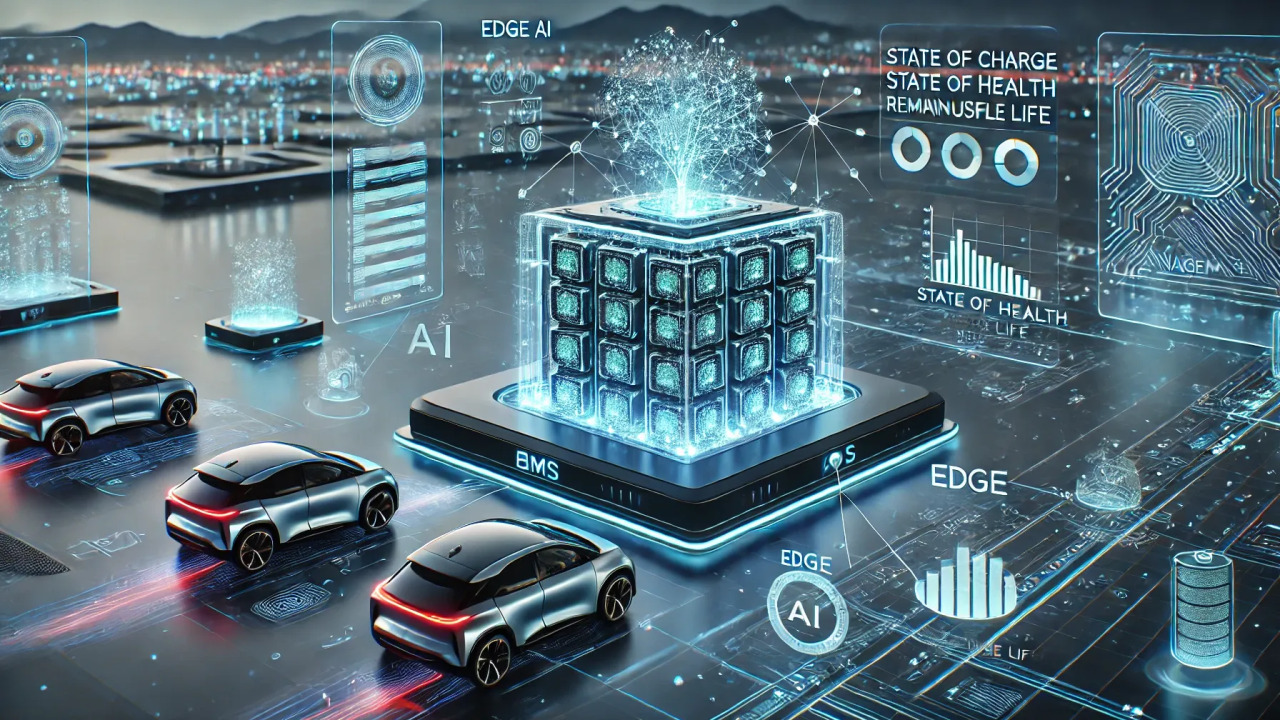
With the increasing growth rate of electrical vehicle adoption in India, a paramount concern of battery reliability, safety and lifespan arises. Conventionally, Battery Management Systems (BMS) have monitored parameters such as voltage, current and temperature constantly. But with the modern technology approach of integrating artificial intelligence (AI) and machine learning (ML), battery management could be transformed from conventional monitoring into a predictive system capable of identifying degradation patterns, detecting abnormalities, estimating battery health, and supporting predictive maintenance.
One key application is a State of Health (SoH) prediction, that represents the state of the battery compared to their original state of capacity or performance. ML models can be used with charging and discharging curves, temperature, current, voltage and past usage history to predict battery degradation, avoiding periodic physical tests.



Likewise, Data-driven algorithms are also useful for the estimation of state of charge (SOC). To accurately estimate the remaining usable energy is crucial in order to enhance driving range prediction. ML models can be a good supplement to current approaches (such as coulomb counting, model-based estimation), especially in varying conditions.
Other applications being developed include remaining useful life (RUL) prediction. Algorithms trained on historical data for degradation behaviour may use battery performance to determine how long a battery or cell could last before a certain level of performance was reached. This might enable predictive maintenance and warranty management.
As a part of the growing Indian EV manufacturing community shifting to connected cars and data-driven fleet management it is possible that an AI-based BMS might evolve as one more layer within the EV system. High-performance prediction would again depend on accuracy of the sensor inputs, quality of algorithm and computational capacity available and to be validated across various conditions.

