
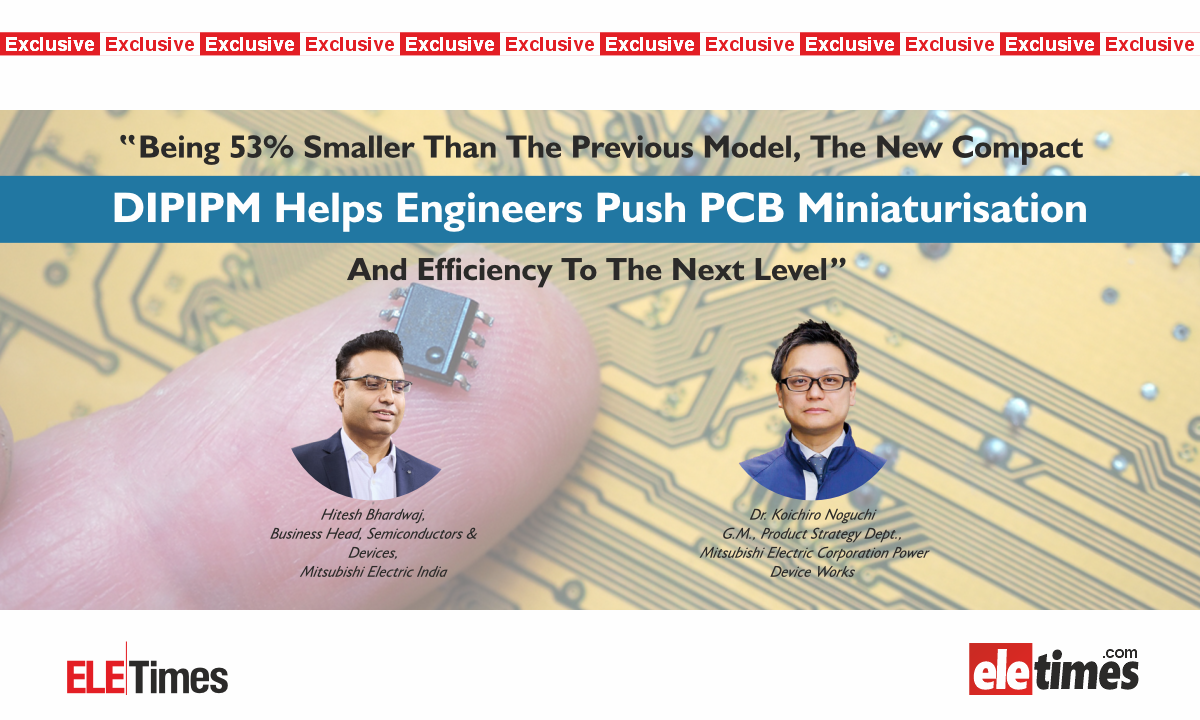
“We are more interested in driving the power electronics ecosystem in the Indian market,” says Hitesh Bhardwaj, GM, Semiconductor & Devices Department, Mitsubishi Electric India, in an exclusive conversation with the ELE Times. As India doubles down on its electronics sector through various schemes, including ECMS, PLI, and DLI, the private sector, along with the government, also seems equally aspirational and positive about the Indian prospects in the electronics landscape.
In the conversation, he, along with Dr. Koichiro Noguchi, General Manager, Product Strategy Dept. Mitsubishi Electric Corporation Power Device Works touched upon some innovations that Mitsubishi Electric is launching in India, including Unifull (SBD embedded MOSFETs). In addition to the innovations, the conversation also touched upon other issues like overall material trends in the power electronics line-up and supporting the local talent.




New Dual Inline Package Intelligent Power Modules (DIPIPM)
“The key feature of compact DIPIPM is that it is 53% smaller than the Slim DIP, which is a previous generation device that we were selling in the Indian market,” says Hitesh Bharadwaj. Mitsubishi’s all-new DIPIPM platform is all set to make the design engineers in India target next-level and more compact designs, owing to its unique construction consisting of an RC-IGBT that makes it more resilient towards thermal challenges and, consequently, improves its overall performance.
The new DIPIPM comes in two ratings: 30 amp 600 volt and 50 amp 600 volt, which make it suitable for consumer appliances, industrial equipment, and small-capacity inverters.
Unifull- New SiC high Voltage Product
“It is a unique solution in the segment of the SiC high voltage product where we architect a Schottky barrier diode and MOSFET into a single chip,” says Koichiro Noguchi as he explains the USP of the Unifull. It improves the switching and DC performance highly. He adds that this innovation in the 3.3 Kilowatt & 200-600 Amp range is the industry’s first.
Also, Mitsubishi Electric is confident of its Unifull technology, also evidenced by Koichiro Noguchi’s words when he says, “We are ready for the new business” with the all-new Unifull.
Material Trends in Power Electronics
On material trends, Hitesh Bhardwaj points out that while innovation is advancing, the industry must first capitalise on the already available WBG devices such as SiC and GaN, along with emerging 2D materials like graphene (which today sees limited use in specialised areas). Looking ahead, he notes that the next decade may open the door to ultra-wide bandgap materials, with several oxide- and nitride-based devices showing promising results in the research and development phase.
“We should give at least 10 to 12 years for WBG devices, just the way silicon was given decades to mature,” he says, underlining the natural progression of material technologies. He also mentions ongoing experiments on materials like gallium oxide and recalls Mitsubishi Electric’s earlier work with gallium arsenide for low-power, space-grade applications.
Power Electronic Ecosystem in India
Moving further, Hitesh Bhardwaj also talks about the India Power Electronics System, wherein he says, “Our priority is to develop the power electronics ecosystem in India.” He further goes on to underline the ongoing contributions of Mitsubishi Electric, specifically in regard to the training and upskilling of the local talent. He further adds that Mitsubishi Electric is currently focusing on developing the capabilities and sharing their best global practices with the local engineers, with the local design centers, and consequently making them drive benefits out of it.
Hence, enabling a self-sufficient and skilled power electronics ecosystem in India. It is currently in collaboration with universities and institutions, including IITs, NITs, so that they can contribute on their own, by using Mitsubishi’s devices.

