
| India’s semiconductor ambitions are backed by initiatives like the ₹76,000 crore ISM and the ₹1,000 crore DLI scheme, which focuses on fostering a strong design ecosystem. A critical part of this effort is ensuring design engineers get timely access to quality components.
To highlight how distributors are enabling this, we present our exclusive series — “Powering the Chip Chain” — featuring conversations with key industry players. |
As India solidifies its position in the global electronics manufacturing landscape, the role of distribution has evolved from merely supplying components to enabling rapid, AI-driven innovation. This shift demands hyper-efficient inventory, advanced technical support, and flexible commercial policies.
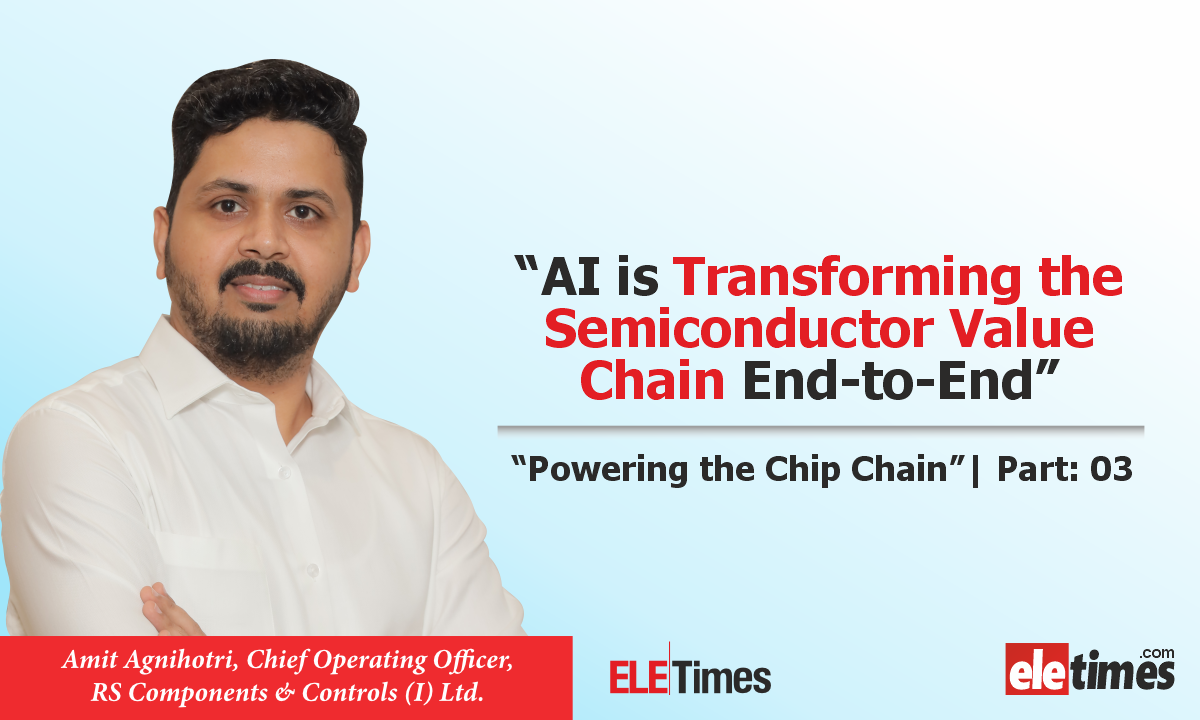
In an exclusive interaction for the ‘Powering the Chip Chain’ series, Amit Agnihotri, Chief Operating Officer at RS Components & Controls (I) Ltd., shares his perspective on the exponential growth of AI-centric component demand and how digital transformation is equipping distributors to accelerate time-to-market for a new generation of Indian engineers.




AI: The New Core of Product Discovery
The integration of AI is no longer a future concept but a foundational element of distribution platforms. Mr. Agnihotri confirms that RS Components India is integrating AI into both its customer-facing systems and internal operations.
The primary objective is to make product discovery simpler, faster, and more intuitive. By leveraging AI-driven analytics, the company analyzes customer trends and buying patterns to anticipate future needs, ensuring the most relevant products are recommended with greater precision and speed. In line with this vision, RS is also investing heavily in enhancing its website recommendation engine through advanced AI, enabling customers to easily find the right products that best suit their specific applications.
“On our digital platform, AI-powered features guide users in identifying the right product based on their specific needs and selection criteria, significantly improving turnaround time and enhancing the overall experience,” says Agnihotri. This capability also extends internally, allowing RS India to optimize inventory management and ensure offerings remain aligned with volatile market demand.
Exponential Demand for Edge Intelligence
The rapid advancement of AI is fundamentally restructuring component demand, particularly accelerating the need for specialized silicon. This is most evident in the shift of high-performance components away from only high-end data centers.
Mr. Agnihotri notes that RS Components is witnessing exponential growth in AI adoption across core sectors such as automotive, electronics manufacturing, and industrial automation.
This growth is driving demand for specialized parts such as edge AI chips, neural network accelerators, and high-performance GPUs. These solutions, which support AI-centric applications across healthcare devices, autonomous systems, and smart mobility, enable customers to achieve higher processing speeds, ultra-low latency, and greater energy efficiency in their designs.
“The scale and speed at which AI technologies are being integrated into these industries indicate a clear shift in product development priorities—towards high-speed processing capabilities, ultra-low latency architectures, and energy-efficient AI hardware,” he explains.
Empowering R&D with Flexibility and Tools
To support this rapid prototyping and iteration, RS Components focuses on providing R&D teams with both technical enablement and commercial flexibility.
The support spans the entire design cycle, from concept to validation, anchored by the DesignSpark platform. This platform provides an integrated suite of free design tools, including PCB design and simulation, which accelerates the transition from concept to prototype.
Furthermore, all product listings are enriched with technical data. “All listings are enriched with datasheets, footprints, 3D models, parametric filters, and application notes so design engineers can perform compatibility checks and Design For Manufacture (DFM) assessments early in the process,” Agnihotri says.
Crucially, the company has adapted its commercial policies to match the low-volume needs of R&D work:
“Recognising that R&D and PoC work often requires small quantities of the latest components, we operate with No MOQ [Minimum Order Quantity] and No MOV [Minimum Order Value] policies on many products, and we add approximately 5,000 NPIs [New Product Introductions] to our portfolio each month.”
These practices ensure that startups, academic labs, and enterprise R&D teams can source cutting-edge parts in small batches without heavy inventory commitments.
The Policy Tailwinds and Supply Chain Agility
Government initiatives, most notably the Semicon India programme and national AI policies, are playing a material role in creating market readiness.
Amit states, “By incentivizing local manufacturing, design centers and skilling, these programs shorten lead times, attract investment and create predictable demand for AI accelerators, advanced chips and supporting components.” This policy support, he adds, allows distributors to implement deeper localization of inventory and expand value-added services.
To ensure supply chain agility in the face of this growing complexity, RS Components utilizes AI and predictive analytics. Machine-learning models ingest purchase history and market signals to produce more accurate short- and medium-term forecasts.
“AI-driven SKU segmentation and safety-stock algorithms prioritize high-demand electronic components, while predictive lead-time modelling and allocation analytics enable proactive vendor coordination,” he explains. This systemic use of AI helps manage potential foundry constraints and allocation volatility, which remains a persistent challenge in the global semiconductor ecosystem.
Conclusion: The Distributor as an Innovation Partner
Mr. Agnihotri concludes by emphasizing that AI will continue to transform the semiconductor value chain end-to-end—from component design (using AI for simulation) to distribution (through predictive analytics and personalized recommendations).
RS Components’ strategy is clear: by embedding AI into its DesignSpark toolchain, leveraging predictive models to localize inventory, and providing flexible commercial terms, the company is positioning itself as a strategic partner. This integrated approach enables engineers and manufacturers to iterate quickly, source the right components, and scale with confidence, fundamentally accelerating innovation across the Indian market.

