
HomeNewsIndia NewsCapturing Free-Space Optical Light for High-Speed Wi-Fi

    Capturing Free-Space Optical Light for High-Speed Wi-Fi

    Visible and Infrared Light can carry more data than radio waves but has always been confined to a hard-wired, fiber-optic cable. Working with Facebook’s Connectivity Lab, a Duke research team has now made a major advance toward the dream of ditching the fiber in fiber optics.

    While working to create a free-space optical communication system for high-speed wireless internet, the researchers also show that speed and efficiency properties previously demonstrated on tiny, single-unit plasmonic antennas can also be achieved on larger, centimeter-scale devices.


    In 2016, researchers from Internet.org’s Connectivity Lab—a subsidiary of Facebook—outlined a new type of light detector that could potentially be used for free-space-optical communication. Traditionally, hard-wired optical fiber connections can be much faster than radio wave wireless connections. This is because visible and near-infrared light frequencies can carry much more information than radio waves (WiFi, Bluetooth, etc).

    But using these higher frequencies in wireless devices is difficult. Current setups use either LEDs or lasers aimed at detectors that can reorient themselves to optimize the connection. It would be much more efficient, however, if a detector could capture light from different directions all at once. The catch is that increasing the size of an optical receiver also makes it slower.

    This was also the case for the Connectivity Lab’s design. A spherical bundle of fluorescent fibers captured blue laser light from any direction and re-emitted green light that could be funneled onto a small receiver. While the prototype was able to achieve rates of two gigabits per second, most fiber optic internet providers offer up to 10 Gb, and higher-end systems can push into the thousands.

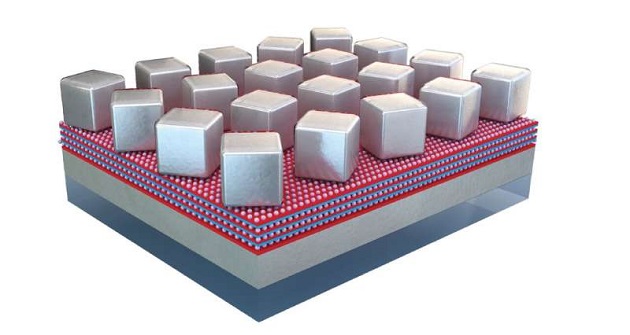
    Looking for a way to speed up their free-space optical communication designs, the Connectivity Lab turned to Maiken Mikkelsen, the James N. and Elizabeth H. Barton Associate Professor of Electrical and Computer Engineering and Physics at Duke. Over the past decade, Mikkelsen has been a leading researcher in the field of plasmonics, which traps light on the surface of tiny nanocubes to increase a device’s speed and efficiency at transmitting and absorbing light by more than a thousand times.

    “The Connectivity Lab’s prototype was constrained by the emissions lifetime of the fluorescent dye they were using, causing it to be inefficient and slow,” said Mikkelsen. “They wanted to increase the efficiency and came across my work showing ultrafast response times in fluorescent systems. My research had only proven that these efficiency rates were possible on single, nanoscale systems, so we didn’t know if it could scale up to a centimeter-scale detector.”
    The overall effect of the demonstration is the ability to capture light from a large field of view and funnel it into a narrow cone without losing any speed. To move forward with this technology, researchers would need to piece several plasmonic devices together to cover a 360-degree field of view and once again include a separate interior detector. While there is work to be done, the researchers see a viable path forward.
    ELE Times Research Desk
    ELE Times Research Deskhttps://www.eletimes.ai
    ELE Times provides a comprehensive global coverage of Electronics, Technology and the Market. In addition to providing in depth articles, ELE Times attracts the industry’s largest, qualified and highly engaged audiences, who appreciate our timely, relevant content and popular formats. ELE Times helps you build awareness, drive traffic, communicate your offerings to right audience, generate leads and sell your products better.

    Related News

    Must Read

    India’s Electronics Push: Ambition Is Clear. Execution Will Decide the Outcome

    India’s electronics story has entered a decisive phase. The...

    India on the Road to Semicon Self-Reliance with Three More Plants

    India to welcome three more semiconductor plants after PM...

    Upcoming years to Bring Boom for Semiconductors and Electronics

    Union Minister for Electronics and Information Technology Ashwini Vaishnaw...

    R&S Propels 6G Readiness With FR1–FR3 Carrier Demonstration

    Rohde & Schwarz and Qualcomm Technologies, Inc. have reached...

    ROHM and Suchi Semicon Establish a Strategic Semicon Manufacturing Partnership in India

    ROHM and Suchi Semicon have announced the establishment of...

    Keysight to Demonstrate NR-NTN devices Mobility Testing at MWC 2026 in Collaboration with Samsung

    Keysight Technologies, Inc. will demonstrate lab-based validation of new...

    ROHM Strengthens Supply Capability for GaN Power Devices

    Combining TSMC’s Process Technology to Build an End-to-End, In-Group...

    element14 Community launches smart security and surveillance design challenge

    element14, an Avnet Community, in collaboration with ADI, has...

    R & S and LITEON demonstrate high‑throughput 5G femtocell testing with the PVT360A

    Rohde & Schwarz and LITEON collaborate to showcase a...

