
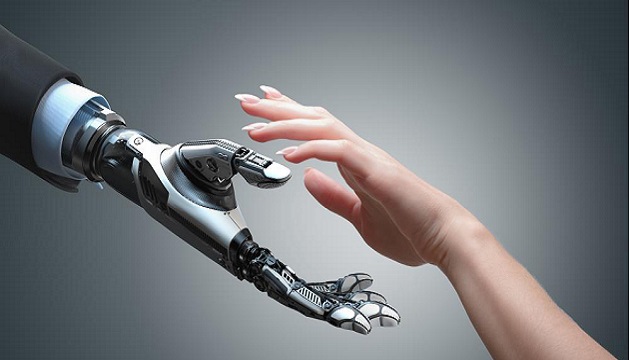
The attempt to mimic human’s five senses led to the development of innovative electronic devices such as camera and TV, which are inventions that dramatically changed human life. As a result, many scientists are continuously performing research to imitate tactile, olfactory, and palate senses and tactile sensing is expected to be the next mimetic technology for various reasons. Currently, most tactile sensor researches are focusing on physical mimetic technologies that measure the pressure used for a robot to grab an object, but psychosensory tactile research on how to mimic human tactile feeling such like soft, smooth or rough has a long way to go.
As a result, Professor Jae Eun Jang’s team developed a tactile sensor that can feel pain and temperature like human through a joint research with Professor Cheil Moon’s team in the Department of Brain and Cognitive Science, Professor Ji-woong Choi’s team in the Department of Information and Communication Engineering, and Professor Hongsoo Choi’s team in the Department of Robotics Engineering. Its key strengths are that it has simplified the sensor structure and can measure pressure and temperature at the same time and can be applied on various tactile systems regardless of the measurement principle of the sensor.




For this, the research team focused on zinc oxide nano-wire (ZnO Nano-wire) technology, which was applied as a self-power tactile sensor that does not need a battery thanks to its piezoelectric effect, which generates electrical signals by detecting pressure. Also, a temperature sensor using Seebeck effect1) was applied at the same time for one sensor to do two jobs. The research team arranged electrodes on polyimide flexible substrate, grew the ZnO nano-wire, and could measure the piezoelectric effect by pressure and the Seebeck effect by temperature change at the same time. The research team also succeeded in developing a signal processing technique that judges the generation of pain signals considering the pressure level, stimulated area and temperature.
Seebeck effect: Forms electric circuit by connecting different metals and generates thermoelectromotive forces on the circuit if there is a temperature difference on both access points.
Professor Jang in the Department of Information and Communication Engineering said “We have developed a core base technology that can effectively detect pain, which is necessary for developing future-type tactile sensor. As an achievement of convergence research by experts in nano engineering, electronic engineering, robotics engineering, and brain sciences, it will be widely applied on electronic skin that feels various senses as well as new human-machine interactions. If robots can also feel pain, our research will expand further into technology to control robots’ aggressive tendency, which is one of the risk factors of AI development.”

