
element14, an Avnet Company and global distributor of electronic components, products and solutions, has signed a global franchise with XinaBox to broaden its market leading range of educational devices and kits. The XinaBox range provides a low-cost entry into the Internet of Things (IoT), Artificial Intelligence (AI), Machine Learning (ML) and automation and helps educators combine Science Technology Engineering and Mathematics (STEM) learning with the experience of physical computing for students from a young age. Although targeted at education, XinaBox also provides solutions to easily scale beta testing for prototyping new applications.
XinaBox is widely used in secondary schools and colleges across the world due to its ease of use, and suitability for first-time users right through to more advanced secondary students and makers. The XinaBox kits include a selection of xChips, designed to fast track a user’s understanding of the IoT. Specialist knowledge of soldering or hardware components is not required as xChips are simply clipped together without wires, soldering or breadboards, meaning experiments can be setup quickly.




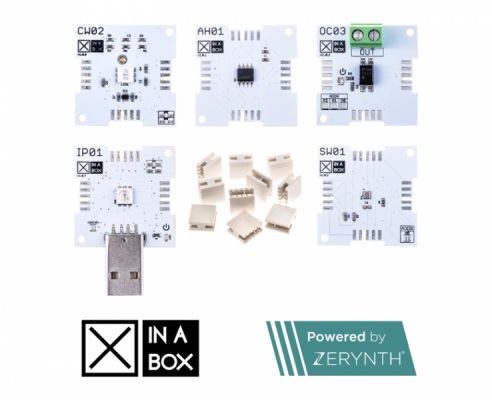
The range of over 80 modular hardware xChips includes cores/CPUs, sensors, power, communication, output and storage. Wi-Fi, Bluetooth and LoRaWAN cores have been designed to make it easy to connect projects to the IoT, and other components such as the BBC micro:bit and Raspberry Pi can be easily integrated to supercharge projects. xChips can operate with pre-compiled code or can be programmed from scratch using leading platforms such as MakeCode, Arduino and Python.
The range of XinaBox kits now available from element14 include:
- XK01 STEM Starter Kit: Suitable for secondary school classrooms, the XK01 STEM Starter Kit enables students to build a simple project and connect to an IoT platform, using the quick start guide. The kit features a Wi-Fi Core, xChip (ESP8266) and includes sensors for temperature, humidity, and pressure, UV index, a mini-OLED display, a spacer chip and connectors. The starter kit can be used to collect and investigate the relationship between data sets such as temperature and atmospheric pressure, temperature and light, temperature and humidity, and visible light and ultraviolet light.
- XK05 micro:bit IoT Kit: An ideal entry-level product, the XK05 IoT kit for micro:bit is designed to introduce young people to IoT technology. The kit enables the analysis of large data sets in the classroom with no previous experience required. Users can learn how to connect the micro:bit to the cloud and build a smart IoT device with the coding extension, MakeCode.
Professional users and makers can also use XinaBox to progress their ideas to prototypes much faster, rapidly improving time to market whilst reducing cost of prototyping and facilitating scaled beta testing:
- XK12 IoT Starter Kit: Powered by Zerynth, the XK12 IoT Starter Kit combines modular electronics with an ecosystem of software tools in Python. The kit contains everything required to build a smart IoT edge device that collects environmental data. An actuator can also be attached to create automation projects such as automated electric gates, garage doors or fans.
Lee Turner, Global Head of Semiconductors and SBC at Farnell and element14, said: “Easy to use tools are key to supporting teachers as they help students development the computation thinking and complex problem-solving skills needed for a career in a digital economy. XinaBox provides schools and colleges with accessible tools to introduce STEM and IoT while providing inspiration for hands-on learning in the classroom, enabling students to learn about new technologies in a highly creative and collaborative way. For more advanced students, and even professional engineers, XinaBox provides new options to scale beta testing and reduce time to market through its simple, modular, non-solder structure.”
Farnell has worked with multiple educational organisations and governments to support strategic rollouts of STEM learning solutions into the classroom, and stocks a broad range of education devices that can be supplied in classes, schools and multiple-school quantities. Farnell can also offer support with provision and bundling of equipment for bespoke large-scale programmes similar to the Super:bit programme in Norway.
The complete XinaBox range is available from Farnell in EMEA, Newark in North America and element14 in APAC.
For more information, visit in.element14.com

