
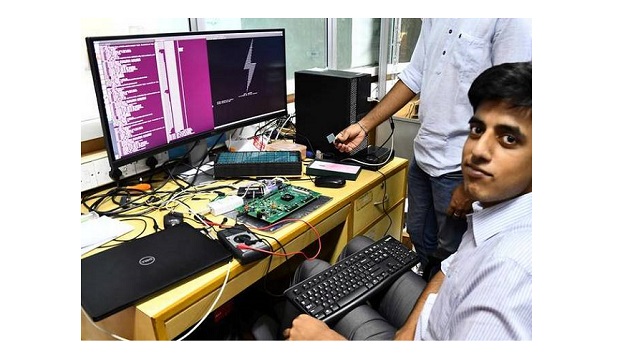
These are the kind of chips that India always wanted, but could not make. Now, computer scientists and a student team from the IIT- Madras have developed the first of a family of six industry-standard microprocessors.
The initial batch of 300 chips, named RISECREEK and produced under Project Shakti, have been fabricated free at Intel’s facility at Oregon, U.S., to run the Linux operating system.




The IIT team says its microprocessors can be adapted by others, as the design is open source. They optimise power use and compete with international units such as the Cortex A5 from Advanced RISC Machines (ARM).
On the test bench, the IIT design fared better than the A5, measured in terms of the DMIPS per megahertz rating, scoring 1.68 against the competition’s 1.57. At a frequency of 350 MHz, RISECREEK can meet the demands of defence and strategic equipment such as NAVIC (Indian Regional Navigation Satellite) and Internet of Things (IoT) electronics, its developers say. “Our process helps us develop the processor three times sooner than industry standards,” says Kamakoti Veezhinathan, Professor of Computer Science at the IIT- Madras, who led the project.
What makes RISECREEK different is the open source nature of the designs. “This is made in India, but even if it were made in the U.S., it would be contemporary,” says G.S. Madhusudan, project adviser from the IIT- Madras.
“The Shakti project is not aimed at only building processors. It also aims to build high speed interconnects for servers and supercomputers based on variants of the RapidiIO and GenZ standards. These are key to build large clusters of processors to get Petaflop and Exaflop level supercomputers,” says Mr. Madhusudan.
Intel has fabricated the chip free of cost, and the team incurred a development cost of about ₹1.2 Crore. Regarding vulnerabilities due to outsourcing the fabrication of the chip, he says, “Since the entire design has been developed in-house, it is extremely difficult for a foundry to add backdoors or security vulnerabilities. But yes, an external fab can always induce vulnerabilities. A probable solution for this is to move towards a controlled fab.”

