
HomeIndustryRenewable EnergyIntegrating Solar Panels in Shady Places

    Integrating Solar Panels in Shady Places

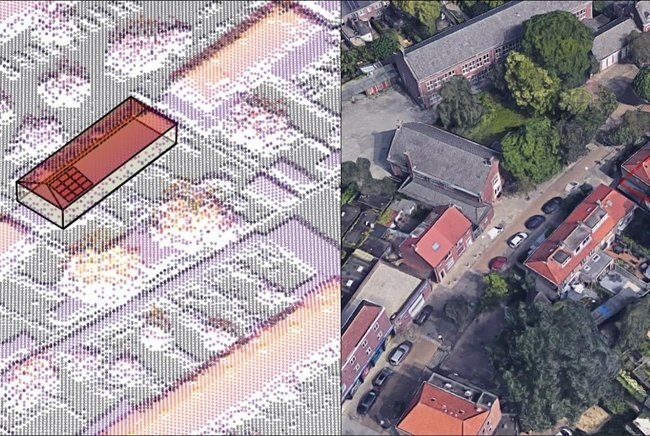
    Due to stricter regulations of sustainability, we might see solar panels more often not only on sunny rooftops but more and more on shaded roofs and facades as well, which brings new challenges in their integration. In his thesis, Ádám Bognár developed a method to simulate solar irradiance based on LiDAR point clouds, leading to better simulation models for the integration of solar panels.

    As lowering carbon emissions and increasing comfort levels in buildings are getting higher priority, also due to regulations such as the BENG norm 2021, the ability to design high-performance buildings with on-site renewable energy generation is increasingly in demand.


    When designing high-performance buildings, combining building simulations with PV performance simulations is an efficient method to make go/no-go decisions in the early phases of the design and to mark out or optimize design variants. Moreover, the use of simulations has the potential to improve the monitoring and fault detection of in-operation PV sites. However, shading and reflections from the surroundings are difficult to model.

    Simulating Solar Irradiance

    Ádám Bognár used LiDAR point clouds and integrated the resulting simulated irradiance with detailed simulation models of PV systems. He demonstrated the usability and practical value of his newly developed method with a comprehensive case study of a building renovation project in the city center of Eindhoven. Bognár’s work supports the design of new PV systems and performance monitoring of existing ones. He hopes that the new method can aid the adoption of building-integrated and building-applied PV systems located in environments where shading is common. The software implementation of his work is distributed as free and open-source

    ELE Times Research Desk
    ELE Times Research Deskhttps://www.eletimes.ai
    ELE Times provides extensive global coverage of Electronics, Technology and the Market. In addition to providing in-depth articles, ELE Times attracts the industry’s largest, qualified and highly engaged audiences, who appreciate our timely, relevant content and popular formats. ELE Times helps you build experience, drive traffic, communicate your contributions to the right audience, generate leads and market your products favourably.

    Related News

    Must Read

    What Are Memory Chips—and Why They Could Drive TV Prices Higher From 2026

    As the rupee continues to depreciate, crossing the magical...

    Anritsu & HEAD Launch Acoustic Evaluation Solution for Next-Gen Automotive eCall Systems

    ANRITSU CORPORATION and HEAD acoustics have jointly launched of...

    Dell Technologies’ 2026 Predictions: AI Acceleration, Sovereign AI & Governance

    Dell Technologies hosted its Predictions: 2026 & Beyond briefing...

    NAL-CSIR Advances Field testing of Indigenous Defence Tech

    The Council of Scientific and Industrial Research (CSIR)-National Aerospace...

    Toyota & NISE Test Mirai Hydrogen FCEV in India Conditions

    Toyota Kirloskar Motor (TKM) and the National Institute of...

    Nissan Powering EV Component Plant with Repurposed Batteries

    Nissan Australia has launched the Nissan Node project, a...

    KEC, Powernet & Wise Integration Co-Develop AI Server SMPS Power Solutions

    Wise Integration (France), Powernet (Korea) and KEC (Korea) will...

    FAMES Pilot Line R&D Advances: 400°C CMOS Enables 3D Integration Goals

    CEA-Leti, the coordinator of the FAMES Pilot line, has achieved...

    Keysight & KT SAT Nail Industry First GEO-to-LEO Multi-Orbit NTN Handover!

    Keysight Technologies, Inc., in collaboration with KT SAT, has...

    Nuvoton Emphasises Need to Strengthen Taiwan-Israel R&D Collaboration

    Nuvoton Technology showcased its leadership in international expansion by...

