
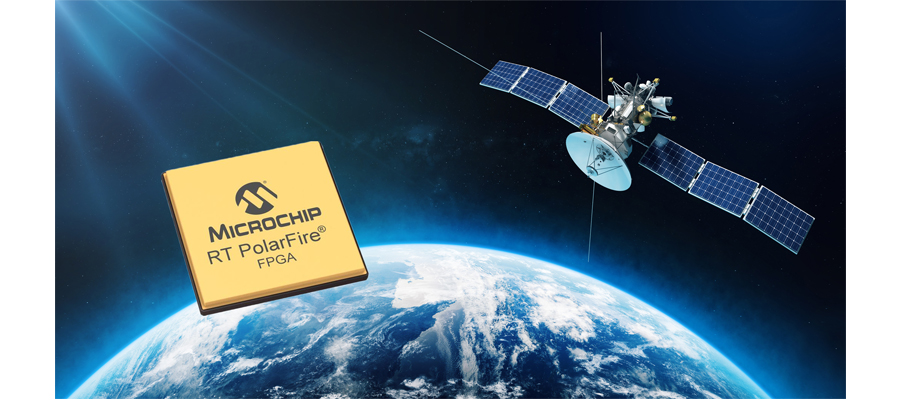
Brings high levels of density and performance to space applications, saving system cost and engineering efforts through low power consumption and immunity to configuration upsets
Products that have Qualified Manufacturers List (QML) designations are often the most trusted and readily accepted in space program designs. As designated by the Defense Logistics Agency (DLA), the RT PolarFire FPGA from Microchip Technology (Nasdaq: MCHP) is now QML Class Q qualified. This certification is considered the gold standard in entry-level qualification, enabling designers to begin integrating the RT PolarFire FPGA into their space flight systems more easily. Because QML qualifications are standardized based on specific performance and quality requirements governed by the DLA, customers can streamline their design process by using QML-qualified products.




Low-power and reprogrammable RT PolarFire FPGAs offer expanded logic density and high performance, providing significant improvements in signal processing throughput. Unlike SRAM-based FPGA alternatives, these devices do not exhibit any configuration Single-Event Upsets (SEUs) in radiation and therefore do not require mitigation, which reduces engineering expenses and Bill of Materials (BOM) costs.
“The RT PolarFire FPGA reduces satellite signal processing congestion with higher levels of density and performance than any other product in our FPGA portfolio,” said Shakeel Peera, vice president of marketing for Microchip’s FPGA business unit. “Microchip is committed to providing high-quality and reliable solutions, and this milestone qualification provides customers with added confidence when designing our devices into their spaceflight systems.”

MIL-STD-883B, the baseline qualification standard for QML Class Q, sets forth strict methods for testing microelectronic devices to ensure they are suitable for military and aerospace electronic systems. To achieve QML Class Q qualification, the RT PolarFire FPGA went through rigorous assessments to determine its ability to withstand the harmful effects of natural elements and brutal conditions found in defense and space operations.
By achieving QML Class Q qualification, RT PolarFire FPGAs prove their ability to support systems that require the highest level of component quality. In addition, the QML Class Q qualification paves the way for an eventual QML Class V qualification while demonstrating the continued reliability of RT PolarFire FPGAs in space applications.
For more than 60 years, Microchip’s solutions have powered space flight missions. The company boasts one of the industry’s most comprehensive space product portfolios of radiation-hardened and RT solutions that includes high-performance microcontrollers (MCUs), microprocessors (MPUs), FPGAs, memories, communication interfaces, frequency and timing solutions, mixed-signal ICs, custom power supplies, diodes, transistors, RF components and more. To learn more, visit Microchip’s space application product page.

