
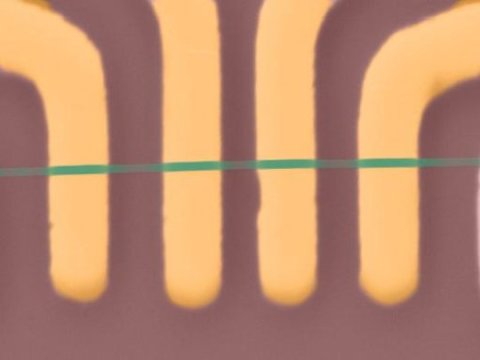
In a major breakthrough, prototype devices made of an exotic material that can conduct a current density nearly 50 times more than the conventional copper interconnect technology has been demonstrated by the engineers at the University of California, Riverside.
Current density, for learning purposes, is the amount of electrical current per cross-sectional area at a particular time. With advances in technology, the size and shape of transistors within integrated circuits is becoming smaller every day; and as a result, to perform at the optimum level, they need more and more current densities. Popular electrical conductors like silicon and copper often break courtesy of overheating which is a major barrier to creating small components.




In such a time, when circuits and components are becoming smaller and more complex at the same time, the electronics fraternity needs a better alternative which can withstand high current densities with a size of just a few nanometers.
With the advent of graphene, the world directed their research towards other two-dimensional (2D) layered materials that could sustain high current densities while also satisfying the compact size of components that the entire industry is vouching for. 2D materials consist of a single layer of atoms while on the other hand 1D materials contain individual chains of weakly bound atoms. However, their potential and scope in the electronics industry have not been an area of immense research.
While 2D materials like graphene are extremely small, 1D materials are smaller still. Think of 2dD materials as a loaf of bread and 1D materials as a piece of spaghetti. That is the relative size difference these two materials have.
A group of researchers led by Alexander A. Balandin, a distinguished professor of electrical and computer engineering in the Marlan and Rosemary Bourns College of Engineering at UC Riverside, discovered that zirconium telluride, or ZrTe3, nanoribbons have an exceptionally high current density that far exceeds that of any conventional metals like copper.
The new strategy undertaken by the UC Riverside team pushes research from two-dimensional to one-dimensional materials- an important advance for the future generation of electronics.
“Conventional metals are polycrystalline. They have grain boundaries and surface roughness, which scatter electrons,” Balandin said. “Quasi-one-dimensional materials such as ZrTe3consist of single-crystal atomic chains in one direction. They do not have grain boundaries and often have atomically smooth surfaces after exfoliation. We attributed the exceptionally high current density in ZrTe3 to the single-crystal nature of quasi-1D materials.”
In principle, such quasi-1D materials could be grown directly into nanowires with a cross-section that corresponds to an individual atomic thread, or chain. In the present study, the level of the current sustained by the ZrTe3 quantum wires was higher than reported for any metals or other 1D materials. It almost reaches the current density in carbon nanotubes and graphene.
Electronic devices depend on special wiring to carry information between different parts of a circuit or system. As developers miniaturize devices, their internal parts also must become smaller, and the interconnects that carry information between parts must become smallest of all. Depending on how they are configured, the ZrTe3 nanoribbons could be made into either nanometer-scale local interconnects or device channels for components of the tiniest devices.
The UC Riverside group’s experiments were conducted with nanoribbons that had been sliced from a pre-made sheet of material. Industrial applications need to grow nanoribbon directly on the wafer. This manufacturing process is already under development, and Balandin believes 1D nanomaterials hold possibilities for applications in future electronics.
“The most exciting thing about the quasi-1D materials is that they can be truly synthesized into the channels or interconnects with the ultimate small cross-section of one atomic thread- approximately one nanometer by one nanometer,” Balandin said.

