
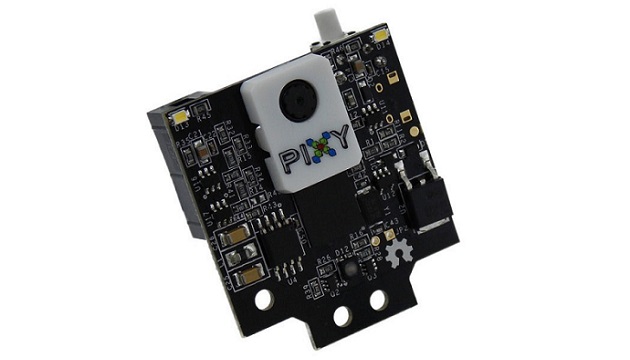
Rajguru Electronics’ all-new Pixy2 is an image sensor with a powerful processor that you can program to only send the information. The Pixy2 also exports its information in a variety of useful ways – UART serial, SPI, I2C, digital out, or analog out – so your microcontroller or microcomputer can communicate easily while still doing other tasks.
Pixy2 is smaller, faster and more capable than the original Pixy. Like its predecessor, Pixy2 can learn to detect objects that you teach it, just by pressing a button. Additionally, Pixy2 has new algorithms that detect and track lines for use with line-following robots. The new algorithms can detect intersections and “road signs” as well. The road signs can tell your robot what to do, such as turn left, turn right, slow down, etc. And Pixy2 does all of this at 60 frames-per-second, so your robot can be fast, too.




The Pixy2 uses hue and saturation as its primary means of image detection – rather than the normal RGB. This means that lighting or exposure won’t affect the Pixy2’s detection of an item – which is a frustrating problem with many image sensors. It’s also a vast improvement over previous versions of the Pixy CMUCam, adding increased flexibility when it comes to lighting and exposure changes.
It can also remember seven different color signatures, find hundreds of objects at the same time, and is super fast – processing at 60 frames a second. Finally, the Pixy2 is also teachable so you can set it up to only send you images that you’ve specifically told it to look for. It’s easy and fast and has an open source application called PixyMon.
Each Pixy2 Sensor comes with a 6-pin-to-10-pin IDC cable, a USB to Micro USB cable, and mounting tabs and screws.
Technical Specs:
- Processor: NXP LPC4330, 204 MHz, dual-core
- Image sensor: Aptina MT9M114, 1296×976 resolution with integrated image flow processor
- Lens field-of-view: 60 degrees horizontal, 40 degrees vertical
- Power consumption: 140 mA typical
- Power input: USB input (5V) or unregulated input (6V to 10V)
- RAM: 264K bytes
- Flash: 2M bytes
- Available data outputs: UART serial, SPI, I2C, USB, digital, analog
- Dimensions:1.5” x 1.65” x 0.6”
- Weight: 10 grams
- Integrated light source, approximately 20 lumens
Features :
Pixy2 is the second version of Pixy. It’s faster, smaller and more capable than the original Pixy, adding line tracking/following algorithms as well as other features.
- Pixy2 detects lines, intersections and small barcodes, intended for line-following robots
- Improved framerate – 60 frames-per-second
- Tracking algorithms have been added to color-based object detection
- Improved and simplified libraries for Arduino, Raspberry Pi and other controllers
- Integrated light source
- Small, fast, easy-to-use, low-cost, readily-available vision system
- Learns to detect objects that you teach it
- Connects to Arduino with included cable. Also works with Raspberry Pi, BeagleBone and similar controllers
- All libraries for Arduino, Raspberry Pi, etc. are provided
- C/C++ and Python are supported
- Communicates via one of several interfaces: SPI, I2C, UART, USB or analog/digital output
- Configuration utility runs on Windows, MacOS and Linux
- All software/firmware is open-source GNU-licensed
- All hardware documentation including schematics, bill of materials, PCB layout, etc. are provided
Connect directly to Arduino or Raspberry Pi
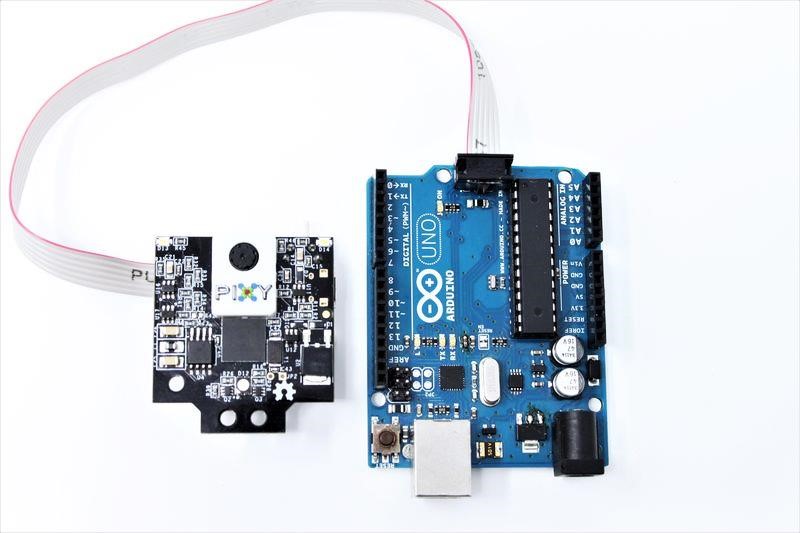
No need to futz around with tiny wires — Pixy2 comes with a special cable to plug directly into an Arduino and a USB cable to plug into a Raspberry Pi, so you can get started quickly.
Article Courtesy: Rajguru Electronics

