
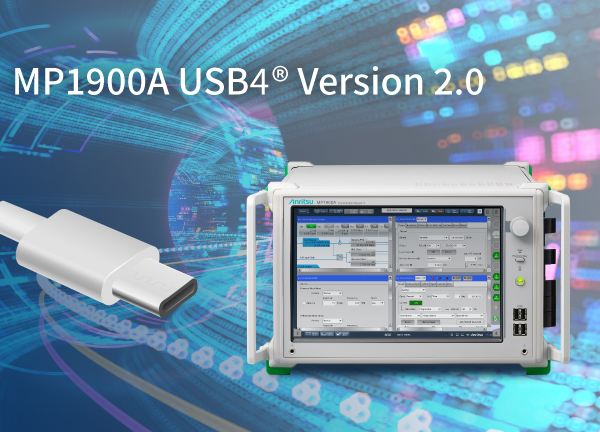
ANRITSU CORPORATION gets certified by the USB Implementers Forum (USB-IF) for its test solution for the latest USB4 Version 2.0 (USB4 v2) communication standard.
The solution is based on the Signal Quality Analyzer-R MP1900A and provides advanced USB device evaluation capabilities. It helps improve the quality and reliability of products implementing the USB4 Version 2.0 standard, supporting widespread deployment of next-generation high-speed interfaces.




As of December 2025, USB4 v2 is the most advanced USB standard, delivering data transfer speeds of up to 80 Gbit/s — twice that of USB4 v1 (40 Gbit/s). This supports next-generation applications, such as high-resolution video transmission, external GPUs, high-speed storage, and VR/AR devices.
Furthermore, the specification significantly improves communication performance and reliability. By introducing innovations including Pulse Amplitude Modulation 3-level (PAM3) signaling to improve bandwidth efficiency, the Frequency Variation Profile to enhance the stability of link training — a signal quality and initialization procedure — and a new TS2.CLKSW training sequence incorporating clock switching.
Current demand for evaluation and certification testing is driven primarily by semiconductor manufacturers producing USB4 v2 control ICs. Looking ahead, adoption is expected to expand to test houses for test equipment deployment and, in the long term, to consumer product manufacturers of USB4 v2 hubs, docking stations, and cables.
Product Overview: Signal Quality Analyzer-R MP1900A
The MP1900A is a high-performance Bit Error Rate Tester (BERT) supporting receiver tests for multiple high-speed interfaces, including PCIe, USB, Thunderbolt, DisplayPort, and 400 GbE/800 GbE. It combines industry-leading PPG technology for high-quality waveforms with a high-sensitivity error detector, precision jitter sources (SJ, RJ, SSC, BUJ), and noise sources (CM-I, DM-I). The MP1900A also supports link training and LTSSM analysis for comprehensive high-speed device evaluation.

