
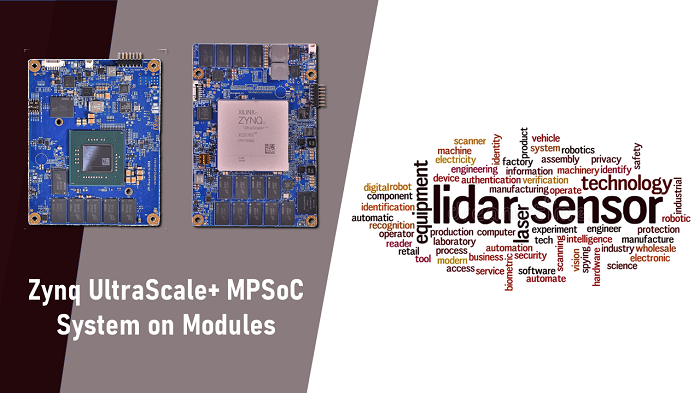
LiDAR has emerged as an important remote-sensing technology for many scientific and military applications. It provides high-resolution & accurate measurements of 3D structures, easily convert the received data into 3D maps to interpret the surrounding, and remains unaffected even in even in challenging weather and lighting conditions.
The adaptability of Zynq UltraScale+ MPSoC to support LiDAR technology




The Zynq UltraScale+ MPSoC devices enable an adaptive SoC-based product design, which is extremely promising for LiDAR application implementation. Integrating both the processor and FPGA architecture into a single device allows rapid deployment of a flexible yet optimized solution for any given domain.
The programmability of FPGA provides a great deal of flexibility in developing custom capabilities for the product. Also, FPGAs have the potential to speed up processing by employing multi-level parallelism.
The Zynq UltraScale+ MPSoC series combines real-time control with soft and hard engines for graphics, video, waveform, and packet processing. As a result, MPSoC devices are powerful and flexible enough to deliver advanced capabilities for Lidar sensors: signal processing, point cloud pre-processing, and point cloud machine learning acceleration. Additionally, Zynq MPSoC devices are well known for being power efficient, which is critical for LiDARs.
Why use a SoM approach to build LiDAR products
Using a System on Module approach for building LiDAR products provides significant benefits by offloading several complexities involved in the design cycle. A product designer can focus on developing firmware and software stacks by eliminating the complex hardware part of the design. Which significantly reduces time to market with reduced product development cost.
Furthermore, System on Modules provides enormous scalability and flexibility to a designer when migrating to a higher computing SoM without changing the design of a carrier card.
Zynq MPSoC System on Module features for lidar
The Zynq UltraScale+ MPSoC SoM features the heterogeneous ARM + FPGA architecture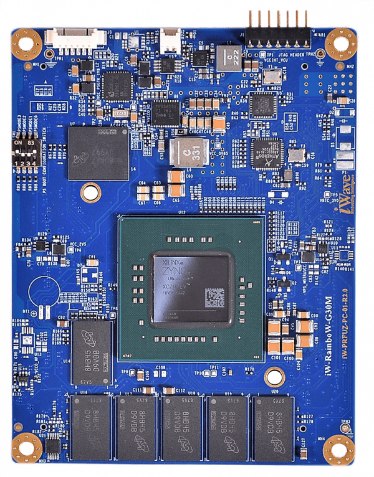 and provides a robust combination of the processing system (PS) and programmable logic (PL).
- The PS contains a quad-core ARM Cortex-A53 processor operating at up to 1.5GHz and a real-time processing unit equipped with ARM Cortex-R5 processors operating at up to 600MHz
- PL based on 16nm UltraScale+ architecture that contains up to 504K configurable logic block, Block RAM, and DSP elements
Other benefits include
- Any-To-Any interfacing
- Design toolchains
- Image processing capabilities
- Accelerate neural network
- Safety and Security features
Any-To-Any interfacing
Compliance with different interfacing standards is a significant challenge presented by sensor interfacing and processing. A typical solution should have the capability to support high-speed interfaces such as MIPI, JESD204B, LVDS, and GigE to support high-bandwidth sensors such as cameras, RADAR, and LiDAR. Sensor interfacing and processing will also be required to interface with lower-bandwidth sensors that use standards such as CAN, SPI, I2C, and UARTs for accelerometers.
The Zynq UltraScale+ MPSoCs PS and PL support a variety of industry-standard interfaces such as CAN, SPI, I2C, UART, and GigE. The PL I/O flexibility allows for direct interfacing with MIPI, LVDS, and GigaBit Serial Links, allowing for higher levels of protocol implementation within the PL.
By providing the correct PHY in the hardware design, the PL enables any interface to be implemented, providing any-to-any interfacing.
Design toolchains
The Zynq UltraScale+ devices come with Vivado Design Suite to configure the PS and PL design. Vivado provides the complete PL development experience, including the support for synthesis, place & route, and simulation.
Vitis comes into play when it comes to developing software solutions. Vitis supports Embedded Linux development using PetaLinux and real-time operating systems such as FreeRTOS.
In addition to system development capabilities, Vitis supports kernel acceleration within the PL using OpenCL.
Image processing capabilities
Image processing is critical in LiDAR applications for navigation and monitoring. Typically, the algorithms used in these systems are created and modeled in high-level frameworks such as OpenCV.
An H.264/H.265 video codec unit is included in the Zynq UltraScale+ MPSoC EV series to support image processing.
Accelerate Neural Network
Aside from image processing, machine learning is a critical technology for developing automated applications. Machine learning helps classify objects on the highway or observe and monitor occupants.
To enable this, Viti AI provides Model Zoo, AI compiler, Optimizer, Quantizer, and profiler to deploy the application onto the deep learning processing unit.
Safety & Security features
The Advanced Encryption Standard (AES) is used to secure the configuration of Xilinx devices.
The Zynq UltraScale+ MPSoC devices further implement layered security solutions via configuration security unit (CSU) within the PS. The CSU supports AES 256-GCM, 4096 RSA Multiplier, and SHA-384, providing confidentiality, authentication, and integrity functions.
Anti-tamper response through the inbuilt system monitor enables the customer to track device voltages and die temperatures of the SoM.
Scalability across the iWave Zynq MPSoC SoM
iWave offers an extensive portfolio of System on Modules for Zynq UltraScale+ MPSoC series ranging from ZU4 to ZU19 variants. These modules serve a variety of industries, including high-end industrial, military, and defense.
In terms of logic density, I/O availability, number of transceiver lanes, and high-speed DDR design, these System on Modules provides excellent scalability for end applications. Thus, a designed carrier board can cover multiple I/O ports for a wide range of end products, from ZU4 with 192K logic cells to ZU19 with up to 1.1 M logic cells.

