
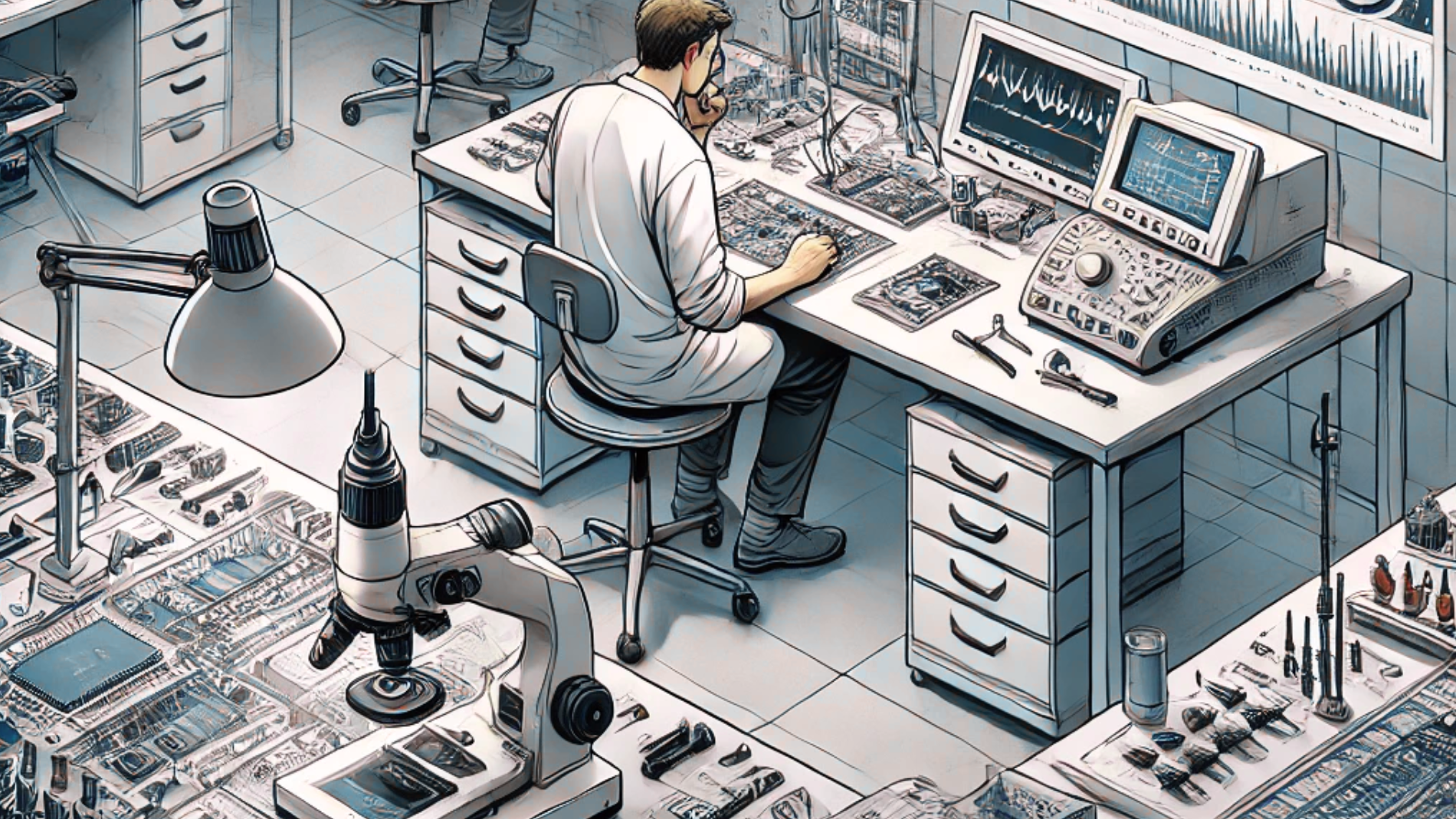
The engineering of contemporary electronic devices reflects a convergence of system thinking, material maturity, multidisciplinary collaboration, and accelerated development cycles. In laboratories across the world, each new product emerges from a structured, iterative workflow that integrates architecture, hardware, firmware, testing, and manufacturing considerations into a cohesive design process. As electronic systems become more compact, intelligent, and operationally demanding, the pathway from concept to certified production device requires a high level of methodological discipline.
This article outlines how modern electronics are engineered, focusing on workflows, design considerations, and the interdependencies that define professional hardware development today.




Requirements Engineering: Establishing the Foundation
The design of any electronic device begins with a comprehensive articulation of requirements. These requirements typically combine functional objectives, performance targets, environmental constraints, safety expectations, and compliance obligations.
Functional objectives determine what the system must achieve, whether sensing, processing, communication, actuation, or power conversion. Performance parameters such as accuracy, latency, bandwidth, power consumption, and operating lifetime define the measurable boundaries of the design. Environmental expectations—temperature range, ingress protection, shock and vibration tolerance, electromagnetic exposure, and mechanical stresses—shape the system’s robustness profile.
Regulatory frameworks, including standards such as IEC, UL, BIS, FCC, CE, and sector-specific certifications (automotive, medical, aerospace), contribute additional constraints. The initial requirement set forms the reference against which all subsequent design decisions are evaluated, creating traceability between intent and implementation.
System Architecture: Translating Requirements into Structure
System architecture bridges conceptual requirements and concrete engineering design. The process involves defining functional blocks and selecting computational, sensing, power, and communication strategies capable of fulfilling the previously established criteria.
The architecture phase typically identifies the processing platform—ranging from microcontrollers to SoCs, MPUs, or FPGAs—based on computational load, determinism, power availability, and peripheral integration. Communication subsystems are established at this stage, covering interfaces such as I²C, SPI, UART, USB, CAN, Ethernet, or wireless protocols.
The power architecture also takes shape here, mapping energy sources, conversion stages, regulation mechanisms, and protection pathways. Considerations such as thermal distribution, signal isolation, noise-sensitive regions, and preliminary enclosure constraints influence the structural arrangement. The architectural framework becomes the guiding reference for schematic and PCB development.
Component Selection: Balancing Performance, Reliability, and Lifecycle
Modern device design is deeply influenced by semiconductor availability, lifecycle predictability, and performance consistency. Component selection involves more than identifying electrically suitable parts; it requires an understanding of long-term supply chain stability, tolerance behaviour, temperature performance, reliability data, and compatibility with manufacturing processes.
Processors, sensors, regulators, discrete, passives, communication modules, and protection components are evaluated not only for electrical characteristics but also for de-rating behaviours, thermal performance, and package-level constraints. Temperature coefficients, impedance profiles, safe-operating-area characteristics, clock stability, and signal integrity parameters become central evaluation factors.
The resulting bill of materials represents an intersection of engineering decisions and procurement realities, ensuring the device can be produced reliably throughout its intended lifespan.
Schematic Design: The Logical Core of the Device
Schematic design formalizes the architectural plan into detailed electrical connectivity. This stage defines logical relationships, reference paths, power distribution, signal conditioning, timing sequences, and safety structures.
Circuit blocks—analog conditioning, digital logic, power conversion, RF front-ends, sensor interfaces, and display or communication elements—are designed with full consideration of parasitic behaviour, noise propagation, and functional dependencies. Power distribution requires careful sequencing, decoupling strategies, transient response consideration, and ripple management. Signal interfaces require appropriate level shifting, impedance alignment, and termination strategies.
Test points, programming headers, measurement references, and diagnostic interfaces are defined at this stage to ensure observability during validation. The schematic ultimately serves as the authoritative source for layout and firmware integration.
PCB Layout: Integrating Electrical, Mechanical, and Thermal Realities
PCB layout transforms the schematic into a physical system where electrical performance, manufacturability, and thermal behaviour converge. The arrangement of components, routing topology, layer stack-up, ground referencing, and shielding determines the system’s electromagnetic and thermal characteristics.
High-speed interfaces require controlled impedance routing, differential pair tuning, length matching, and clear return paths. Power networks demand minimized loop areas, appropriate copper thickness, and distribution paths that maintain voltage stability under load. Sensitive analog signals are routed away from high-noise digital or switching-power regions. Thermal dissipation—achieved through copper pours, thermal vias, and heat-spreading strategies—ensures the system can sustain continuous operation.
Mechanical constraints, such as enclosure geometry, connector placement, mounting-hole patterns, and assembly tolerances, influence layout decisions. The PCB thus becomes a synthesized embodiment of electrical intent and mechanical feasibility.
Prototyping and Hardware Bring-Up: Validating the Physical Implementation
Once fabricated, the prototype enters hardware bring-up, a methodical verification process in which the design is examined against its expected behavior. Validation typically begins with continuity and power integrity checks, ensuring that supply rails meet voltage, ripple, and transient requirements.
System initialization follows, involving processor boot-up, peripheral activation, clock stability verification, and interface-level communication checks. Subsystems are evaluated individually—power domains, sensor blocks, RF modules, analog interfaces, digital buses, and storage components.
Observations from oscilloscopes, logic analyzers, current probes, and thermal imagers contribute to a detailed understanding of the device’s operational profile. Any deviations from expected behavior guide iterative optimization in subsequent revisions.
Firmware Integration: Achieving Functional Cohesion
Firmware integration establishes coordination between hardware capabilities and system functionality. Board-support packages, peripheral drivers, middleware stacks, and application logic are aligned with the hardware’s timing, power, and performance characteristics.
Real-time constraints influence the choice of scheduling structures—whether bare-metal loops, cooperative architectures, or real-time operating systems. Communication stacks, sensor acquisition pipelines, memory management, and power-state transitions are implemented and tested on the physical hardware.
Interaction between firmware and hardware exposes edge cases in timing, voltage stability, electromagnetic sensitivity, or analog behavior, which often inform refinements in both domains.
Validation and Testing: Confirming Performance, Robustness, and Compliance
Comprehensive testing examines a device’s functionality under nominal and boundary conditions. Functional validation assesses sensing accuracy, communication stability, user-interface behavior, control logic execution, and subsystem interoperability. Reliability evaluation includes thermal cycling, vibration exposure, mechanical stress tests, humidity conditioning, and operational aging.
Electromagnetic compatibility testing examines emissions and immunity, including radiated and conducted profiles, ESD susceptibility, fast transients, and surge resilience. Pre-compliance evaluation during early prototypes reduces the probability of redesign during final certification stages.
Data collected during validation ensures that the system behaves predictably throughout its expected operating envelope.
Manufacturing Readiness: Transitioning from Prototype to Production
Production readiness involves synchronizing design intent with assembly processes, quality frameworks, and cost structures. Design-for-manufacturing and design-for-assembly considerations ensure that the device can be fabricated consistently across multiple production cycles.
Manufacturing documentation—including fabrication drawings, Gerber files, pick-and-place data, test specifications, and assembly notes—forms the reference package for contract manufacturers. Automated test equipment, in-circuit test fixtures, and functional test jigs are developed to verify each assembled unit.
Bill-of-materials optimization, yield analysis, and component sourcing strategies ensure long-term production stability.
Compliance and Certification: Meeting Regulatory Obligations
Final certification ensures that the device adheres to the safety, electromagnetic, and environmental requirements of the markets in which it will be deployed. Testing laboratories evaluate the system against regulatory standards, verifying electrical safety, electromagnetic behaviour, environmental resilience, and user-level protections.
The certification phase formalizes the device’s readiness for commercial deployment, requiring complete technical documentation, traceability data, and repeatable test results.
Lifecycle Management: Sustaining the Design Beyond Release
After the product reaches the market, lifecycle management ensures its sustained usability and manufacturability. Engineering change processes address component obsolescence, firmware enhancements, mechanical refinements, or field-observed anomalies.
Long-term reliability data, manufacturing feedback, and supplier updates contribute to ongoing revisions. In connected systems, firmware updates may be deployed over the air, extending functionality and addressing vulnerabilities.
Lifecycle management closes the loop between deployment and continuous improvement.
Conclusion
The design of a modern electronic device is a coordinated engineering endeavour that integrates requirements analysis, architectural planning, hardware design, firmware development, validation, manufacturing readiness, and lifecycle stewardship. Each stage influences the next, forming a continuous chain of interdependent decisions.
As technological expectations expand, the engineering methodologies supporting electronic design continue to mature. The result is a disciplined, multi-phase workflow that enables the creation of devices that are reliable, certifiable, scalable, and aligned with the complex operational demands of contemporary applications.

