
Courtesy: Broadcom
Wi-Fi 8 has officially arrived—and it marks a major leap forward for next-generation connectivity.




Wi-Fi has come a long way. Earlier generations (Wi-Fi 1 through 5) focused mainly on delivering content to users: streaming video, online gaming, and video calls. But today’s digital world runs in both directions. We create as much data as we consume. We upload high-resolution content, collaborate in real time, and rely on on-device AI for everything from productivity to entertainment. That makes the “last hop” between devices and wireless networks more critical than ever.
Wi-Fi 8 is built for this new reality. Evolving from the advances of Wi-Fi 6 and 7, it offers reliable performance at scale, consistently low latency, and significantly stronger uplink capacity—precisely what modern, AI-driven applications need to run smoothly and responsively.
Why Wi-Fi 8 Matters
The internet has shifted from passive browsing to immersive, interactive, and personalized experiences. Devices now sense, analyze, and generate data constantly. By the end of 2025, hundreds of millions of terabytes will be created every day, much of it from IoT, enterprise telemetry, and video. A lot of that data never even makes it to the cloud—it’s handled locally. But guess what still carries it around? Wi-Fi.
Uplink matters
Traditional traffic patterns skewed roughly 90/10 downlink/uplink. Not anymore. AI apps, smart assistants, and continuous sync push networks toward a 50/50 split. Your Wi-Fi can’t just be fast going to you—it has to be equally fast, fair, and predictable going from you.
Real-time Wi-Fi
In the age of AI, Wi-Fi has to be far more real-time. Take, for example, agentic apps that work with voice inputs. We all know today’s assistants can feel clunky—they buffer, they miss interruptions. To get to your true agentic assistant with a “Jarvis-like” back-and-forth, networks need ultra-low latency, less jitter, and fewer drops.
With the right broadband and Wi-Fi 8, those thresholds become possible.
What’s New in Wi-Fi 8
Wi-Fi 8 delivers a system-wide upgrade across speed, capacity, reach, and reliability. Here’s what that means in practice:
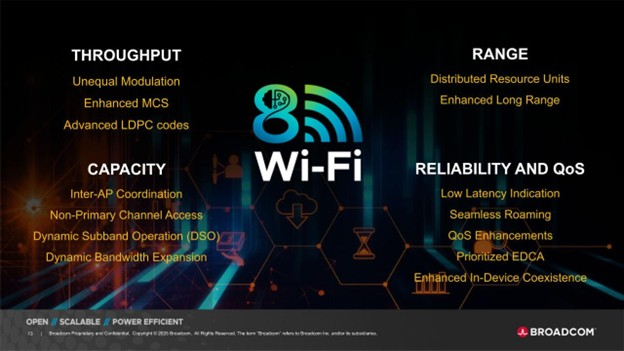
Higher throughput—more of the time: Wi-Fi 8 achieves higher real-world speeds with smarter tools. Unequal Modulation ensures each stream runs at its best rate, so one fading link doesn’t drag the others down. Enhanced MCS smooths out the data-rate ladder to prevent sudden slowdowns, while Advanced LDPC codes hold strong even in noisy conditions. The result: faster, steadier performance across the network.
More network capacity in busy air: In crowded spaces, Wi-Fi 8 is built for cooperation. Inter-AP Coordination helps access points schedule transmissions instead of colliding. Non-Primary Channel Access (NPCA) taps into secondary channels when the primary is congested, while Dynamic Subband Operation (DSO) lets wide channels serve multiple narrower-band clients at once. Dynamic Bandwidth Expansion (DBE) then selectively opens wider pipes for Wi-Fi 8 devices without disrupting legacy clients—unlocking more usable capacity where it’s needed most.
Longer reach and stronger coverage close to the edge: Connections go farther with Distributed Resource Units (dRU), which spread transmit energy for noticeable gains at the fringe. And with Enhanced Long Range (ELR), a special 20-MHz mode extends coverage up to 2× in line-of-sight and about 50% farther in non-LoS—keeping links alive even at the outer edge of the network.
Reliability and QoS that stick: Real-time apps get the consistency they need thanks to smarter quality-of-service features. Low-Latency Indication prioritizes AR/VR, gaming, and voice traffic, while Seamless Roaming keeps calls and streams intact during movement. QoS enhancements and Prioritized EDCA reduce latency and prevent bottlenecks across multiple streams. Plus, enhanced in-device coexistence coordinates Wi-Fi with Bluetooth, UWB, and more to avoid self-interference. Together, these features make the network feel smoother and more reliable.
Wi-Fi 8 Real-World Impact
So what does all this look like in everyday use? Assume a busy apartment building, or an office full of devices roaming between access points. Signals aren’t perfect, interference is everywhere, but Wi-Fi 8 keeps things flowing. It does this by coordinating access points, smoothing out delays, and reducing radio clashes—so your most important traffic doesn’t get stuck in line.
Picture this: It’s a busy evening in a modern family home. One person is streaming a live sports match in 8K on the big screen, another is deep into an online game while streaming to friends, and a third is working on a project that involves real-time AI voice assistance.
Meanwhile, the smart doorbell detects someone approaching. But instead of just pinging a vague “motion alert,” the AI-powered camera recognizes whether it’s a delivery driver dropping off a package, a neighbor stopping by, or a family member arriving home. The alert is contextual and useful.
In older Wi-Fi environments, that mix of high-bandwidth streams, real-time gaming, and constant AI inference could lead to stutters, buffering, or dropped packets at the worst moments. With Wi-Fi 8, all of it just works. The 8K stream stays crisp. The gamer experiences smooth, low-latency play. The AI assistant responds instantly without awkward delays. And the doorbell notification comes through without competing for airtime—because the network can intelligently prioritize, coordinate, and balance all that traffic.
That’s the difference Wi-Fi 8 brings: a reliable home network, no matter how many devices or demands are piled on at once.
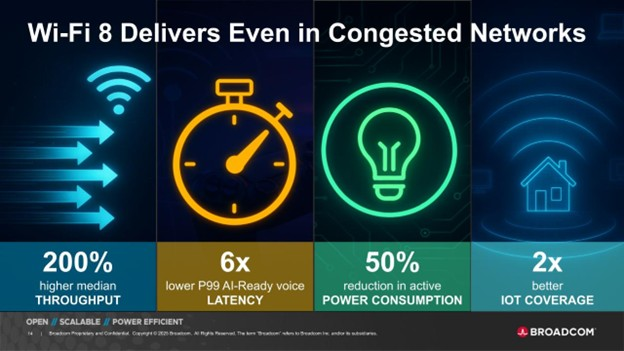
Why it works: Wi-Fi 8 increases throughput and, at the same time, greatly reduces the 99th percentile latency tail. By coordinating APs, elevating delayed packets, and reducing radio self-contention, it shortens queues, avoids collisions, and keeps critical traffic flowing—even when signals aren’t perfect.
Conclusion
Wi-Fi 8 represents far more than an incremental upgrade—it marks a fundamental shift in how wireless networks will power the AI-driven world. As our homes, offices, factories, and devices generate and process more data than ever, the need for reliable uplink performance, real-time responsiveness, and intelligent coordination becomes non-negotiable. Broadcom’s new ecosystem brings these capabilities to life, ensuring that next-generation applications—from immersive entertainment and autonomous IoT to true conversational AI—can operate smoothly, consistently, and securely.
With Wi-Fi 8, the wireless edge finally catches up to the ambitions of modern computing. It isn’t just faster Wi-Fi; it’s the foundation for the seamless, AI-enabled experiences we’ve been waiting for—and a major leap toward the connected future we’re building every day.

